
Key Takeaways
- High Deductible Health Plan (HDHP) trade lower monthly premiums for higher out-of-pocket costs when you need care.
- HDHPs are the only plans that allow Health Savings Account (HSA) contributions, which can offer powerful long-term tax benefits.
- These plans work best for people with stable health, predictable expenses, and emergency savings.
- HDHPs can be financially risky for households with frequent medical needs or tight cash flow, even if the premiums look affordable.
- Understanding deductibles, out-of-pocket limits, and IRS rules is essential before choosing an HDHP.
Why High-Deductible Health Plans Matter for Everyday Americans
Health insurance decisions affect more than just doctor visits. For many households, the wrong plan choice doesn’t just affect health — it affects debt, savings, and long-term financial security. They shape monthly budgets, emergency readiness, and long-term financial stability.
Many Americans choose an HDHP because the monthly premium is lower than other plans offered by an employer or the Health Insurance Marketplace. On paper, that can look like easy savings. In real life, it often leads to confusion, surprise bills, and stress when medical care is needed.
A common mistake is focusing only on the premium and overlooking how much you might need to pay before insurance actually starts helping. Another is opening an HSA without fully understanding how HDHP rules work under IRS guidelines.
This section lays the groundwork so the rest of the article makes sense in practical, real-world terms.
What Is a High-Deductible Health Plan (HDHP)?
Plain-English Definition
A High Deductible Health Plan (HDHP) is a health insurance plan that requires you to pay a larger amount out of pocket for medical care before the insurance company begins covering most costs.
In exchange, the plan usually charges a lower monthly premium than traditional health plans.
How the IRS Defines an HDHP
The IRS sets strict rules for what qualifies as an HDHP. These rules matter because only IRS-qualified HDHPs allow Health Savings Account (HSA) contributions.
For the most recent confirmed IRS year:
| Coverage Type | Minimum Deductible | Maximum Out-of-Pocket Limit |
|---|---|---|
| Self-only | $1,600 | $8,050 |
| Family | $3,200 | $16,100 |
These limits apply only to plans that meet IRS HDHP qualification rules and may differ from employer-labeled “high deductible” plans.
Important notes:
- These figures reflect the most recently published IRS limits at the time of writing.
- Limits typically change each year due to inflation.
- Deductibles and out-of-pocket maximums must meet both requirements to qualify as an HDHP.
What Makes an HDHP Different From Other Plans
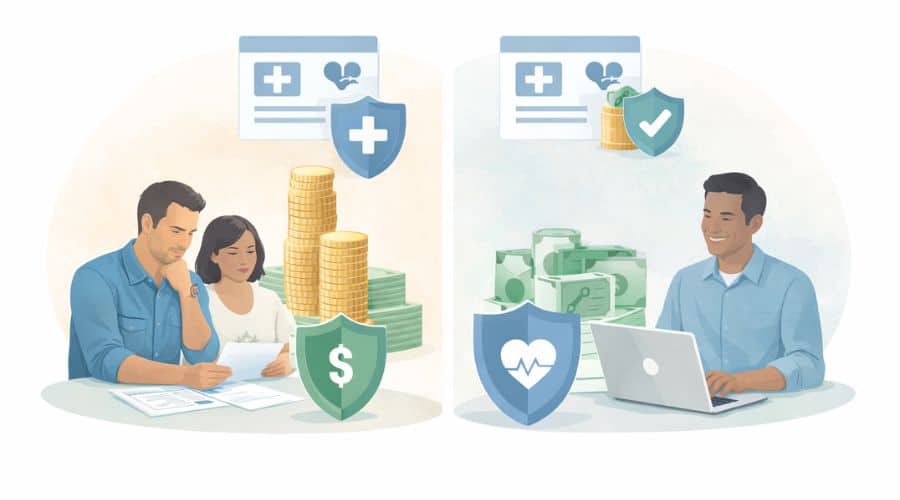
HDHPs differ from traditional plans in several key ways:
- Higher deductible before most services are covered
- Lower monthly premium
- Greater upfront financial responsibility
- Eligibility for an HSA, if no disqualifying coverage exists
- Preventive care, such as annual physicals, vaccines, and many screenings, is typically covered before the deductible, as required by federal health insurance rules.
How High Deductible Health Plans Work in the U.S.
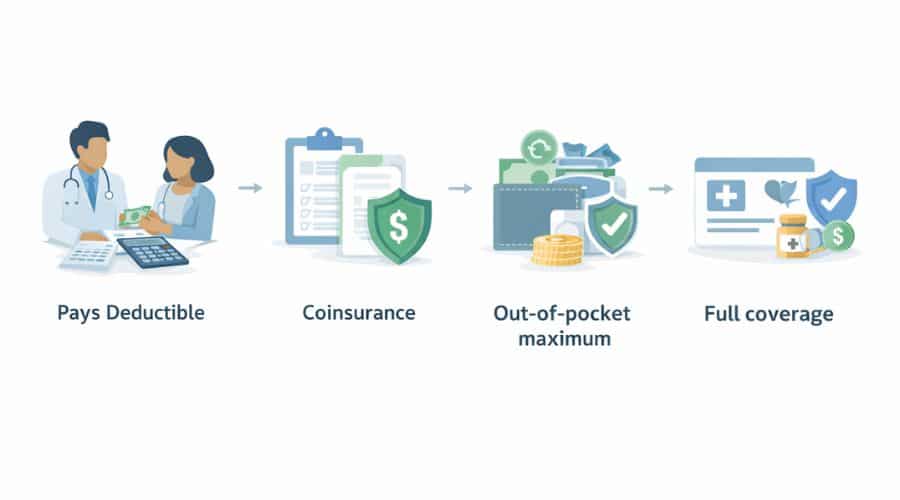
Step-by-Step: What Happens When You Use Care
- You pay the full negotiated cost of most medical services until you reach your deductible
- After meeting the deductible, coinsurance usually applies (for example, the plan pays 80%, you pay 20%)
- Once you reach the out-of-pocket maximum, the plan covers 100% of eligible in-network costs for the rest of the year
This structure shifts more financial responsibility to the policyholder early in the year.
Monthly Premium vs. Real-World Costs
Lower premiums do not automatically mean lower total costs.
Two people with the same HDHP can have very different outcomes:
- One may save money all year and barely use healthcare
- Another may face thousands of dollars in expenses after an unexpected illness or injury
This variability is the core trade-off of HDHPs. This is why HDHPs feel affordable in enrollment season but expensive during medical emergencies.
Preventive Care Exception
Under federal rules:
- Many preventive services are covered with no deductible
- This applies even if you haven’t paid anything out of pocket yet
However, diagnostic tests or follow-up care often do count toward the deductible, which surprises many first-time HDHP users.
The Role of Health Savings Accounts (HSAs)
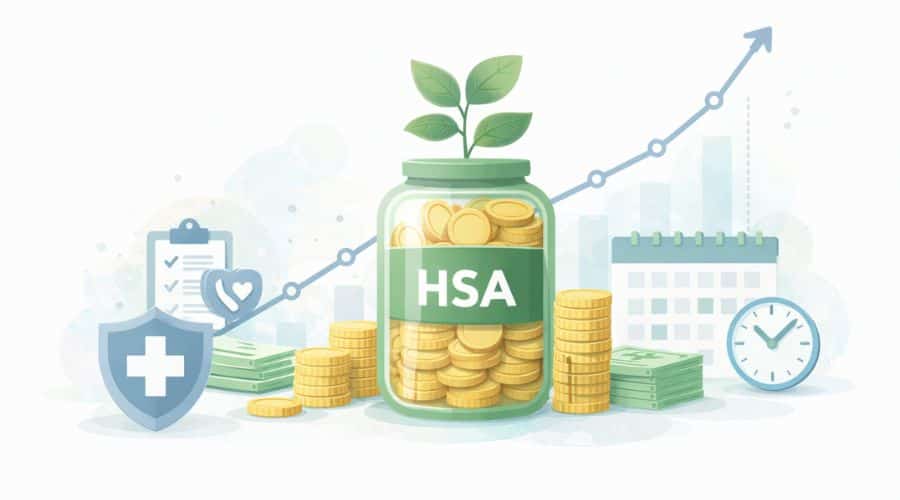
Why HDHPs and HSAs Are Linked
An HSA is not required, but it is one of the main reasons people choose HDHPs.
Only individuals enrolled in an IRS-qualified HDHP, with no other disqualifying coverage, can contribute to an HSA.
HSAs offer:
- Tax-deductible contributions
- Tax-free growth
- Tax-free withdrawals for qualified medical expenses
This triple tax advantage makes HSAs unique in U.S. personal finance.
Common HSA Misunderstandings
- An HSA is not a “use it or lose it” account
- Money rolls over year to year
- The account belongs to you, not your employer
- HSAs can be used for medical expenses even after leaving an HDHP, as long as expenses are qualified
However, contribution eligibility depends on HDHP enrollment, which creates planning constraints.
Who High-Deductible Health Plans Are Usually Best For
People With Predictable or Low Medical Use
HDHPs tend to work best for:
- Generally healthy individuals
- People who mainly use preventive care
- Those without chronic conditions requiring frequent treatment
Lower utilization reduces exposure to high out-of-pocket costs.
Households With Strong Emergency Savings
HDHPs assume you can handle large upfront expenses if needed.
A solid emergency fund helps cover:
- Deductibles
- Coinsurance
- Unexpected medical events early in the year
Without savings, an HDHP can quickly become financially stressful.
Long-Term Planners Using HSAs Strategically
Some Americans use HSAs as:
- A medical expense buffer
- A long-term retirement health fund
This approach requires:
- Consistent contributions
- Discipline not to overspend
- Comfort with delayed benefits
It is not suitable for everyone, especially those living paycheck to paycheck.
Who Should Be Careful — or Avoid — High-Deductible Health Plans

HDHPs are not “bad” plans, but they are not neutral either. They shift financial risk toward the individual. For many households, that risk is not theoretical — it shows up as real bills and delayed care. This makes plan selection especially important for households with limited financial margin for error.
People With Chronic or Ongoing Medical Conditions
HDHPs are often a poor fit for individuals who:
- Require regular prescriptions
- Have chronic illnesses such as diabetes, asthma, heart disease, or autoimmune conditions
- Need frequent specialist visits, labs, or imaging
- Anticipate planned procedures or ongoing therapy
Even if the premium is lower, repeated out-of-pocket spending can quickly exceed the cost of a lower-deductible plan. Over time, this can make annual healthcare costs more predictable — but consistently higher.
Key reality:
Paying a high deductible every single year is very different from paying it once during an emergency.
Families With Young Children
Families often underestimate healthcare usage for children, including:
- Pediatric sick visits
- Urgent care visits
- Emergency room trips
- Diagnostic tests
- Specialist referrals
While preventive visits are usually covered, many common childhood health needs are not fully preventive and hit the deductible immediately.
For families with tight monthly cash flow, HDHPs can create unpredictable financial pressure. This uncertainty often matters more than the advertised premium savings.
Households Living Paycheck to Paycheck
HDHPs assume financial flexibility.
If paying:
- $1,500–$3,000 upfront
- Or several hundred dollars unexpectedly
would require debt, borrowing, or skipping care, an HDHP may increase financial stress rather than reduce it.
Lower premiums do not help if medical bills force credit card debt. In these cases, the plan increases financial fragility rather than protection.
People Who Delay Care Due to Cost
One documented downside of HDHPs is delayed or avoided care.
When people face high upfront costs, they may:
- Skip doctor visits
- Delay diagnostic testing
- Ignore early symptoms
This can lead to worse health outcomes and higher costs later, even though the plan technically “saved money” on premiums.
Real-Life U.S. Examples: How HDHPs Play Out
Example 1: Healthy Single Adult With Savings
- Age: 29
- Employer offers HDHP with low premium
- Rarely uses medical care
- Contributes regularly to an HSA
Likely outcome:
Lower total healthcare costs and long-term HSA growth.
Example 2: Family of Four With Moderate Healthcare Needs
- Two adults, two children
- Several sick visits per year
- One child needs specialist care
Likely outcome:
Deductible reached most years, with total costs exceeding a traditional plan.
Example 3: Middle-Aged Adult With Chronic Condition
- Requires monthly prescriptions
- Regular lab work
- Specialist visits
Likely outcome:
HDHP creates consistent financial strain despite lower premiums.
These examples are common, not extreme.
These outcomes depend less on luck and more on health patterns and financial preparedness.
Pros and Cons of High-Deductible Health Plans
| Pros | Cons |
|---|---|
| Lower monthly premiums | High upfront costs |
| HSA eligibility | Financial risk early in the year |
| Potential long-term tax advantages | Can discourage needed care |
| Useful for healthy individuals | Poor fit for chronic conditions |
| Predictable premium cost | Unpredictable total annual cost |
This trade-off is the core decision point.
Financial Risks and Common Mistakes
Mistake 1: Choosing Based on Premium Alone
Premiums are the most visible cost — but often not the most important.
Total cost =
Premiums + Deductible + Coinsurance + Copays
Ignoring this leads to unpleasant surprises.
Mistake 2: Not Funding an HSA
An HDHP without an HSA strategy removes one of its biggest advantages.
Without savings or HSA contributions:
- The plan becomes pure risk exposure
- Tax benefits are lost
Mistake 3: Assuming “I’ll Be Healthy This Year”
Health events are unpredictable.
HDHPs magnify the financial impact of:
- Accidents
- Unexpected diagnoses
- Emergency care
Optimism is not a financial strategy.
Impact on Credit, Debt, and Long-Term Finances
Medical Bills and Credit Scores
Medical bills can affect credit when they:
- Go unpaid
- Are sent to collections
While newer credit scoring models reduce the impact of paid medical collections, unpaid bills still matter.
HDHPs increase the chance of large bills appearing suddenly.
Debt Risk
Many Americans cover HDHP costs with:
- Credit cards
- Payment plans
- Personal loans
Interest and fees can erase any premium savings.
Long-Term Financial Trade-Off
HDHPs work best when:
- Savings exist
- Cash flow is stable
- Health risk is relatively low
When these conditions are missing, HDHPs can quietly weaken financial stability.
HDHPs vs. Traditional Health Plans
| Feature | HDHP | Traditional Plan |
|---|---|---|
| Monthly premium | Lower | Higher |
| Deductible | High | Lower |
| HSA eligible | Yes | No |
| Upfront risk | High | Lower |
| Cost predictability | Low | Higher |
There is no universally “better” option — only better aligned choices. The best plan is the one that matches both your health needs and your financial resilience.
Common Myths vs. Facts About High-Deductible Health Plans
Misunderstanding HDHPs is one of the main reasons people regret choosing them. Clearing up these myths helps avoid costly assumptions.
Myth 1: “HDHPs Are Only for Young People”
Fact:
Age alone doesn’t determine whether an HDHP makes sense.
What matters more:
- Frequency of medical care
- Prescription needs
- Cash reserves
- Risk tolerance
A healthy 55-year-old with savings may do better than a 25-year-old living paycheck to paycheck.
Myth 2: “If I Don’t Use Healthcare Much, I’ll Always Save Money”
Fact:
Low usage reduces risk, but it doesn’t eliminate it.
One accident or unexpected diagnosis can:
- Trigger the full deductible
- Create large bills early in the year
- Disrupt finances suddenly
HDHP savings are probabilistic, not guaranteed. This is why HDHPs reward consistency, not assumptions.
Myth 3: “An HSA Makes an HDHP Automatically Better”
Fact:
An HSA is powerful only if it’s used intentionally.
If you:
- Can’t afford to contribute
- Withdraw funds immediately every year
- Never build a balance
then the HSA benefit is limited.
Myth 4: “Once I Hit the Deductible, Everything Is Free”
Fact:
Most HDHPs still require coinsurance after the deductible.
You may continue paying a percentage of costs until the out-of-pocket maximum is reached.
Common Beginner Misunderstandings
Confusing Deductible With Out-of-Pocket Maximum
- Deductible: What you pay before insurance starts sharing costs
- Out-of-pocket maximum: The absolute cap on what you pay in a year for covered services
These are not the same, and confusing them leads to budgeting errors.
Assuming All Services Count Toward the Deductible
Preventive care is often covered before the deductible.
However:
- Diagnostic tests
- Specialist visits
- Imaging
usually do count, even if the visit felt “routine.”
Overestimating Employer Contributions
Some employers contribute to HSAs — many do not.
Never assume:
- The contribution is guaranteed
- The amount stays the same each year
- It fully offsets the deductible
Always verify the details.
Step-by-Step: How to Decide If an HDHP Makes Sense for You
This checklist helps translate theory into real-life decision-making.
Step 1: Estimate Your Likely Healthcare Use
Look at the past 1–2 years:
- Doctor visits
- Prescriptions
- Labs and imaging
- Planned procedures
Patterns matter more than best-case scenarios.
Step 2: Compare Total Annual Costs — Not Just Premiums
For each plan, estimate:
- Annual premiums
- Likely out-of-pocket costs
- Worst-case scenario (hitting the out-of-pocket maximum)
This provides a realistic comparison.
Step 3: Assess Your Cash Reserves
Ask honestly:
- Could I pay the full deductible within 30 days if needed?
- Would I need debt to cover medical costs?
If the answer is yes to debt, the risk is high. If medical costs would force financial trade-offs, the plan may be misaligned with your situation.
Step 4: Evaluate HSA Eligibility and Use
Confirm:
- You have no disqualifying coverage
- You can contribute consistently
- You understand qualified medical expenses
An HSA only helps if used correctly.
Step 5: Consider Non-Financial Factors
Health decisions are not purely mathematical.
Also consider:
- Stress tolerance
- Willingness to shop for care
- Comfort managing bills and reimbursements
These factors affect real outcomes.
When an HDHP Can Be a Responsible Choice
HDHPs are most defensible when multiple conditions are true:
- Stable income
- Emergency savings available
- Low or predictable medical usage
- Ability to fund an HSA
- Comfort with financial variability
Missing one condition doesn’t automatically rule it out — missing several does. HDHPs work best when flexibility exists on both the health and financial side.
When a Traditional Plan Is Often the Safer Choice
Traditional plans tend to work better when:
- Medical usage is frequent
- Costs are predictable but ongoing
- Cash flow is tight
- Peace of mind matters more than optimization
Predictability has real value.
HDHPs work best when flexibility exists on both the health and financial side.
Frequently Asked Questions About High-Deductible Health Plans (HDHPs)
These are real questions Americans commonly search when trying to decide whether an HDHP is right for them. They reflect common concerns during open enrollment and real-world use.
-
Is a high-deductible health plan always cheaper?
No.
HDHPs often have lower monthly premiums, but total annual cost depends on how much healthcare you actually use. If you reach the deductible or out-of-pocket maximum, an HDHP can cost more than a traditional plan in the same year. This is why comparing worst-case scenarios matters.
-
Can I have an HSA without an HDHP?
No.
Under rules set by the Internal Revenue Service, you must be enrolled in an IRS-qualified HDHP to contribute to a Health Savings Account. Other health plans, even high-cost ones, do not qualify.
-
Are prescriptions covered before the deductible?
Usually no.
Most HDHPs require you to pay the full negotiated cost of prescriptions until the deductible is met. Some plans offer limited exceptions, but this varies by insurer and plan design.
Always check the plan’s drug formulary.
-
Do HDHPs cover preventive care for free?
Yes, in most cases.
Federal health insurance rules require most HDHPs to cover certain preventive services without applying the deductible. This typically includes:
– Annual physicals
– Vaccinations
– Many screeningsDiagnostic or follow-up care is usually not considered preventive.
-
What happens if I can’t afford the deductible?
If you can’t pay upfront costs, you may:
– Delay care
– Set up payment plans
– Use credit cards or loansWhile providers often offer billing options, this can still lead to financial stress or debt. This is one of the biggest risks of HDHPs for households without savings. This is where HDHPs create the most financial strain.
-
Do HDHPs affect my credit score?
Indirectly, yes.
Medical bills themselves do not appear on credit reports immediately. However, unpaid medical bills sent to collections can affect credit, especially if left unresolved.
HDHPs increase the chance of large bills appearing unexpectedly. Large unexpected bills increase the risk of missed payments.
-
Are HDHPs bad for families?
Not automatically.
They can work for families with:
– Low medical usage
– Strong emergency savings
– Employer HSA contributionsThey are often risky for families with frequent care needs or unpredictable expenses.
-
Can I switch out of an HDHP later?
Usually yes, but timing matters.
Most people can change plans:
– During annual open enrollment
– After a qualifying life event (marriage, birth, job change, etc.)Outside these windows, options are limited.
-
Is an HDHP a good long-term strategy?
It depends.
For some, pairing an HDHP with an HSA supports long-term financial planning. For others, the stress and risk outweigh the benefits.
There is no universally correct answer.
Final Perspective: Choosing Based on Reality, Not Optimism

High Deductible Health Plan are tools — not shortcuts.
They can support:
- Lower premiums
- Long-term tax planning
- Flexibility for healthy individuals
They can also expose:
- Cash flow weaknesses
- Medical cost risk
- Gaps in financial preparedness
Good insurance decisions reduce regret, not just premiums.
The right choice is the one that aligns with your health, savings, and tolerance for uncertainty, not just the lowest monthly price.
Disclaimer
This content is provided for educational and informational purposes only.
It does not constitute legal, tax, insurance, or financial advice.
Health insurance rules, costs, and eligibility vary by state, insurer, employer, and individual circumstances. Readers should consult a licensed insurance professional, tax advisor, or financial professional before making personal healthcare or financial decisions.
