
Health Maintenance Organization (HMO) insurance is one of the most common health plans in the United States, especially for people looking for lower monthly premiums and predictable healthcare costs.
This guide explains how HMO insurance works, what it covers, its rules, costs, and who it makes sense for — in clear, plain English.
Key Takeaways
- HMO insurance is a health plan that limits coverage to a specific network of doctors and hospitals to keep costs lower.
- You usually must choose a primary care physician (PCP) and get referrals before seeing specialists.
- HMOs often have lower monthly premiums and predictable copays, but little to no coverage outside the network.
- These plans can work well for people who want simple, budget-friendly coverage and don’t mind network restrictions.
- HMOs are regulated under U.S. federal and state insurance rules, and details vary by insurer and state.
Why HMO Insurance Matters in Everyday American Life

Health insurance decisions in the U.S. aren’t just paperwork choices — they affect monthly budgets, access to doctors, surprise bills, and long-term financial stability. To understand this better, it helps to first know how health insurance works in the U.S.. For many households, the wrong plan choice can affect both healthcare access and long-term finances.
Many Americans choose a health plan based on the monthly premium alone. That’s where confusion often starts. A plan that looks affordable on paper can become frustrating or expensive if it doesn’t match how someone actually uses healthcare.
HMO insurance is one of the most common and misunderstood plan types. People are drawn to its lower costs but are often surprised later by referral rules, network limits, or denied claims for out-of-network care.
Understanding how an HMO really works — before enrolling — helps avoid:
- Unexpected medical bills
- Delayed care
- Claim denials
- Costly plan switches later in the year
What Is HMO Insurance?
An HMO (Health Maintenance Organization) is a type of U.S. health insurance plan that provides coverage only through a defined network of healthcare providers, except in true emergencies.
The plan is built around one central idea:
Care is coordinated through a primary care doctor to control costs and reduce unnecessary treatment.
That structure is what allows HMOs to charge lower premiums and copays than many other plan types.
How HMO Insurance Works in the United States
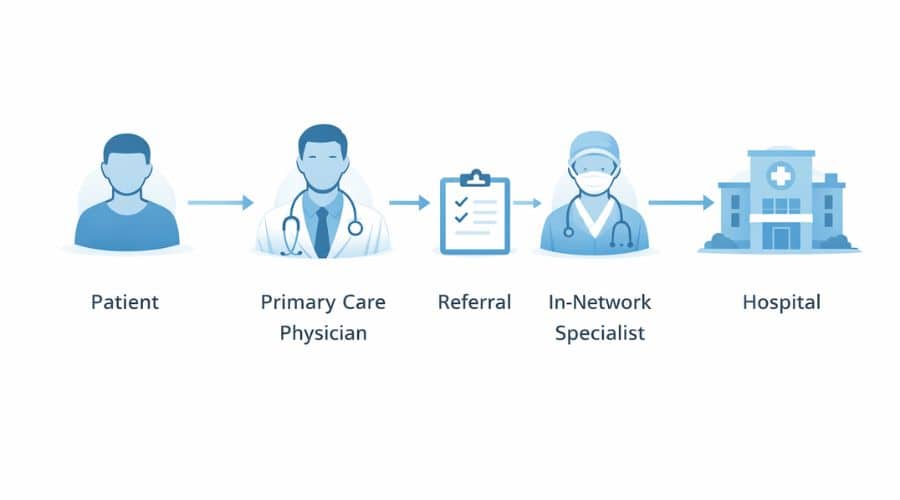
Primary Care Physician (PCP) Requirement
Most HMO plans require you to:
- Select a primary care physician when you enroll
- Use that doctor as your first point of contact for most medical needs
Your PCP:
- Handles routine care
- Manages chronic conditions
- Decides when specialist care is medically necessary
Referrals Are Usually Required
To see a specialist (such as a cardiologist or dermatologist), you typically need:
- A referral from your PCP
- The specialist must be in-network
Without a referral, the insurance company may deny the claim entirely, even if the specialist is in the network.
Network-Only Coverage

HMOs generally:
- Do not cover out-of-network care
- Make exceptions only for:
- True medical emergencies
- Emergency room care as defined under federal rules
Routine care outside the network is usually 100% out-of-pocket. This is why understanding in-network vs out-of-network health insurance is critical for HMO members.
Where HMO Plans Are Commonly Offered
HMO insurance plans are widely available through: (Many of these plans are regulated and offered through the federal Health Insurance Marketplace, as outlined on HealthCare.gov.)
- Employer-sponsored health insurance
- ACA Marketplace (HealthCare.gov or state exchanges)
- Some Medicaid managed care programs
- Certain Medicare Advantage plans (HMO-style)
Availability, rules, and network size vary by state and insurer.
Typical Costs in an HMO Plan

While exact numbers vary by plan and year, HMOs generally follow a predictable cost structure. To see how costs break down in real life, it’s important to understand deductible vs copay vs coinsurance.
Common Cost Features
- Lower monthly premiums compared to PPO plans
- Fixed copays for:
- Doctor visits
- Prescriptions
- Urgent care
- Often low or no deductible for basic services
Cost Predictability
Because services are controlled through the network and PCP:
- Bills are more predictable
- Surprise charges are less common if rules are followed
Ignoring network or referral rules can quickly erase those savings.
Who HMO Insurance Is Usually Best For
HMO plans often work well for people who:
- Want lower monthly premiums
- Prefer predictable healthcare costs
- Are comfortable using a defined provider network
- Don’t need frequent out-of-network care
- Live in areas with strong local hospital systems
Families with routine care needs often choose HMOs for budget stability.
Who Should Be Careful With HMO Plans
An HMO may be a poor fit if someone:
- Wants freedom to see any specialist without referrals
- Travels frequently or lives in multiple states
- Already sees out-of-network doctors
- Has complex conditions requiring multiple specialists
- Values flexibility over cost savings
For these cases, other plan types may reduce friction, even if they cost more.
Pros and Cons of HMO Insurance
Understanding the trade-offs matters more than focusing on price alone. HMOs are intentionally designed to limit choice in exchange for lower costs.
Pros & Cons Comparison
| Aspect | Pros | Cons |
|---|---|---|
| Monthly Premiums | Usually lower than PPO plans | Fewer plan design options |
| Cost Predictability | Fixed copays make budgeting easier | Out-of-network care usually not covered |
| Primary Care | Centralized care coordination | PCP choice is limited to the network |
| Specialist Access | Prevents unnecessary specialist visits | Referrals required in most cases |
| Claims Simplicity | Fewer surprise bills if rules are followed | Claims can be denied if rules are broken |
These trade-offs are intentional — HMOs reduce costs by controlling how and where care is delivered.
Real-Life U.S. Examples of How HMO Insurance Works

Example 1: Routine Care Scenario
Maria lives in Arizona and has an employer-sponsored HMO.
- She visits her PCP for an annual physical
- Copay: $25
- Blood work is done at an in-network lab
- Total out-of-pocket cost stays predictable
In this case, the HMO works exactly as intended.
Example 2: Specialist Visit With Referral
James develops knee pain.
- He schedules an appointment with his PCP
- PCP determines imaging and orthopedic care are needed
- A referral is issued to an in-network orthopedic specialist
James pays a specialist copay and avoids claim issues.
Example 3: Costly Mistake Without a Referral
Same situation — but James skips the PCP and books a specialist directly.
- Specialist visit is in-network
- No referral on file
- Insurance denies the claim
James pays the full bill out of pocket. This is one of the most common and costly HMO mistakes.
Risks, Downsides, and Common Mistakes
HMO insurance works well only when the rules are followed. Most problems happen when people assume it works like other plan types.
Common Mistakes to Avoid
- Seeing specialists without referrals
- Assuming out-of-network care will be partially covered
- Forgetting to update PCP selection after moving
- Using non-network labs or imaging centers
- Not checking network changes during open enrollment
Even one mistake can result in hundreds or thousands of dollars in denied claims.
Emergency Care and HMO Coverage
Under U.S. federal law:
- Emergency room care must be covered, even if out of network. This federal emergency coverage requirement is enforced by the Centers for Medicare & Medicaid Services (CMS).
- This includes situations where a reasonable person believes there is an emergency
However:
- Follow-up care after the emergency may require returning to in-network providers
- Non-emergency care at an ER may not be fully covered
Always review your plan’s emergency definition and post-emergency coverage rules.
Impact on Finances, Credit, and Long-Term Costs
Financial Impact
When used correctly:
- HMOs are among the most affordable plan types
- Lower premiums free up monthly cash flow
When used incorrectly:
- Out-of-network bills can be 100% your responsibility
Credit Score Impact
Health insurance itself does not affect credit, but:
- Unpaid medical bills sent to collections can impact credit reports
- Denied claims increase the risk of unpaid balances
Following HMO rules reduces this risk significantly.
HMO Insurance vs Other Health Plan Types
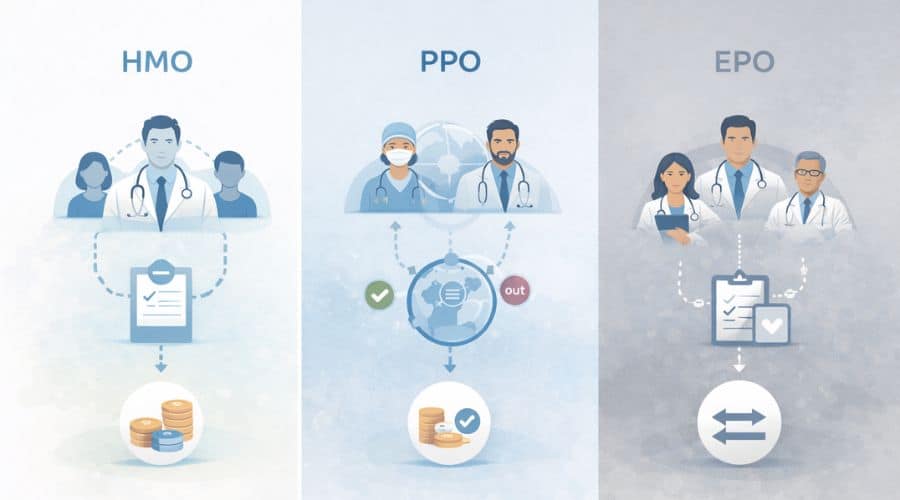
High-Level Comparison
| Feature | HMO | PPO |
|---|---|---|
| Network Restrictions | Strict | Flexible |
| Referrals Required | Usually yes | No |
| Out-of-Network Coverage | Rare | Often partial |
| Premium Cost | Lower | Higher |
| Best For | Budget-focused users | Flexibility-focused users |
Neither plan is universally better — the right choice depends on flexibility needs, travel habits, and budget priorities.
Myths vs Facts About HMO Insurance
Myth: HMOs provide lower-quality care
Fact: Care quality depends on providers, not plan type.
Myth: You can never see specialists
Fact: You can — but referrals are usually required.
Myth: HMOs are only for young or healthy people
Fact: Many families and retirees use HMOs successfully.
Myth: Emergency care is not covered
Fact: Emergency care is federally protected.
Eligibility and Enrollment Rules for HMO Insurance
HMO eligibility depends on where and how the plan is offered, not on health status.
Employer-Sponsored HMO Plans
- Available through employers that offer HMO options
- Enrollment usually limited to: Outside these periods, enrollment is generally not allowed.
- Annual open enrollment
- Qualifying life events (marriage, birth, job loss)
- Employer determines:
- Available networks
- Cost-sharing structure
- PCP selection process
HMO Plans on the ACA Marketplace
HMO plans are common on Health Insurance Marketplaces.
Key points:
- Anyone can apply during open enrollment
- Premium tax credits may apply based on income
- Network size varies widely by state and insurer
- Provider networks must be checked before enrolling. Many Marketplace HMOs have narrower networks than employer plans.
Rules and subsidies are governed by federal law, but plan availability varies by state.
Medicaid Managed Care HMOs
Many states use HMO-style plans for Medicaid.
Features often include:
- Mandatory PCP selection
- Strong care coordination
- Very low or zero out-of-pocket costs
Eligibility is determined by:
- Income
- Household size
- State-specific Medicaid rules
Medicare Advantage HMO Plans
Medicare Advantage HMOs are different from Original Medicare.
Key distinctions:
- Must use network providers
- PCP coordination is required
- Often include prescription drug coverage
- Coverage area is usually regional
These plans are regulated federally, but benefits and networks vary by insurer and county. Enrollees should review provider directories carefully before switching.
Step-by-Step: How to Choose an HMO Plan Wisely
Step 1: Check the Provider Network First
Before looking at price:
- Confirm your current doctors are in-network
- Verify nearby hospitals and labs
- Check specialist availability
Networks can change yearly.
Step 2: Understand Referral Requirements
Not all HMOs operate identically.
Confirm:
- Which services require referrals
- Whether virtual referrals are allowed
- How long referrals remain valid
Step 3: Review Cost Details Carefully
Focus on:
- Copays by service type
- Prescription drug tiers
- Emergency care costs
- Annual out-of-pocket maximum
Low premiums can hide higher service copays.
Step 4: Consider Your Lifestyle and Travel
Ask yourself:
- Do I travel often?
- Do I live in multiple states?
- Do I rely on out-of-area specialists?
HMOs work best when care stays local.
State-by-State Variations to Be Aware Of
HMO rules are influenced by both:
- Federal law
- State insurance regulations
Common variations include:
- Referral flexibility
- Network adequacy standards
- Telehealth coverage
- Emergency care definitions
Always review state-specific plan documents. State insurance department websites often publish plan-specific guidance.
Common Beginner Misunderstandings
“I can just switch doctors anytime”
PCP changes are allowed but:
- Must be done through the insurer
- May take effect at a later date
“If the doctor accepts my insurance, I’m covered”
Acceptance does not guarantee:
- In-network status
- Referral approval
- Covered service codes
Always verify through the insurer.
“Low premium means low total cost”
Total cost depends on:
- How often you use care
- Whether rules are followed
- Prescription needs
Impact on Long-Term Healthcare Planning
HMO insurance encourages:
- Preventive care
- Ongoing provider relationships
- Early intervention
For many Americans, this structure leads to:
- Lower lifetime healthcare spending
- Better chronic condition management
For others, it may feel restrictive.
HMO Insurance vs Other Common Health Plan Types
Choosing an HMO only makes sense when it’s compared against realistic alternatives Americans actually see at work or on the Marketplace.
HMO vs PPO vs EPO (Practical Comparison)
| Feature | HMO | PPO | EPO |
|---|---|---|---|
| Primary Care Physician Required | Yes (most plans) | No | No |
| Referrals for Specialists | Usually required | Not required | Not required |
| Out-of-Network Coverage | Emergency only | Partial coverage | Generally none |
| Monthly Premiums | Lower | Higher | Mid-range |
| Cost Predictability | High | Moderate | Moderate |
| Best Fit For | Budget-focused, local care | Flexibility seekers | Controlled flexibility |
No plan type is “better” overall. The right choice depends on how often you use care, where you receive it, and how much flexibility you need.
When an HMO Is a Smart Financial Choice
An HMO tends to make financial sense when:
- Most care happens close to home
- You already use in-network doctors
- You value lower premiums over flexibility
- You want predictable costs
- You’re comfortable with structured care coordination
For households managing monthly budgets tightly, HMOs often reduce financial stress.
When an HMO Can Create Problems
An HMO can become costly or frustrating if:
- You frequently see specialists without referrals
- You travel or live part-time in another state
- You already have trusted out-of-network providers
- You need ongoing specialty care across systems
In these cases, higher premiums elsewhere may reduce friction and risk. In these situations, flexibility may matter more than monthly premium savings.
Frequently Asked Questions About HMO Insurance
-
What happens if I see a specialist without a referral?
In most HMOs, the claim will be denied, and you may owe the full cost. Even if the doctor is in-network, referrals are often mandatory.
-
Does HMO insurance cover emergency room visits?
Yes. Under federal law, emergency care must be covered, even if the hospital is out of network. Follow-up care may need to return in-network.
-
Can I change my primary care doctor in an HMO?
Yes, but:
– Changes must be made through the insurer
– Timing rules apply
– Coverage may not update immediatelyAlways confirm before scheduling visits.
-
Are prescriptions cheaper with an HMO?
Often yes, but it depends on:
– The plan’s drug formulary
– Pharmacy network
– Medication tier placementAlways review the prescription drug list.
-
Are HMOs only for young or healthy people?
No. Many families, seniors, and people with chronic conditions use HMOs successfully — as long as their providers are in-network.
-
Can I use an HMO if I travel frequently?
HMOs are usually not ideal for frequent travelers unless:
– Travel is short-term
– Emergency-only coverage is acceptableRoutine out-of-area care is typically not covered.
-
Why are HMO premiums usually lower?
Because HMOs:
– Limit provider networks
– Control specialist access
– Coordinate care through PCPsThese controls reduce insurer costs, which lowers premiums.
-
Do HMOs affect my credit score?
Not directly. However:
– Denied claims can lead to unpaid medical bills
– Unpaid bills sent to collections may affect creditFollowing HMO rules helps prevent this.

Final Thoughts on HMO Insurance
HMO insurance is not a shortcut or a trap. It’s a structured system designed to balance access, cost control, and coordinated care.
For many Americans, it offers:
- Lower premiums
- Predictable expenses
- Strong preventive care
For others, the restrictions outweigh the savings.
The difference comes down to how closely the plan matches real-life healthcare habits. The best health insurance plan is the one that fits your actual healthcare needs — not just your budget.
Disclaimer
This content is provided for educational and informational purposes only.
It does not constitute legal, tax, insurance, or financial advice.
Health insurance rules, benefits, and costs vary by state, insurer, employer, and individual situation.
Readers should consult a licensed insurance professional, financial advisor, or appropriate expert before making personal healthcare or financial decisions.
