
Key Takeaways
- Health insurance in the U.S. is a cost-sharing system, not full bill coverage.
- You usually pay monthly premiums, plus part of the cost when you receive care.
- Key terms like deductible, copay, coinsurance, and out-of-pocket maximum determine what you actually pay.
- In-network care is significantly cheaper than out-of-network care in most plans.
- Federal laws protect consumers, but rules can vary by plan, state, and insurer.
Why Health Insurance Confuses So Many Americans
Health insurance is one of the most misunderstood parts of personal finance in the U.S.
Many people assume that having insurance means medical care is “covered.” Then a bill arrives for hundreds or thousands of dollars, even after insurance paid its share. Others avoid care entirely because they’re unsure what it will cost or whether their plan applies.
This confusion isn’t accidental. U.S. health insurance mixes private companies, government programs, federal laws, state rules, and medical pricing that rarely looks like normal consumer pricing. Understanding how the system actually works can prevent unexpected medical debt, help you choose better plans, and reduce long-term financial stress. For most people, the confusion isn’t about intelligence — it’s about a system that was never designed to be simple.
what is health insurance
At its core, health insurance is a shared-cost agreement between you and an insurance company.
You pay the insurer a monthly premium to stay enrolled. In return, the insurer agrees to pay part of your medical costs when you receive covered care. You are still responsible for some costs, depending on your plan.
Health insurance does not mean:
- Free healthcare
- Fixed prices for every service
- Automatic coverage for all doctors or hospitals
Instead, it sets rules for how costs are divided.
How the U.S. Health Insurance System Is Structured
Employer-Sponsored Insurance
Most non-elderly Americans get health insurance through an employer.
- Employers typically pay part of the monthly premium
- Employees pay the rest through payroll deductions
- Coverage usually extends to spouses and dependents (with higher premiums)
This system ties insurance to employment, which is unusual compared to other developed countries and creates gaps during job changes.
Individual and Family Plans
If you don’t get insurance through work, you can buy your own plan.
Common situations include:
- Self-employment
- Gig or contract work
- Early retirement
- Job transitions
Many individual plans are purchased through federal or state marketplaces created under the Affordable Care Act (ACA), also known as Obamacare. Eligibility for subsidies depends on household income and family size, and rules can change by state.
Government Health Insurance Programs
Some Americans are covered through government programs, including:
- Medicare (primarily for people age 65+ and certain disabilities)
- Medicaid (for low-income households, with state-specific rules)
- CHIP (for children in eligible families)
Each program has different eligibility standards, costs, and coverage rules.
The Core Cost Components You Pay
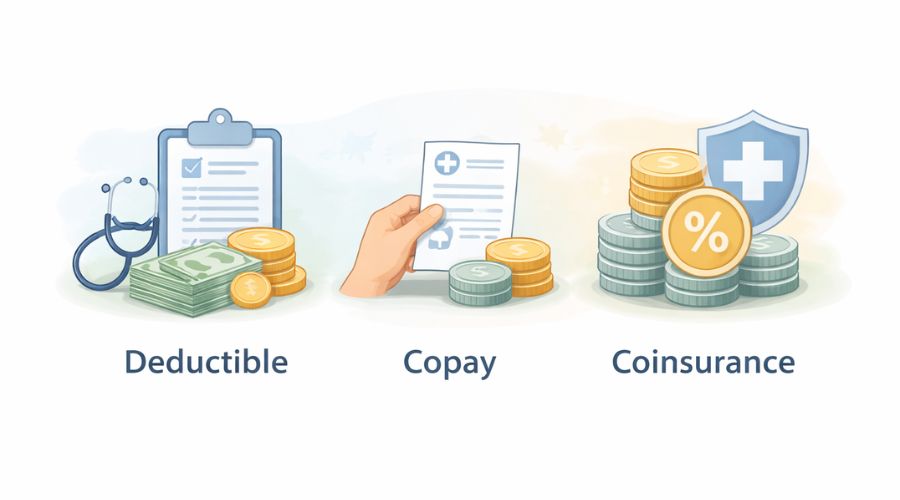
Understanding these terms is essential. They determine what health insurance actually costs you over the year.
Premium
Your premium is the amount you pay every month to keep your insurance active.
- You pay this whether you use medical care or not
- Missing payments can result in coverage termination
- Premiums do not count toward your deductible or out-of-pocket maximum
Deductible
The deductible is the amount you must pay out of pocket each year before the insurer starts sharing costs for many services.
- Some services may be covered before you meet the deductible
- High-deductible plans usually have lower monthly premiums
- Deductibles reset each plan year. If you want a deeper explanation with real-life examples, read our detailed guide on what a deductible means in health insurance and how it affects your total costs.
Example:
If your deductible is $2,000 and you receive a $1,200 medical bill, you pay the full amount. Insurance cost-sharing begins only after the deductible is met.
Copay
A copay is a fixed dollar amount you pay for certain services.
Examples:
- $25 for a primary care visit
- $50 for a specialist visit
- $10 for generic prescriptions
Copays often apply even after you meet your deductible, depending on the plan.
Coinsurance
Coinsurance is a percentage of the cost you pay after meeting your deductible.
Example:
- Plan pays 80%
- You pay 20%
The actual dollar amount depends on the negotiated price between the insurer and the provider. If copays and coinsurance still feel confusing, this detailed comparison of copay vs coinsurance explains the differences with clear cost examples.
Out-of-Pocket Maximum

This is the most you’ll pay in a plan year for covered in-network services.
- Once you reach it, the insurer pays 100% of covered costs
- Premiums do not count toward this limit
- Federal law sets a maximum cap, updated periodically
This protection is critical for serious illness or injury. Many people underestimate this limit, but the out-of-pocket maximum often matters more than the deductible for financial protection.
Why “In-Network” Matters So Much
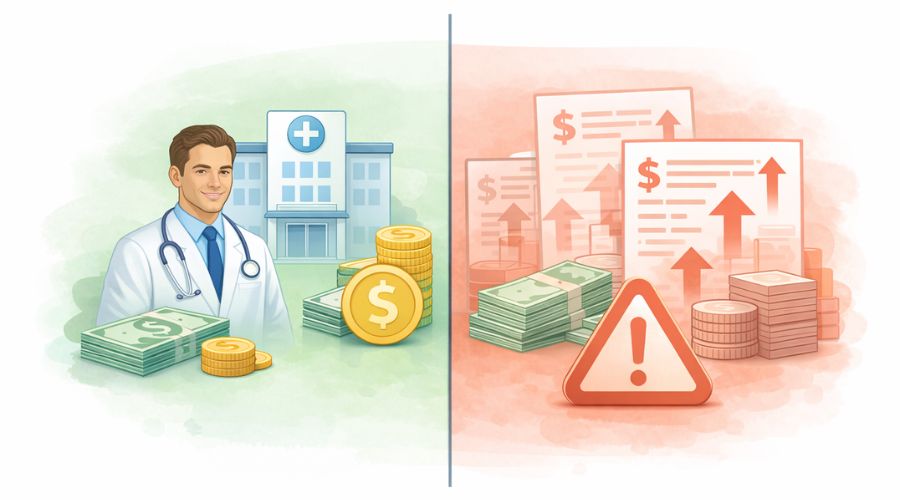
Health insurance plans contract with specific doctors, hospitals, and facilities.
- In-network providers agree to negotiated rates
- Out-of-network providers do not
Using out-of-network care often means:
- Higher deductibles
- Higher coinsurance
- No protection from balance billing in some situations
For a full breakdown of how network status changes your medical bills, see our in-depth guide on in-network vs out-of-network health insurance costs in the U.S.
Even one out-of-network provider involved in your care can significantly increase costs, though federal protections apply in certain emergency and surprise billing cases. Checking network status before care is one of the simplest ways to avoid unnecessary medical bills.
What Health Insurance Actually Covers

Health insurance does not cover everything equally. Coverage depends on federal rules, your specific plan, and whether care is in-network.
Preventive Care (Often Covered Before the Deductible)
Under federal law, most ACA-compliant plans must cover certain preventive services at no cost to you when received in-network. According to Healthcare.gov, preventive services such as screenings, vaccines, and annual checkups are covered without cost-sharing under ACA-compliant plans.
Common examples include:
- Annual physical exams
- Blood pressure and cholesterol screenings
- Vaccinations
- Cancer screenings (such as mammograms and colonoscopies)
- Certain prenatal and women’s health services
Important Limitations to Know
“Free” only applies when:
- The service is preventive (not diagnostic)
- The provider is in-network
- The visit does not turn into treatment for a specific condition
If a preventive visit leads to testing or treatment, cost-sharing may apply.
Primary Care and Specialist Visits
For routine medical care, how costs apply depends on your plan design.
Typical scenarios:
- A copay for each visit
- Coinsurance after meeting your deductible
- Higher costs for specialists than primary care doctors
Some plans require a referral from a primary care physician before seeing a specialist. Skipping this step can result in denied claims or higher out-of-pocket costs. Referral requirements are common in HMO plans but less common in PPO plans.
Emergency Care

Emergency services are treated differently under federal law.
Key protections:
- Emergency care must be covered even if the provider is out-of-network. These emergency care and surprise billing protections are enforced by the Centers for Medicare & Medicaid Services under federal law.
- You cannot be charged higher out-of-network rates for true emergencies
- Prior authorization is not required for emergency treatment
However:
- Non-emergency follow-up care may not receive the same protections
- Ambulance services may still involve separate billing rules
These protections are defined under federal emergency care and surprise billing rules.
Prescription Drug Coverage
Most health insurance plans include prescription drug coverage, but not all medications are treated equally.
Plans use a formulary, which groups drugs into tiers:
- Generic drugs (lowest cost)
- Preferred brand-name drugs
- Non-preferred brand-name drugs
- Specialty medications (highest cost)
Your cost depends on:
- Drug tier
- Whether you use a network pharmacy
- Whether the drug requires prior authorization
High-cost specialty drugs can significantly affect annual healthcare spending.
Example:
A generic drug may cost $10 per month, while a specialty drug could cost hundreds or thousands, even with insurance.
How Claims and Billing Work Behind the Scenes

Many people never see how claims actually move through the system, which adds to confusion.
Step-by-Step: What Happens After You Get Care
- You receive medical services
- The provider submits a claim to your insurer
- The insurer reviews coverage rules and negotiated rates
- The insurer pays its portion
- You receive a bill for the remaining balance
This process can take weeks.
Explanation of Benefits (EOB)
Many people mistake an EOB for a bill, which can lead to unnecessary confusion or missed errors.
- What the provider charged
- What the insurer allowed
- What the insurer paid
- What you may owe
Errors can happen. Reviewing EOBs helps catch:
- Duplicate charges
- Incorrect coding
- Services you did not receive
Health Insurance Plan Types Explained
Different plan structures affect cost, flexibility, and provider access.
HMO (Health Maintenance Organization)
- Requires in-network care except emergencies
- Usually requires referrals
- Lower premiums and predictable costs
- Less flexibility
PPO (Preferred Provider Organization)
- Allows out-of-network care at higher cost
- No referral required for specialists
- Higher premiums
- More provider choice
EPO (Exclusive Provider Organization)
- No out-of-network coverage except emergencies
- No referrals required
- Moderate premiums
HDHP (High-Deductible Health Plan)
- Higher deductible
- Lower monthly premiums
- Often paired with Health Savings Accounts (HSAs)
- Higher upfront costs, lower long-term tax advantages for some households
Pros and Cons Comparison
| Plan Type | Pros | Cons |
|---|---|---|
| HMO | Lower costs, simple structure | Limited provider choice |
| PPO | Flexibility, no referrals | Higher premiums |
| EPO | Lower cost than PPO | No out-of-network coverage |
| HDHP | Lower premiums, HSA eligibility | High upfront costs |
Who Health Insurance Is Best For — and Who Should Be Cautious
Generally Beneficial For:
- Anyone without substantial emergency savings
- Families with children
- People managing chronic conditions
- Individuals who want protection from large medical bills
Requires Extra Care For:
- People with frequent specialist needs
- Those who travel often
- Individuals on expensive medications
- Anyone considering high-deductible plans without sufficient savings
Choosing the wrong plan can, in rare short-term situations, cost more than being uninsured.
Common Health Insurance Mistakes That Cost Americans Money
Many financial problems tied to healthcare are not caused by illness itself, but by misunderstandings about how insurance works.
Assuming Insurance Covers “Everything”
One of the most expensive mistakes is assuming coverage equals full payment.
Reality:
- Insurance shares costs, it doesn’t eliminate them
- Deductibles, coinsurance, and copays still apply
- Out-of-network care can dramatically increase bills
This assumption is one of the most common reasons insured households still face medical debt.
This misunderstanding often leads to delayed care, surprise bills, or medical debt.
Not Checking Network Status in Advance
Seeing the wrong provider is one of the fastest ways to inflate medical costs.
Common scenarios:
- Hospital is in-network, but the anesthesiologist is not
- Primary doctor refers to an out-of-network specialist
- Emergency care is followed by non-emergency out-of-network services
Even with federal protections, gaps still exist depending on the situation and the plan. Network status should be confirmed for both the facility and individual providers involved in care.
Ignoring the Explanation of Benefits (EOB)
Many people throw away EOBs assuming they are bills.
That’s risky.
Errors can include:
- Services billed twice
- Incorrect procedure codes
- Charges for care never received
Disputing mistakes early is easier than fixing them after accounts go to collections.
Choosing a Plan Based Only on Monthly Premium
Lower premiums often come with:
- Higher deductibles
- Higher coinsurance
- Higher total annual risk
A plan that looks “cheap” monthly can be far more expensive over the year if medical care is needed.
How Health Insurance Can Affect Credit and Debt
Health insurance itself does not affect your credit score. Medical debt does.
When Medical Bills Become a Credit Problem
Medical bills can harm credit if:
- You miss payments
- Bills are sent to collections
- Errors are not resolved promptly
Recent credit reporting changes have reduced the impact of small or paid medical collections, but large unpaid balances can still matter, especially for future lending decisions.
Insurance as Financial Protection
Health insurance acts as a risk cap, not a savings tool.
The out-of-pocket maximum is especially important:
- It limits financial damage from major illness or injury
- It protects savings and future income
- It reduces the chance of long-term debt
Without insurance, there is no such cap. This protection is what separates insurance from paying medical bills entirely on your own.
Legal and Consumer Protections in the U.S.
Several federal laws protect health insurance consumers, though enforcement and application can vary.
Key Federal Protections
- Coverage for pre-existing conditions
- Required coverage of essential health benefits in ACA-compliant plans
- Limits on annual out-of-pocket costs
- Emergency care protections
- Surprise billing protections in many situations
Consumer complaints and disputes often fall under oversight from agencies such as the Consumer Financial Protection Bureau and state insurance departments. The Consumer Financial Protection Bureau offers official guidance on medical billing disputes and insurance-related consumer rights.
Where Protections Can Differ
Rules may vary by:
- State law
- Type of insurance plan
- Employer size
- Self-funded vs fully insured plans
Reading the plan’s Summary of Benefits and Coverage (SBC) is critical before enrolling.
Myths vs. Facts About Health Insurance
Myth: “If my plan has a low deductible, it’s always better.”
Fact:
Low deductibles often come with higher premiums. The “better” plan depends on usage, cash flow, and risk tolerance.
Myth: “Emergency care is always fully covered.”
Fact:
Emergency care must be covered, but you may still owe deductibles, coinsurance, or ambulance fees.
Myth: “I can fix insurance problems later.”
Fact:
Many disputes have deadlines. Waiting can limit appeal rights and increase costs.
How to Use Health Insurance More Effectively
Practical Steps That Help
- Review your plan documents once per year
- Confirm network status before appointments
- Keep EOBs and medical bills organized
- Ask for cost estimates in advance when possible
- Appeal denied claims when appropriate
Small habits can prevent large financial consequences. Consistency matters more than perfection when managing health insurance.
Health Insurance vs. Being Uninsured in the U.S.

Some Americans consider going without health insurance to save money. That choice carries very real financial tradeoffs.
What Insurance Changes Financially
Health insurance primarily provides risk protection, not convenience.
With insurance:
- Costs are negotiated between insurers and providers
- Annual spending has a hard cap through the out-of-pocket maximum
- Preventive care is often covered at no cost
- Certain consumer protections apply
Without insurance:
- You are billed full, undiscounted prices
- There is no limit to potential medical costs
- Payment plans and discounts are not guaranteed
- Medical debt risk is significantly higher
Real-World Cost Comparison Example
Scenario: Emergency room visit + imaging + follow-up care
| Situation | Approximate Financial Exposure |
|---|---|
| Insured (in-network, OOP max applies) | Limited to plan’s out-of-pocket maximum |
| Insured (out-of-network complications) | Higher but still capped in many cases |
| Uninsured | Full charges, potentially tens of thousands |
Even a single accident can create long-term financial consequences without insurance.
How to Choose a Health Insurance Plan Step by Step
Choosing a plan is a financial decision, not just a healthcare one.
Step 1: Estimate Your Likely Usage
Consider:
- Ongoing prescriptions
- Chronic conditions
- Planned procedures
- Expected doctor visits
Past usage is often the best indicator, though emergencies remain unpredictable. This step helps narrow options before comparing costs.
Step 2: Compare Total Annual Cost — Not Just Premiums
Look at:
- Annual premiums
- Deductible
- Coinsurance
- Out-of-pocket maximum
The lowest monthly premium is rarely the lowest total cost. Annual cost matters more than monthly affordability alone.
Step 3: Check Provider and Drug Networks
Confirm:
- Your doctors are in-network
- Nearby hospitals are covered
- Your medications are on the formulary
Changing doctors or pharmacies can increase costs quickly.
Step 4: Understand Plan Rules Before Enrolling
Review:
- Referral requirements
- Prior authorization rules
- Coverage exclusions
- Appeal procedures
These rules affect real-world access to care. These rules determine whether claims are approved or denied.
Who Benefits Most From Different Plan Designs
Lower Deductible Plans Tend to Help:
- People with predictable medical expenses
- Families with children
- Individuals on ongoing treatment
High-Deductible Plans May Fit:
- People with strong emergency savings
- Those eligible for Health Savings Accounts
- Individuals with low expected usage
No plan type is universally “best.” The right plan depends on both financial stability and healthcare needs.
Important State and Employer Differences
Health insurance rules are not identical everywhere.
Differences may arise from:
- State insurance regulations
- Employer plan design
- Self-funded employer plans
- Regional healthcare pricing
Always rely on your specific plan documents rather than general assumptions.
Why Health Insurance Is a Long-Term Financial Tool
Health insurance affects more than medical bills.
It can influence:
- Emergency savings needs
- Debt risk
- Job flexibility
- Retirement planning
Unexpected healthcare costs are one of the most common causes of financial instability in the U.S., even among insured households.
Healthcare costs are unpredictable, but financial planning doesn’t have to be.
Frequently Asked Questions About Health Insurance in the U.S.
-
How does health insurance work if I don’t use medical care at all?
You still pay monthly premiums to stay covered. Health insurance is primarily protection against large, unexpected costs, not a pay-per-use service. Preventive benefits may still apply even if you don’t seek treatment.
-
Why do I still get bills after insurance pays?
Insurance usually pays only part of the cost. Deductibles, copays, and coinsurance determine what remains your responsibility. Bills after insurance are normal and not necessarily a sign of error.
-
Does health insurance cover pre-existing conditions?
Yes, ACA-compliant plans must cover pre-existing conditions. Coverage details, cost-sharing, and provider access still depend on the specific plan.
-
What happens if I miss a health insurance payment?
Missing a payment can trigger a grace period. If the premium remains unpaid, coverage can be terminated, and claims during that time may be denied. Rules vary by insurer and plan type.
-
Can health insurance deny coverage for certain services?
Yes. Plans can deny services that are:
– Not medically necessary under plan rules
– Excluded from coverage
– Received without required referrals or authorizationDenials can often be appealed. Most denials include instructions on how to file an appeal.
-
Does health insurance affect my taxes?
Employer-sponsored premiums are often paid with pre-tax dollars. Other tax effects depend on income, plan type, and eligibility rules. Tax treatment varies and can change by year.
-
What should I do if I receive a medical bill I don’t understand?
Start by comparing the bill with your Explanation of Benefits. Confirm the service, provider, and dates are correct. Contact the insurer or provider promptly if something doesn’t match. Billing errors are common and can often be corrected when addressed early.
-
Is it ever cheaper to be uninsured?
In rare, short-term situations, some people pay less without insurance. However, the financial risk of a single emergency often outweighs any short-term savings.
-
How often should I review my health insurance plan?
At least once per year, especially during open enrollment. Health needs, provider networks, and plan costs change regularly. Annual review helps avoid surprises when health or coverage needs change.
Final Thoughts for Everyday Americans

Health insurance in the U.S. is not intuitive, but it becomes manageable once the system is understood.
The goal is not to eliminate medical costs. The goal is to limit financial risk, protect savings, and avoid long-term debt when health issues arise.
Understanding how plans work before you need care is one of the most practical financial steps an American household can take. Health insurance works best when it is understood before it is needed.
Disclaimer
This content is provided for educational and informational purposes only.
It is not legal, tax, medical, or financial advice.
Health insurance rules, costs, and coverage vary by plan, state, employer, and individual circumstances.
Readers should consult a qualified professional or their insurance provider before making personal healthcare or financial decisions.

3 thoughts on “How Does Health Insurance Work? Costs, Coverage & Common Mistakes Explained”