
Choosing the right health insurance plan in the United States is not just about monthly premiums. Many Americans only discover the real tradeoffs when they actually need medical care…
Key Takeaways
- EPO insurance is a type of U.S. health plan that covers care only within a specific provider network.
- No referrals are required to see specialists, but out-of-network care is not covered (except true emergencies).
- Monthly premiums are often lower than PPOs, with less flexibility.
- These plans are commonly offered on ACA marketplaces and through employers.
- Understanding the network rules is critical to avoiding large, unexpected medical bills.
Why EPO Insurance Matters in Real Life
Many Americans choose a health plan based on the monthly premium and only discover the tradeoffs when they need care. A common surprise with EPO plans is that one wrong doctor or lab can mean paying the full bill out of pocket. That’s not a loophole—it’s how the plan is designed.
EPO insurance sits in the middle of the HMO–PPO spectrum. It promises simpler access than an HMO without referrals, but it demands strict loyalty to the network. For people who already have preferred doctors—or who don’t check networks carefully—this structure can cause real financial stress. If you want a full side-by-side breakdown of how EPO plans compare with other options, see our detailed guide on HMO vs PPO vs EPO health insurance plans.
Understanding how EPO plans actually work helps avoid denied claims, coverage gaps, and budgeting mistakes that show up months later.
What Is EPO Insurance?
EPO (Exclusive Provider Organization) insurance is a U.S. health insurance plan that covers medical care only when you use doctors, hospitals, and facilities within the plan’s network.
If you go outside that network, the plan generally pays nothing, unless the care qualifies as a true emergency under federal law.
Core Characteristics of EPO Plans
- No primary care physician (PCP) requirement
- No referrals needed for specialists
- In-network coverage only
- Emergency care covered nationwide
- Typically lower premiums than PPOs, higher than some HMOs
EPO plans are regulated under the same federal and state insurance rules as other major medical plans and must meet ACA essential health benefit requirements.
How EPO Insurance Works in the United States
Provider Networks Are the Foundation

Every EPO plan is built around a defined provider network. This includes: (If you’re not clear on how provider networks affect costs, our in-network vs out-of-network health insurance guide explains why staying in network matters financially.)
- Primary care doctors
- Specialists
- Hospitals
- Labs and imaging centers
- Urgent care clinics
Coverage applies only when care is received from these contracted providers.
Insurance companies negotiate rates with network providers, which keeps costs lower—but in exchange, the plan limits your choices.
No Referrals, But No Flexibility
Unlike HMOs, EPOs allow you to book appointments with specialists directly. That convenience is often why people choose them.
However, EPOs are less forgiving than PPOs:
| Situation | EPO Coverage |
|---|---|
| In-network doctor visit | Covered (subject to copays/deductible) |
| In-network specialist | Covered, no referral required |
| Out-of-network specialist | Not covered |
| Out-of-network hospital | Not covered |
| Emergency care | Covered (federal requirement) |
Emergency Coverage Is Federally Protected
Under federal law, including ACA rules and later consumer protections enforced by agencies like the Consumer Financial Protection Bureau, EPO plans must cover emergency services as if they were in network. These emergency coverage requirements are enforced by the Centers for Medicare & Medicaid Services, which oversees federal health insurance regulations.
That includes:
- ER visits for serious or life-threatening conditions
- Ambulance services (rules vary by plan and state)
However, once you’re stabilized, follow-up care outside the network may not be covered.
Cost Structure: Premiums, Deductibles, and Copays

EPO plans typically use standard cost-sharing elements:
- Monthly premium
- Annual deductible
- Copayments for visits and prescriptions
- Coinsurance after deductible (varies by plan)
- Out-of-pocket maximum (ACA-compliant plans only)
To understand how deductibles, copays, and coinsurance work together in real plans, see our full guide on deductible vs copay vs coinsurance.
The lower premium often reflects the network restriction, not necessarily better overall value for every household.
Who EPO Insurance Is Designed For
EPO plans are not good or bad by default—their value depends entirely on whether the network matches your real healthcare usage.
EPO plans tend to work best for people who:
- Already use doctors within a known network
- Live in urban or suburban areas with strong provider coverage
- Want lower premiums and can manage network rules
- Don’t need frequent out-of-network specialty care
They are often a poor fit for people who:
- Travel frequently or live in multiple states
- Need access to specialized or out-of-network providers
- Already have long-standing doctors outside the plan network
Pros and Cons of EPO Insurance
Choosing an EPO plan is a tradeoff. The value depends almost entirely on how comfortable you are staying inside a defined provider network.
EPO Insurance: Pros vs. Cons
| Pros | Cons |
|---|---|
| Lower monthly premiums than many PPO plans | No coverage outside the network (non-emergency) |
| No referrals needed for specialists | One out-of-network visit can mean 100% out-of-pocket cost |
| Simpler than HMOs for scheduling care | Limited provider choice compared to PPOs |
| ACA-compliant plans include essential health benefits | Not ideal for frequent travelers or rural residents |
| Predictable costs when staying in network | Network changes can disrupt ongoing care |
Key warning:
With EPO plans, “mostly in network” is not enough. Coverage is usually all-or-nothing, even for small services like labs or imaging.
EPO vs HMO vs PPO: How They Compare
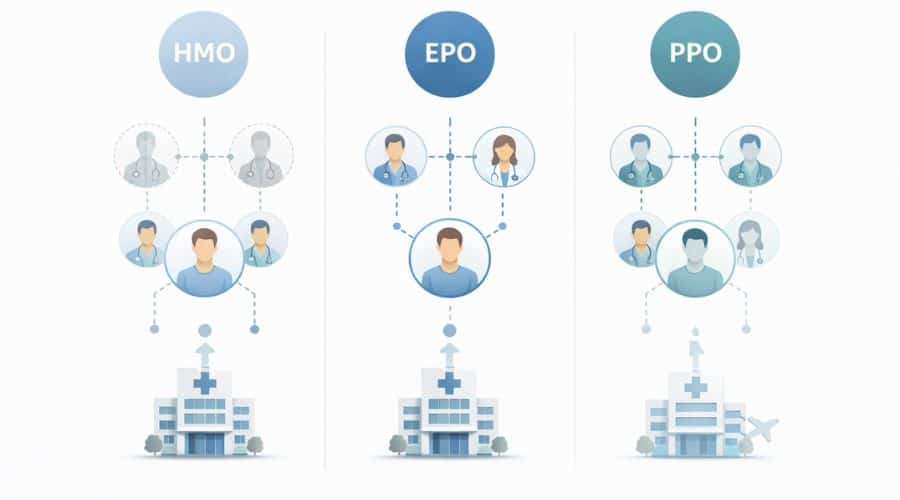
Many Americans confuse EPOs with HMOs or assume they’re just cheaper PPOs. They’re neither.
Comparison of Common U.S. Health Plan Types
| Feature | EPO | HMO | PPO |
|---|---|---|---|
| In-network requirement | Yes | Yes | No |
| Out-of-network coverage | ❌ No (except emergencies) | ❌ No (except emergencies) | ✅ Yes (higher cost) |
| Specialist referrals required | ❌ No | ✅ Yes | ❌ No |
| Monthly premiums | Medium | Low | High |
| Provider flexibility | Low | Very low | High |
Plain-English takeaway:
- HMO = Cheapest, strict rules
- EPO = Moderate cost, strict network
- PPO = Most freedom, highest cost
Real-Life EPO Insurance Examples
Example 1: In-Network Care (Works Well)
A 35-year-old in Chicago chooses an EPO offered through their employer. Their primary doctor, dermatologist, and local hospital are all in network.
- Office visit copay: $30
- Specialist visit: Covered without referral
- Prescription drugs: Covered per formulary
Result: Predictable costs and lower premiums.
Example 2: Out-of-Network Surprise (Costly Mistake)
A family chooses an EPO marketplace plan. Their child needs imaging, and the pediatrician sends them to a nearby imaging center.
- Imaging center is out of network
- Insurance pays $0
- Family receives a $1,800 bill
Result: Coverage denial despite having “good insurance.”
Common EPO Insurance Mistakes Americans Make

Assuming “Nearby” Means “In Network”
Networks are based on contracts—not geography. A hospital across the street may be excluded.
Not Checking Ancillary Providers
Even if a hospital is in network:
- Radiologists
- Anesthesiologists
- Labs
may not be.
Confusing Emergency Care With Urgent Care
Emergency rooms are covered nationwide. Urgent care centers are not always considered emergencies.
EPO Insurance and the Affordable Care Act
Most EPO plans sold on HealthCare.gov or state marketplaces are ACA-compliant, meaning they must. According to HealthCare.gov, ACA-compliant health plans must cover essential health benefits and emergency services even when care is received outside the network.
- Cover essential health benefits
- Include preventive care with no cost-sharing
- Follow federal limits on out-of-pocket maximums
- Cover emergency services as in network
However, network design is still allowed, and federal law does not require out-of-network coverage for non-emergency care.
Financial and Credit Implications
Health insurance choices affect more than medical care.
Potential Financial Impacts
- Large uncovered bills can lead to medical debt
- Medical debt may be reported to credit bureaus under certain conditions
- Missed payments can still harm credit, even though medical collections rules are more lenient than in the past
Understanding network rules upfront reduces the risk of avoidable financial stress. Medical debt prevention starts with choosing the right plan—not just managing bills afterward.
Eligibility and Where EPO Plans Are Offered
EPO insurance is not a special or restricted program. Availability depends on where you live and how you get coverage.
Common Places You’ll See EPO Plans
- Employer-sponsored health insurance
- ACA marketplaces (HealthCare.gov or state exchanges)
- Some off-exchange individual plans
Not every insurer offers EPOs in every state or county. Network size and plan rules can vary significantly even within the same insurer.
Important:
Plan availability and networks are approved at the state level and overseen federally by agencies like the Centers for Medicare & Medicaid Services for ACA marketplace plans.
How to Choose an EPO Plan the Right Way (Step-by-Step)
Choosing an EPO plan without checking the network is the biggest mistake people make. This process helps avoid it.
Step 1: List Your Actual Providers
Write down:
- Primary care doctor
- Specialists you see now
- Hospitals you realistically use
- Prescription medications
Do not rely on memory—use real names and locations.
Step 2: Verify Each Provider Inside the Plan Network
Use only the insurer’s official provider directory for that specific plan.
Check:
- Doctor name spelling
- Practice location
- Hospital system
- Specialty
Never assume a provider is in network because they were covered last year or under another plan from the same insurer.
Step 3: Check Ancillary Services
Ask or look up:
- Labs
- Imaging centers
- Anesthesia groups
- Emergency hospital affiliations
These are frequent sources of denied EPO claims.
Step 4: Review Emergency and Travel Rules
Confirm:
- How emergencies are defined
- Coverage for out-of-area emergencies
- Post-stabilization coverage limits
Emergency care is protected, but follow-up care often is not.
Step 5: Compare Total Annual Cost — Not Just Premium
Include:
- Premium × 12
- Deductible
- Expected copays
- Worst-case out-of-pocket maximum
Lower premiums do not always mean lower total cost.
Risks and Downsides That Deserve Extra Attention
Network Changes Mid-Year
Insurers can update networks during the year. If a provider leaves the network:
- You may need to switch doctors
- Ongoing treatment may become uncovered
- Transitional care protections are limited and time-bound
No Safety Net for Non-Emergency Out-of-Network Care
With EPOs:
- There is usually no partial reimbursement
- No negotiated rate protections
- No balance billing protection outside emergencies
This is stricter than PPO rules and surprises many enrollees.
Referral Freedom Can Be Misleading
EPOs feel flexible because referrals aren’t required. That convenience can lead people to:
- See specialists without confirming network status
- Schedule tests without checking facilities
The lack of referrals does not mean broader coverage.
Myths vs. Facts About EPO Insurance
Myth 1: “EPOs are just cheaper PPOs”
Fact:
EPOs trade flexibility for cost. PPOs still cover out-of-network care at higher rates; EPOs usually do not cover it at all.
Myth 2: “Emergency coverage means any urgent situation”
Fact:
Only true medical emergencies are protected. Urgent care, follow-up visits, and specialist care may not qualify.
Myth 3: “If the hospital is in network, everything is covered”
Fact:
Individual providers within a hospital can be out of network unless federal emergency protections apply.
EPO Insurance and Taxes, Laws, and Regulation
Tax Treatment
- Premiums paid through payroll may be pre-tax
- Premium tax credits may apply for ACA marketplace plans
- Out-of-pocket medical expenses may be deductible only if IRS thresholds are met (rules vary by year)
EPO plans themselves receive no special tax status compared to other major medical plans.
Consumer Protections Still Apply
Even with strict networks, EPO plans must follow:
- ACA essential health benefit rules
- Preventive care coverage requirements
- Federal emergency service protections
- Claims and appeals rights
However, network design is legally allowed, and courts consistently uphold it.
Who Should Reconsider an EPO Plan
An EPO may not be appropriate if you:
- Have complex or ongoing specialist care
- Travel frequently across states
- Live in a rural area with limited networks
- Want the option to see out-of-network providers
In these cases, paying more for a PPO can reduce long-term risk.
Frequently Asked Questions About EPO Insurance
-
What does EPO stand for in health insurance?
EPO stands for Exclusive Provider Organization. It means the plan only covers care from a specific network of doctors, hospitals, and facilities, except in true emergencies.
-
Is EPO insurance the same as PPO?
No. While both plans allow you to see specialists without referrals, PPO plans still offer partial coverage for out-of-network care, usually at a higher cost. EPO plans generally offer no coverage at all outside the network.
-
Does EPO insurance cover emergencies anywhere in the U.S.?
Yes. Under federal law, EPO plans must cover emergency services as if they were in network, even if the hospital is outside the plan’s service area.
However, non-emergency follow-up care after stabilization may not be covered if it occurs outside the network. This distinction is important for people who travel or receive follow-up care outside their home area.
-
Do EPO plans require a primary care doctor?
Most EPO plans do not require you to choose a primary care physician, and they do not require referrals to see specialists. This is one of the main differences between EPOs and HMOs.
-
Can I use urgent care with an EPO plan?
Sometimes. Urgent care coverage depends on whether the urgent care center is in network and whether the visit meets the plan’s definition of covered care.
Urgent care is not automatically treated as an emergency, even if it feels urgent to the patient.
-
What happens if I accidentally see an out-of-network doctor?
In most EPO plans:
– The insurer pays nothing
– The provider can bill you the full, undiscounted amount
– The cost does not count toward your deductible or out-of-pocket maximumThis is one of the biggest financial risks of EPO coverage.
-
Are EPO plans available on HealthCare.gov?
Yes. Many EPO plans are sold on the ACA marketplaces, depending on your state and county. Availability varies by insurer and location.
Marketplace EPO plans must still meet ACA consumer protection standards.
-
Is EPO insurance a good choice for families?
It depends. EPOs can work well for families who:
– Use in-network pediatricians and hospitals
– Rarely travel
– Are comfortable verifying providers before every visitThey can be risky for families with children who need specialized or ongoing care outside a limited network. Families with complex medical needs should review networks especially carefully.
-
Does EPO insurance affect my credit score?
Indirectly, yes. If uncovered medical bills go unpaid, they can become medical debt. While medical collections are treated differently than other debts, they can still impact credit reports under certain conditions.
Avoiding out-of-network care is the best protection.
-
Can I appeal an EPO coverage denial?
Yes. EPO plans must offer:
– An internal appeal process
– An external review option if the appeal is deniedHowever, appeals rarely succeed if the denial is based on clear out-of-network use. Appeals are more successful when the denial involves medical necessity or documentation errors.

Final Thoughts on EPO Insurance
EPO insurance can be a solid, cost-effective option when the network fits your life and healthcare needs. It rewards people who plan ahead, verify providers, and stay organized.
It can also be financially unforgiving for people who assume flexibility that the plan does not offer.
The plan itself isn’t good or bad — the match between the plan and the person matters most. Taking time to understand the rules before enrolling can prevent years of avoidable financial stress.
Disclaimer
This content is provided for educational and informational purposes only. It is not legal, tax, medical, or financial advice. Health insurance rules, costs, and coverage details vary by plan, insurer, state, and individual situation. Readers should consult a licensed insurance professional, healthcare navigator, tax advisor, or other qualified professional before making personal coverage or financial decisions.
