
Key Takeaways
- Term life insurance provides temporary coverage at a lower cost and is designed to replace income during working years.
- Whole life insurance offers permanent coverage with a built-in cash value component, but comes with significantly higher premiums.
- The right choice depends on income, dependents, time horizon, budget, and long-term financial priorities.
- For most U.S. households, term life meets core protection needs, while whole life fits more limited, specific situations.
- Much of the confusion comes from mixing insurance needs with investment goals — which are not the same thing.
Why This Decision Matters in Real Life

Life insurance decisions usually don’t happen in calm moments. They come up after a marriage, the birth of a child, a mortgage closing, or a health scare. Many Americans buy a policy quickly, often based on advice from a friend, an agent, or something they read online — without fully understanding what they’re committing to.
That’s where problems start.
Some people end up paying thousands of dollars a year for coverage they don’t actually need. Others buy cheap policies that expire right when their family would still be financially vulnerable. A common mistake is assuming all life insurance works the same way, just with different price tags. It doesn’t.
Term life insurance and whole life insurance are built for very different purposes. Choosing between them isn’t about which is “better.” It’s about which one fits your real financial situation, responsibilities, and timeline.
Before comparing features or costs, it helps to understand what each type is designed to do — and what it isn’t.
Understanding the Core Purpose of Life Insurance

At its core, life insurance exists to protect other people financially if you die. In the U.S., this usually means covering:
- Lost income for a spouse or partner
- Childcare and education costs
- Mortgage or rent payments
- Outstanding debts that don’t disappear at death
- Final expenses, including funeral and medical costs
In simple terms, life insurance exists to provide stability — not to create wealth or act as an investment.
Life insurance is not required by law, and it’s not meant to make someone wealthy. Its role is stability — keeping survivors from facing financial disruption during an already difficult time.
Where term and whole life differ is how long that protection lasts and what else, if anything, comes with it.
What Term Life Insurance Is
The Basic Structure
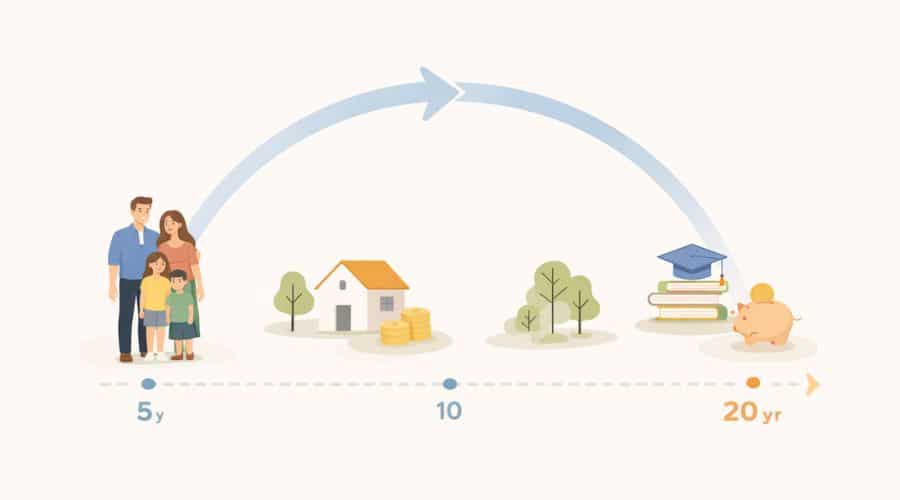
Term life insurance covers you for a specific period of time — commonly 10, 20, or 30 years. If you die during that term, the policy pays a death benefit to your beneficiaries. If you outlive the term, coverage ends.
There is no cash value and no payout if the policy expires unused.
Think of it like renting protection for the years it’s most needed.
How It Works in the U.S.
- Premiums are typically fixed for the entire term
- Coverage amounts often range from $100,000 to several million dollars
- Policies are regulated at the state level, but structures are broadly similar nationwide
- Medical underwriting usually applies, though some simplified policies exist
Because term life is straightforward and temporary, it’s usually the most affordable way to buy a large amount of coverage.
What Whole Life Insurance Is

The Basic Structure
Whole life insurance is designed to last your entire life, as long as premiums are paid. It includes two components:
- A death benefit paid to beneficiaries
- A cash value account that grows over time inside the policy
Part of each premium goes toward insurance costs, and part goes into the cash value, which grows on a tax-deferred basis under current IRS rules.
How It Works in the U.S.
- Premiums are usually fixed for life
- Coverage remains in force until death (or policy lapse)
- Cash value growth is governed by the insurer’s guarantees and dividends (if applicable)
- Policies are regulated by state insurance departments and must comply with IRS definitions to maintain tax advantages
Whole life is often described as both insurance and a financial product. That dual role is the source of much confusion — and many poor purchasing decisions.
Because of this complexity, whole life insurance requires long-term commitment and careful planning.
The Fundamental Difference Most People Miss
The key distinction is intent.
- Term life insurance is designed to protect against temporary financial risk
- Whole life insurance is designed to provide permanent coverage with forced savings
If your financial risk disappears over time — for example, once children are grown and debts are paid — permanent insurance may not be necessary. If your goal is lifelong coverage regardless of financial dependency, whole life may enter the conversation.
Everything else — cost, flexibility, suitability — flows from this difference.
How Term Life Insurance Works in Practice
Premium Structure and Cost Behavior
Term life insurance is priced to be simple and predictable.
- Premiums are usually level for the entire term (for example, 20 years)
- Pricing is based on:
- Age at purchase
- Health and medical history
- Coverage amount
- Term length
Because the insurer is only covering a limited window of risk, premiums are significantly lower than permanent insurance.
For example, a healthy 35-year-old U.S. non-smoker might qualify for:
- $500,000 of 20-year term coverage for a relatively modest monthly cost
Actual pricing varies by insurer, underwriting class, and state regulations.
What Happens When the Term Ends
When the term expires, one of three things happens:
- Coverage ends
No payout, no refund. This is the most common outcome. - Policy is renewed at a higher rate
Renewal premiums are based on your current age, not your original age, and can be dramatically higher. - Policy is converted to permanent insurance
Some term policies include a conversion option, allowing you to convert to whole life or universal life without a new medical exam — usually within a limited time window.
Not all term policies offer renewal or conversion, and rules vary by insurer and state. These features must be reviewed before purchase, not after.
How Whole Life Insurance Works in Practice
Premium Commitments and Longevity
Whole life insurance requires a long-term financial commitment.
- Premiums are typically:
- Fixed
- Due for life (or for a defined payment period, such as 20 years, depending on policy design)
- Missing payments can cause:
- Policy lapse
- Forced use of cash value to cover premiums
- Reduction in death benefit
Unlike term life, walking away from a whole life policy early often means recovering far less than what you paid in.
Cash Value Mechanics
The cash value grows inside the policy under rules defined by the insurer and regulated by state insurance law and the IRS.
Key characteristics:
- Growth is tax-deferred, not tax-free
- Early years are heavily weighted toward fees and insurance costs
- Meaningful cash value accumulation usually takes many years
- Policy loans and withdrawals can reduce the death benefit
If the policy is not managed carefully, loans and withdrawals can trigger tax consequences, especially if the policy lapses or is surrendered.
Side-by-Side: Core Functional Differences

| Feature | Term Life Insurance | Whole Life Insurance |
|---|---|---|
| Coverage length | Fixed term (10–30 years) | Lifetime |
| Premium cost | Lower | Much higher |
| Cash value | None | Yes |
| Complexity | Simple | Complex |
| Flexibility | High | Limited |
| Best suited for | Income replacement | Permanent coverage needs |
This structural gap explains why these products serve very different financial roles, even though both are called “life insurance.”
Who Term Life Insurance Is Usually Best For

Term life tends to align well with common American financial realities.
Typical Situations Where Term Makes Sense
- Parents with young or dependent children
- Households relying on one or two primary incomes
- Homeowners with a mortgage
- Families focused on budget efficiency
- People who expect financial obligations to decline over time
The goal in these cases is protection during the years when loss of income would be financially devastating.
Why Term Often Matches Real Financial Risk
Most financial responsibilities are temporary:
- Children grow up
- Mortgages are paid down
- Retirement savings accumulate
Term insurance mirrors this declining risk rather than extending coverage indefinitely. In these situations, affordability and adequate coverage matter more than permanence.
Who Whole Life Insurance May Be Appropriate For

Whole life is not inherently bad — but it is narrowly appropriate.
Situations Where Whole Life May Make Sense
- Individuals with permanent dependents, such as a child with lifelong care needs
- People planning for estate liquidity, especially where assets are illiquid
- High-income households already maximizing other tax-advantaged accounts
- Those who value guaranteed lifelong coverage and can sustain long-term premiums
Even in these cases, whole life should be evaluated alongside other financial tools, not in isolation.
Pros and Cons: Term Life vs Whole Life Insurance
A clear comparison helps cut through marketing language and focus on real-world tradeoffs.
Term Life Insurance — Pros and Cons
| Pros | Cons |
|---|---|
| Much lower premiums | Coverage ends after the term |
| Simple and easy to understand | No cash value |
| Allows high coverage amounts on a budget | Renewal can be expensive |
| Matches temporary financial needs | Requires planning for expiration |
Why these cons matter
Term life requires intention. If someone buys a 20-year policy and never revisits the decision, they may reach the end of the term still needing coverage but facing much higher costs.
Whole Life Insurance — Pros and Cons
| Pros | Cons |
|---|---|
| Lifetime coverage | Very high premiums |
| Predictable premiums | Slow cash value growth early on |
| Cash value component | Complex rules and fees |
| Can support estate planning goals | Poor flexibility if finances change |
Why these cons matter
Whole life policies lock people into long-term obligations. If income drops, priorities change, or the policy is surrendered early, the financial loss can be significant.
Cost Differences Over Time: What People Often Overlook
The biggest practical difference between term and whole life insurance is not coverage length — it’s opportunity cost.
Upfront Affordability vs Long-Term Commitment
- Term life frees up cash flow for:
- Retirement accounts
- Emergency savings
- College savings
- Debt reduction
- Whole life redirects a large portion of income toward insurance premiums
For many households, paying higher premiums means less flexibility elsewhere, especially during peak earning and spending years.
Break-Even Realities
Whole life policies typically take many years before:
- Cash value equals total premiums paid
- The policy becomes financially efficient
If a policy is surrendered early, the policyholder may receive less than they paid in, even after years of payments.
Risks and Downsides That Deserve Honest Attention
Risk of Over-Insuring Permanently
A common mistake is buying permanent insurance when the financial need is temporary. This can result in decades of unnecessary premiums.
Policy Lapse Risk (Whole Life)
If premiums can’t be maintained:
- Cash value may be consumed to cover costs
- Death benefit may shrink
- Policy may lapse entirely
A lapsed policy can create tax consequences if loans were taken against the cash value.
False Comparisons to Traditional Investing
Whole life cash value growth:
- Is not equivalent to market investing
- Is limited by policy costs and guarantees
- Should not be viewed as a replacement for retirement accounts
Confusing insurance with investing leads to unrealistic expectations and poor planning.
Common Myths vs Facts
Myth: “Whole life insurance is always a better long-term deal”
Fact: It depends entirely on the individual’s financial needs, timeline, and ability to sustain premiums.
Myth: “Term life is wasted money if you don’t die”
Fact: Term life transfers financial risk during critical years. No payout does not mean no value.
Myth: “Cash value is free money”
Fact: Cash value grows from premiums you pay, reduced by fees and insurance costs.
Myth: “Life insurance helps build credit”
Fact: Life insurance generally does not affect your credit score, positively or negatively, unless premiums go unpaid and are sent to collections.
How Life Insurance Affects Credit and Long-Term Finances
Credit Score Impact
- Life insurance policies are not reported to credit bureaus
- Missed payments typically do not affect credit unless escalated to collections
- Policy loans do not appear on credit reports
Long-Term Financial Impact
The bigger impact is indirect:
- High premiums can limit saving and investing
- Poor policy selection can reduce financial flexibility
- Well-matched coverage can protect long-term financial stability
A Practical Way to Decide Between Term and Whole Life
Rather than starting with products, start with questions.
Step 1: Identify Who Depends on Your Income
- Spouse or partner
- Children
- Aging parents
- Anyone who would face financial hardship
Step 2: Estimate How Long That Dependency Lasts
- Until children are financially independent
- Until a mortgage is paid off
- Until retirement savings are sufficient
If the answer is not lifelong, permanent insurance may not be necessary.
Step 3: Assess Budget Sustainability
Ask honestly:
- Can these premiums be paid for decades?
- What happens if income drops?
- Would this crowd out other financial goals?
Step 4: Separate Insurance From Investing
Insurance is about protection, not performance. Mixing the two usually creates confusion rather than efficiency.
Real-Life Scenarios: Which Type Fits Which Situation?

Abstract explanations only go so far. These scenarios reflect common U.S. household situations and how term vs whole life typically aligns with them.
Scenario 1: Young Family With a Mortgage
Situation
- Married couple in their early 30s
- Two young children
- One or two primary incomes
- 30-year mortgage
- Limited savings so far
Primary financial risk
Loss of income during working years.
What usually makes sense
- Term life insurance
- Coverage length aligned with:
- Child-rearing years
- Mortgage term
Why
The financial risk is temporary. The priority is replacing income and keeping the household stable, not permanent coverage.
Scenario 2: Single Adult With No Dependents
Situation
- No spouse or children
- No one relies on income
- Modest debt
Primary financial risk
Final expenses, not income replacement.
What usually makes sense
- Either no life insurance, or
- A small term policy for final expenses
Why
Life insurance exists to protect others financially. Without dependents, large permanent policies often provide little practical value.
Scenario 3: High-Income Household With Advanced Planning Needs
Situation
- High earners
- Maxing out retirement accounts
- Significant assets
- Estate planning considerations
Primary financial risk
Liquidity at death, estate efficiency.
What may make sense
- Whole life insurance, in limited, intentional amounts
- Used as a planning tool, not a primary investment
Why
Permanent coverage can provide predictable liquidity, but only after other foundational financial priorities are already met.
Scenario 4: Parent of a Child With Permanent Care Needs
Situation
- Child will require lifelong support
- Financial dependency does not end at adulthood
Primary financial risk
Permanent income replacement.
What may make sense
- Whole life insurance
- Often coordinated with trusts or guardianship planning
Why
The financial obligation is permanent, not temporary. Term insurance may expire while the need still exists.
Term vs Whole Life: Decision Matrix
This table summarizes how different priorities typically align.
| Priority | Term Life | Whole Life |
|---|---|---|
| Low monthly cost | ✅ | ❌ |
| Temporary income replacement | ✅ | ❌ |
| Lifetime coverage | ❌ | ✅ |
| Simplicity | ✅ | ❌ |
| Cash value accumulation | ❌ | ✅ |
| Flexibility if finances change | ✅ | ❌ |
| Advanced estate planning | ❌ | ✅ |
No product checks every box. The goal is alignment, not perfection.
Common Beginner Misunderstandings That Cause Regret
“I should lock this in forever just in case”
Permanent coverage sounds safe, but paying for lifelong insurance when the risk is temporary often leads to wasted dollars.
“I’ll use whole life as my savings plan”
Insurance-first saving is usually inefficient for people still building emergency funds, paying down debt, or saving for retirement.
“Cheapest option is always best”
Underinsuring — or choosing too short a term — can be just as harmful as overpaying.
“I don’t need to review this again”
Life insurance decisions should be revisited after:
- Marriage or divorce
- Birth or adoption
- Home purchase
- Major income changes
When a Combination Approach Is Used
Some Americans use both types strategically.
How That Might Look
- A large term policy for income replacement during working years
- A smaller whole life policy for:
- Final expenses
- Permanent dependents
- Estate liquidity
This approach limits costs while still addressing long-term needs — but it requires careful planning and clear intent.
What Regulators and Consumer Agencies Emphasize
U.S. consumer protection agencies consistently stress:
- Understanding long-term premium obligations
- Avoiding products that don’t match actual needs
- Reviewing policy illustrations carefully
- Asking how policies perform if premiums stop early
Insurance products are legal and regulated, but suitability depends on the buyer’s situation, not the product label.
Frequently Asked Questions (FAQ)
-
Is term life insurance better than whole life for most Americans?
For most U.S. households, term life insurance better matches real financial needs, especially during working years when income replacement matters most. Whole life insurance serves narrower, long-term purposes and is usually appropriate only in specific situations.
-
What happens if I outlive my term life insurance policy?
If you outlive the term:
– Coverage typically ends
– No death benefit is paid
– No premiums are refundedSome policies allow renewal or conversion, but renewed premiums are usually much higher and conversion options are time-limited.
-
Can I convert term life insurance into whole life later?
Many term policies offer a conversion feature, allowing conversion to permanent insurance without a new medical exam.
Important limitations:
– Conversion windows are restricted
– Available permanent policy types may be limited
– Premiums will reflect your age at conversionThis feature must be confirmed before purchasing the term policy.
-
Is whole life insurance a good investment?
Whole life insurance is not designed to compete with traditional investments. While it includes a cash value component, growth is reduced by insurance costs and fees. It may serve specific planning roles, but it is not a replacement for retirement accounts or diversified investing.
-
Does life insurance affect my credit score?
Life insurance policies generally do not appear on credit reports.
However:
– Missed premiums sent to collections may affect credit
– Policy loans do not impact credit scores -
How much life insurance coverage do I actually need?
Coverage needs depend on:
– Income
– Dependents
– Debts
– Time horizon of financial obligationsThere is no universal number. Over-insuring or under-insuring can both create problems.
-
Is whole life insurance tax-free?
Whole life insurance offers cash value growth that is tax-deferred under current IRS rules.
However:
– Withdrawals beyond premiums paid may be taxable
– Policy lapses with outstanding loans can trigger taxesTax treatment depends on policy structure and personal circumstances.
-
Can I cancel a whole life insurance policy?
Yes, but surrendering a whole life policy early often results in:
– Receiving less than total premiums paid
– Possible tax consequencesThis is one of the biggest risks of buying permanent insurance without long-term commitment.
-
Should I buy life insurance through work or privately?
Employer-provided life insurance can be useful but:
– Coverage amounts are often limited
– Policies usually end when employment endsIndividually owned policies offer portability and more control.
-
Is it ever a mistake to buy whole life insurance?
It can be a mistake if:
– The policy replaces essential savings or debt repayment
– Premiums strain household cash flow
– The buyer does not need permanent coverageThe product itself is not the issue — misalignment is.

Final Thoughts
Choosing between term and whole life insurance is less about product features and more about honest financial self-assessment. Insurance should support stability, not create pressure or confusion. When coverage matches real needs, it does its job quietly and effectively.
Disclaimer
This content is provided for educational and informational purposes only.
It does not constitute legal, tax, or financial advice.
Life insurance needs, costs, tax treatment, and suitability vary based on individual circumstances, state laws, insurer rules, and current regulations.
Readers should consult a qualified insurance professional, financial advisor, or tax professional before making personal financial decisions.
