
Buying a home in the United States often starts with one intimidating question: How much money do I need upfront?
For many Americans, the idea that a 20% down payment is mandatory becomes a major barrier to homeownership—sometimes delaying it for years.
In reality, the U.S. mortgage system is far more flexible than most people realize. Down payment requirements vary widely based on loan programs, credit history, income stability, and personal financial goals. Misunderstanding these rules can lead to unnecessary stress, poor financial decisions, or missed opportunities.
Understanding how down payments actually work can help you avoid waiting longer than necessary, overusing your savings, or choosing the wrong loan type.
This guide explains down payments in plain English, using real U.S. mortgage rules — not outdated myths.
This section lays the foundation—what a down payment actually is, how it works in the U.S., and why the “20% rule” persists.
Key Takeaways
- A 20% down payment is NOT required for most U.S. homebuyers.
- Many conventional loans allow as little as 3% down, while government-backed loans may require 0% to 3.5%.
- A smaller down payment can increase monthly costs and mortgage insurance, but it can still be a smart choice in the right situation.
- The “right” down payment depends on your loan type, credit profile, savings, and long-term financial stability — not on a single rule.
How Much Down Payment for a House Is Required in the U.S.?
How much down payment you need for a house depends on the loan type, your credit profile, and your financial situation. In the U.S., buyers are often surprised to learn that 20% down is not required in many cases.
What Is a Mortgage Down Payment?
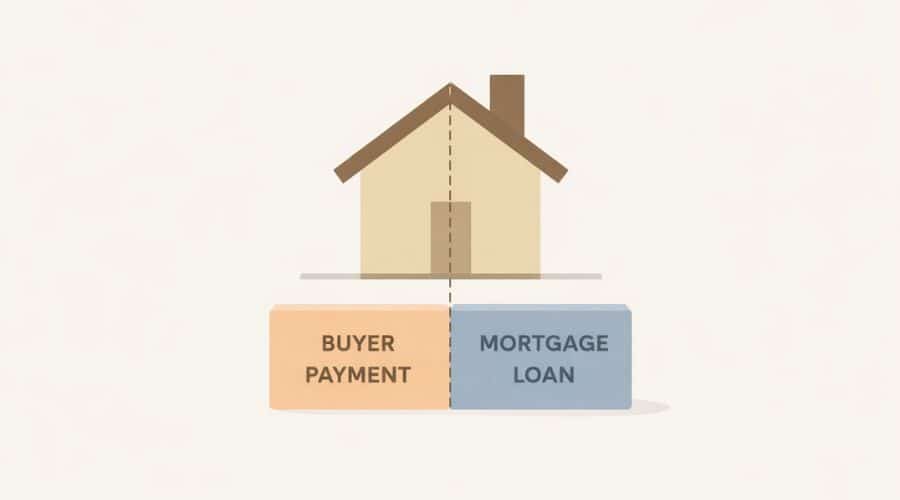
A mortgage down payment is the portion of a home’s purchase price that you pay out of pocket, upfront, when you buy a house. The remaining amount is financed through a mortgage loan.
Example:
If you buy a $300,000 home:
- 20% down = $60,000 upfront
- 5% down = $15,000 upfront
- 3% down = $9,000 upfront
Your lender finances the rest. This upfront payment reduces how much you borrow and directly affects your monthly mortgage payment.
The down payment immediately gives you home equity—your ownership stake in the property from day one.
How Down Payments Work in the United States
In the U.S., down payment requirements are shaped by:
- Federal housing policy
- Government-backed loan programs
- Private mortgage market standards
- Risk-based lending rules
Unlike some countries, the U.S. does not impose a single nationwide minimum down payment. Instead, lenders follow program-specific guidelines overseen or influenced by institutions such as Fannie Mae, Freddie Mac, and federal agencies like the Consumer Financial Protection Bureau.
This structure is why two borrowers buying similarly priced homes can face very different down payment requirements.
In simple terms, the down payment rules depend more on the loan program than on the home price alone.
Why People Still Believe 20% Is Required
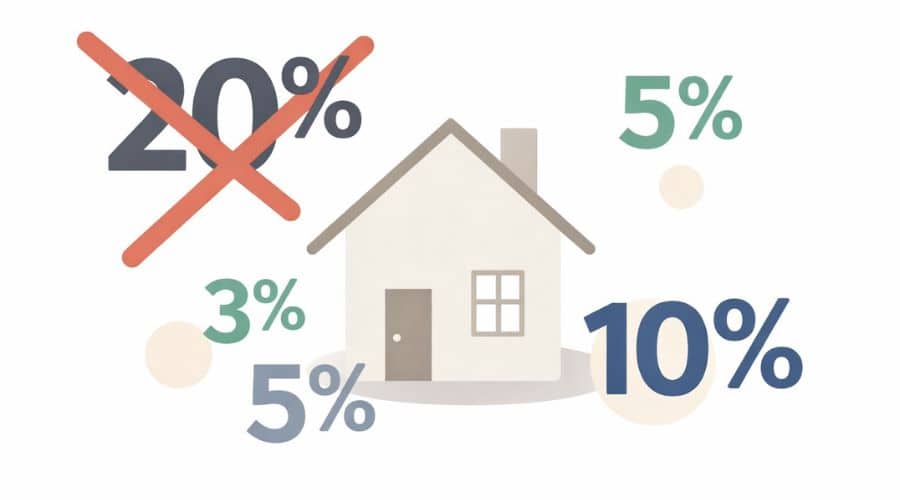
The 20% figure didn’t come from law—it came from risk management and tradition.
Historically:
- Putting 20% down reduced lender risk
- It eliminated the need for private mortgage insurance (PMI)
- It signaled strong financial stability
Over time, this became “common wisdom,” even though lending rules changed. Today, 20% is still financially beneficial for some buyers—but it is no longer a requirement for most mortgage programs.
Important:
Believing you must save 20% before buying can sometimes do more harm than good—especially if rising home prices outpace your savings.
What a Down Payment Actually Affects
Your down payment size influences several key parts of your mortgage:
- Loan approval risk (lower down = higher lender risk)
- Monthly payment amount
- Interest rate (sometimes)
- Mortgage insurance requirement
- Cash reserves after closing
- Financial flexibility after moving in
It does not, by itself, determine whether buying a home is “smart” or “unsafe.” Context matters.
Minimum Down Payment vs. Smart Down Payment
These are not the same thing.
- Minimum down payment: The lowest amount a loan program allows
- Smart down payment: The amount that fits your income, emergency savings, job stability, and long-term plans
Paying the minimum can be reasonable. Paying more can be beneficial. Paying too much can also be risky if it drains your savings.
There is no universally “correct” number.
A Common Beginner Mistake
Mistake:
Focusing only on hitting a specific down payment percentage while ignoring:
- Closing costs
- Emergency savings
- Home maintenance reserves
- Income stability
A financially healthy home purchase protects you both at closing and after you move in.
Down Payment Requirements by Loan Type (U.S. Only)
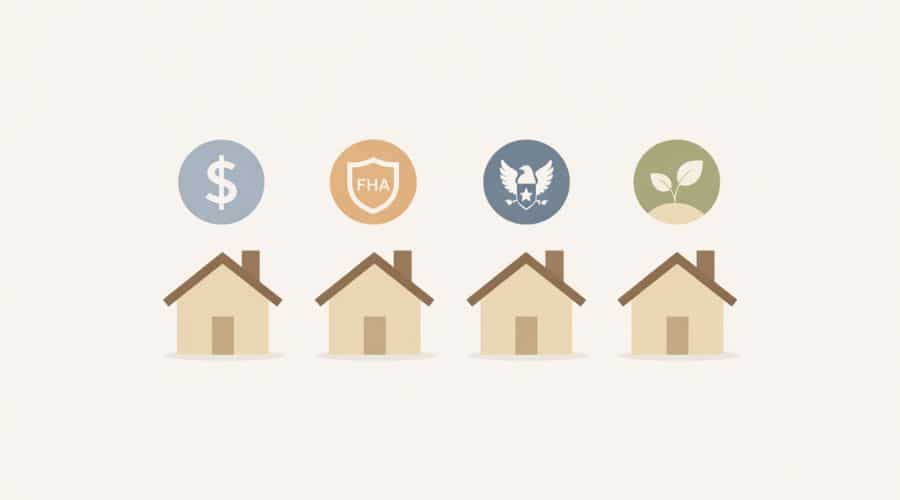
Down payment rules depend primarily on which mortgage program you use, not on a single universal standard. Below are the major U.S. loan types most homebuyers encounter, with their current, widely used minimum down payment requirements based on established federal and secondary-market guidelines.
Conventional Loans
Minimum down payment:
- 3% for qualified borrowers
- 5%–20% is common, depending on financial strength
Conventional loans are not insured or guaranteed by the federal government. Most are backed by Fannie Mae or Freddie Mac, which set standardized underwriting rules used by most lenders. Because these loans are not government-insured, lenders rely more heavily on your credit profile and overall financial strength.
Key points:
- A 3% down payment is typically limited to:
- First-time homebuyers, or
- Borrowers meeting specific income and credit criteria
- Down payments below 20% usually require private mortgage insurance (PMI)
- PMI can be canceled once sufficient equity is reached (subject to rules and lender policies)
Important:
Conventional loans with low down payments usually require strong credit, stable income, and manageable debt.
FHA Loans
Minimum down payment:
- 3.5% with qualifying credit
FHA loans are insured by the Federal Housing Administration and are designed to make homeownership more accessible, particularly for buyers with limited savings or weaker credit profiles.
Key points:
- Credit requirements are generally more flexible than conventional loans
- Mortgage insurance is required regardless of down payment size
- FHA mortgage insurance includes:
- An upfront premium (usually rolled into the loan)
- An annual premium paid monthly
- Mortgage insurance may last for the life of the loan, depending on down payment and loan terms
Critical consideration:
FHA loans often cost more over time than conventional loans for borrowers with strong credit, even though the upfront barrier is lower.
VA Loans
Minimum down payment:
- 0% for eligible borrowers
VA loans are guaranteed by the U.S. Department of Veterans Affairs and are available to eligible:
- Veterans
- Active-duty service members
- Certain surviving spouses
Key points:
- No down payment required
- No monthly mortgage insurance
- A VA funding fee usually applies (with some exemptions)
- Competitive interest rates are common
Note:
Eligibility is based on service history and discharge status, not income level.
USDA Loans
Minimum down payment:
- 0% for eligible properties and borrowers
USDA loans are backed by the U.S. Department of Agriculture and support home purchases in designated rural and some suburban areas.
Key points:
- No down payment required
- Income limits apply
- Property location must meet USDA eligibility criteria
- Annual and upfront guarantee fees apply, but are typically lower than FHA insurance costs
Common misunderstanding:
“Rural” does not always mean remote—many qualifying areas are near suburbs.

Down Payment Comparison Table
Here’s a quick comparison of common U.S. loan types and their minimum down payment requirements:
| Loan Type | Minimum Down Payment | Mortgage Insurance | Who It’s Best For |
|---|---|---|---|
| Conventional | 3% | Required if <20% | Strong credit, flexible options |
| FHA | 3.5% | Always required | Limited savings or lower credit |
| VA | 0% | None | Eligible military borrowers |
| USDA | 0% | Required | Moderate-income buyers in eligible areas |
Why Lenders Care About Down Payments
From a lender’s perspective, a larger down payment:
- Reduces default risk
- Lowers potential losses
- Signals financial discipline
From a borrower’s perspective, it:
- Lowers monthly payments
- Reduces total interest paid
- May avoid mortgage insurance
- Builds immediate equity
However, a larger down payment is not always better if it leaves you short on cash after closing.
How Much Should You Put Down? (There Is No Single Right Number)
The best down payment is not the largest number you can possibly afford. It’s the amount that balances homeownership access, monthly affordability, and financial stability after closing.
This section focuses on decision logic, not rules of thumb.
Who a Lower Down Payment Often Makes Sense For
A lower down payment can be reasonable—even responsible—when certain conditions are present.
You may be a good candidate for a lower down payment if:
- You have stable income and strong job prospects
- Your credit score is solid, even if savings are limited
- You have emergency savings left after closing
- You live in a fast-appreciating housing market
- Waiting to save more would significantly delay buying
Real-life example:
A first-time buyer puts 5% down on a $350,000 home. They keep a six-month emergency fund intact and avoid stretching their budget. Their monthly payment is higher, but their overall financial safety is stronger.
Key warning:
Putting less down is risky if it leaves you house-poor or dependent on unstable income.
Who Should Seriously Consider a Higher Down Payment
A higher down payment is often appropriate when it clearly improves long-term affordability or reduces risk.
You may benefit from putting more down if:
- Your income is variable or commission-based
- You’re close to retirement
- You want to eliminate PMI
- You’re buying at the top of your budget range
- You want lower required monthly payments
Example:
A buyer nearing retirement puts 25% down to reduce monthly obligations and increase cash flow predictability.
The Trade-Off: Cash vs. Monthly Cost
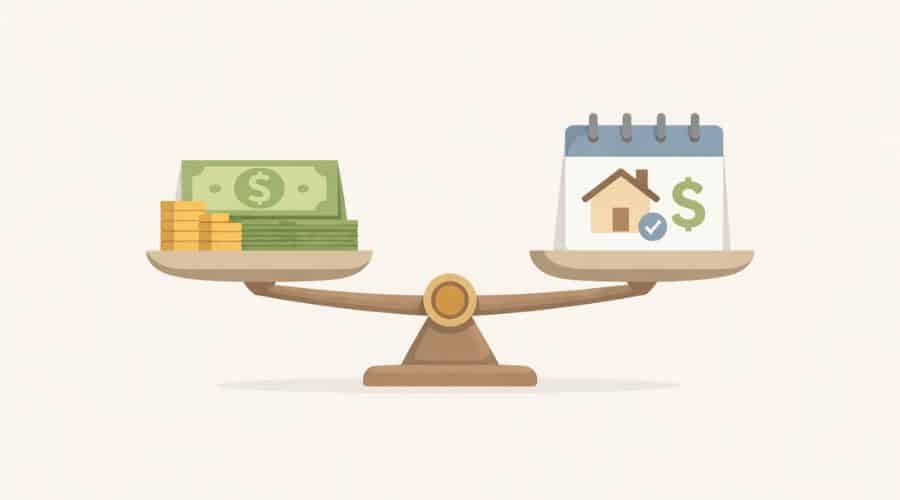
Every dollar you put down does two things:
- Reduces your loan balance
- Removes cash you could otherwise keep accessible
This is a trade-off, not a moral decision.
Common mistake:
Putting every available dollar into the down payment and ignoring post-purchase costs, such as:
- Repairs
- Property taxes
- Insurance increases
- Temporary income disruptions
A home should add stability—not fragility.
Pros & Cons of a Smaller vs. Larger Down Payment
| Down Payment Size | Pros | Cons |
|---|---|---|
| Smaller (0–5%) | Faster entry into homeownership, preserves cash, easier upfront | Higher monthly payment, mortgage insurance, less initial equity |
| Medium (10–15%) | Balanced affordability, lower PMI cost, moderate equity | Still requires insurance in most cases |
| Larger (20%+) | No PMI, lower payments, strong equity position | Ties up cash, higher upfront burden |
Critical takeaway:
Avoid choosing a down payment size solely to “avoid PMI” if doing so weakens your overall financial position.
How Down Payment Size Affects Your Mortgage Long-Term
Down payments influence more than approval.
They affect:
- Total interest paid over time
- Speed of equity growth
- Ability to refinance
- Financial flexibility during emergencies
A smaller down payment does not automatically mean poor financial outcomes—but it does require discipline and planning.
Common Myths vs. Facts
Myth: You must put 20% down to be approved
Fact: Many buyers qualify with 3–5% down
Myth: PMI is always a waste of money
Fact: PMI can be temporary and may allow earlier homeownership
Myth: Bigger down payments always mean better deals
Fact: Liquidity and financial stability matter just as much
Beginner Misunderstandings to Avoid
- Confusing minimum required with financially optimal
- Ignoring closing costs, which are separate from the down payment
- Draining savings to “look stronger” on paper
- Assuming all loan programs work the same way
Mortgage Insurance: What It Is, How Much It Costs, and When It Ends
Mortgage insurance is one of the most misunderstood parts of buying a home—especially for buyers making a smaller down payment. Many people view it as a penalty. In reality, it’s a risk-sharing tool that allows lenders to approve loans with lower upfront cash.
Understanding how it works helps you decide whether a smaller down payment truly costs more—or just costs differently.
What Mortgage Insurance Actually Does
Mortgage insurance protects the lender, not the borrower.
If a borrower defaults, the insurance reduces the lender’s loss.
For borrowers, this trade-off allows:
- Lower down payments
- Earlier access to homeownership
- More flexible qualification standards
There are two main types in the U.S. system:
- Private Mortgage Insurance (PMI) for conventional loans
- Mortgage Insurance Premium (MIP) for FHA loans
Private Mortgage Insurance (PMI) — Conventional Loans
When it applies:
- Required when the down payment is less than 20%
How it’s paid:
- Most commonly as a monthly charge added to the mortgage payment
- Sometimes as:
- Upfront premium
- Lender-paid PMI (built into the interest rate)
Typical cost range:
- Roughly 0.3% to 1.5% of the loan amount per year
- The exact cost depends on:
- Credit score
- Down payment size
- Loan term
- Loan-to-value (LTV) ratio
Important:
PMI is not permanent.
When PMI Can Be Removed
Under federal rules for most conventional mortgages:
- PMI must automatically end once the loan reaches 78% loan-to-value, if payments are current
- Borrowers can often request removal at 80% loan-to-value
- Lenders may require:
- A good payment history
- No second liens
- In some cases, a home value appraisal
Critical takeaway:
PMI is often temporary, not a lifetime cost.
FHA Mortgage Insurance (MIP)
FHA loans use a different system.
Two parts of FHA mortgage insurance:
- Upfront MIP
- Typically financed into the loan
- Annual MIP
- Paid monthly as part of the mortgage payment
Key difference from PMI:
FHA mortgage insurance often cannot be removed unless:
- The loan is refinanced into a non-FHA mortgage, or
- The original down payment was 10% or more (in which case MIP usually lasts 11 years)
For many borrowers, FHA loans are a starting point, not a permanent solution.
Is Mortgage Insurance “Bad”?
Not automatically.
Mortgage insurance can make sense when:
- Home prices are rising faster than your savings
- You have stable income but limited upfront cash
- Waiting would force you to rent much longer
- You plan to refinance once equity improves
It can be a poor choice when:
- Your credit qualifies for a better conventional loan
- You plan to stay in the home long-term with permanent insurance
- The monthly cost strains your budget
PMI vs. MIP Comparison
| Feature | PMI (Conventional) | MIP (FHA) |
|---|---|---|
| Required with low down payment | Yes | Yes |
| Protects borrower | No | No |
| Monthly cost varies by credit | Yes | Limited |
| Can be removed | Yes | Sometimes / Often No |
| Often temporary | Yes | Often long-term |
Common Mortgage Insurance Mistakes
- Assuming PMI is forever
- Choosing FHA solely for low credit without comparing long-term cost
- Draining savings to avoid PMI instead of protecting liquidity
- Ignoring refinance possibilities
Important warning:
Avoid decisions based on emotion (“I hate PMI”) rather than total financial impact.
How Mortgage Insurance Affects Long-Term Finances
Mortgage insurance increases monthly payments—but it can also:
- Allow earlier equity building
- Reduce years spent renting
- Create refinance opportunities later
The real risk is not PMI itself—it’s overstretching your budget.
Closing Costs and Cash-to-Close: The Money Buyers Often Miss
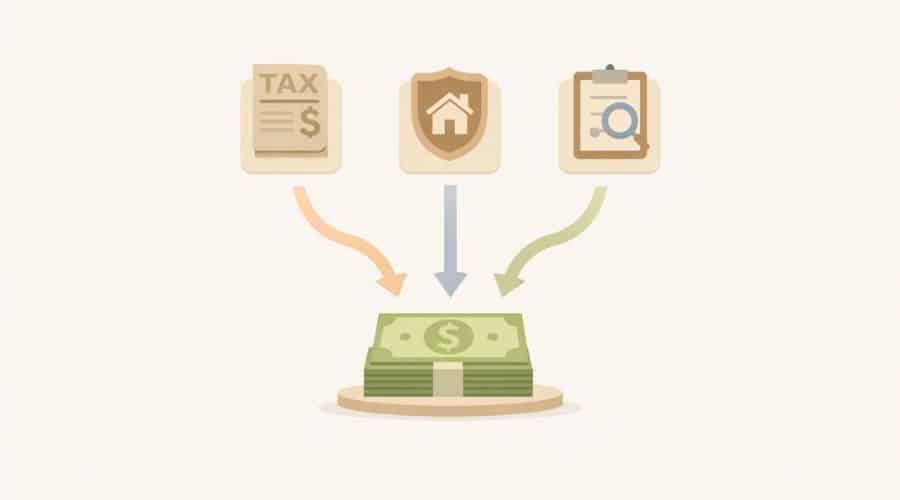
Many buyers focus so much on the down payment that they overlook the total cash required at closing. This gap is one of the most common reasons home purchases fall apart late in the process.
Your down payment is only one piece of what you need.
What Are Closing Costs?
Closing costs are the fees and prepaid expenses required to finalize a mortgage and transfer ownership. In the U.S., they typically range from 2% to 5% of the home’s purchase price, though the exact amount depends on location, loan type, and transaction details.
These costs are separate from your down payment.
Typical Closing Cost Components
While line items vary, most buyers see some combination of the following:
Lender and Loan-Related Costs
- Loan origination or underwriting fees
- Credit report and flood certification fees
- Appraisal fee
- Discount points (if chosen)
Third-Party and Government Fees
- Title search and title insurance
- Attorney or escrow fees (state-dependent)
- Recording and transfer taxes (varies by state and locality)
Prepaid and Escrow Items
- Homeowners insurance premium
- Prepaid interest
- Property taxes placed into escrow
- Mortgage insurance escrows (if applicable)
Important:
Prepaid items are not “junk fees.” They fund expenses you would owe soon after closing anyway.
Cash-to-Close: The Real Number That Matters
Cash-to-close is the total amount of money you must bring to the closing table. It includes:
- Down payment
- Closing costs
- Prepaid items
- Minus any credits (seller concessions, lender credits, earnest money already paid)
This is the number that ultimately determines whether you can complete the purchase.
Example: Why Buyers Get Surprised
A buyer plans for:
- 5% down on a $300,000 home = $15,000
What they didn’t fully account for:
- Closing costs and prepaids = $9,000
Actual cash-to-close: $24,000
That’s a 60% increase over the expected upfront cost.
Can Closing Costs Be Reduced?
Sometimes—but with trade-offs.
Common strategies:
- Seller concessions: The seller pays part of your closing costs (market-dependent)
- Lender credits: Higher interest rate in exchange for lower upfront fees
- State or local assistance programs: Available in some areas, often income-restricted
Critical warning:
Reducing upfront costs often increases long-term interest expense. It’s not free money.
Why Cash Reserves Matter More Than Precision
Lenders may approve a loan with minimal reserves, but approval is not the same as financial readiness.
After closing, homeowners commonly face:
- Immediate repairs
- Higher-than-expected utility bills
- Property tax reassessments
- Insurance adjustments
- Life events that disrupt income
A strong down payment means little if it leaves you without a financial buffer.
Common Beginner Mistakes Around Cash-to-Close
- Planning only for the down payment
- Assuming online calculators include all costs
- Using emergency savings to close
- Confusing lender estimates with final numbers
Key takeaway:
The safest home purchases protect both ownership and liquidity.
Down Payment Assistance Programs: Help or Hidden Trade-Off?
Down payment assistance (DPA) programs can make homeownership possible for buyers who are otherwise financially ready but short on upfront cash. At the same time, these programs come with rules, restrictions, and long-term considerations that are often misunderstood.
Used carefully, assistance can be helpful. Used blindly, it can create problems later.
What Down Payment Assistance Really Is
Down payment assistance programs provide funds to cover part of:
- The down payment
- Closing costs
- Or both
Assistance typically comes from:
- State housing finance agencies
- County or city housing programs
- Nonprofit housing organizations
These programs are often overseen or influenced by agencies such as the U.S. Department of Housing and Urban Development, but they are administered locally. Rules vary widely by state, county, and even city.
Common Types of Down Payment Assistance
Grants
- Do not need to be repaid
- Often require owner-occupancy for a set number of years
- May have income or purchase price limits
Deferred-Payment Loans
- No monthly payments
- Repaid when you sell, refinance, or pay off the mortgage
Forgivable Loans
- Balance is gradually forgiven over time
- If you move or refinance early, repayment may be required
Matched Savings Programs
- Your savings are matched by the program
- Often paired with homebuyer education requirements
Typical Eligibility Requirements
While details vary, many programs require:
- First-time homebuyer status (usually not owning a home in the past three years)
- Income below a set threshold
- Completion of a HUD-approved homebuyer education course
- Purchase of a primary residence
- Use of approved lenders or loan products
Important:
Eligibility is not just about income. Property location and price often matter just as much.
The Trade-Offs Buyers Often Miss
Down payment assistance is not free in every sense.
Potential downsides include:
- Higher interest rates
- Limited lender options
- Restrictions on refinancing
- Repayment obligations if you sell early
- Additional liens on the property
Critical warning:
Some buyers qualify for better long-term terms without assistance, but never compare both options.
When Down Payment Assistance Makes Sense
Assistance can be reasonable when:
- You have stable income and low debt
- Your savings gap is the only obstacle
- You plan to stay in the home long enough to meet occupancy rules
- The assistance does not materially worsen loan terms
When to Be Cautious
Be careful if:
- Assistance pushes you into a higher-rate loan
- You don’t fully understand repayment triggers
- You may relocate within a few years
- You are using assistance to stretch beyond your budget
Common Misunderstandings
- “It’s free money” (sometimes, but often conditional)
- “Everyone qualifies” (most buyers do not)
- “It doesn’t affect refinancing” (it often does)
- “It’s always better than saving longer” (not always)
How to Evaluate a DPA Program Responsibly
Before accepting assistance, compare:
- Monthly payment with and without assistance
- Total interest over time
- Repayment obligations
- Exit scenarios (selling, refinancing, job relocation)
Numbers matter more than marketing.
How Your Down Payment Affects Credit, Debt Ratios, and Future Flexibility
A down payment doesn’t just help you buy a home. It shapes how your mortgage fits into your broader financial life—especially your credit profile, debt-to-income ratio, and options later on.
This section focuses on the longer-term mechanics many buyers don’t consider at the start.
Impact on Credit Approval and Credit Health
Your down payment itself does not directly affect your credit score. Credit bureaus do not score how much cash you put down.
What it does affect is:
- The loan size
- The monthly payment
- The risk profile lenders evaluate during underwriting
A smaller down payment can still be approved with strong credit, but it often requires:
- Higher minimum credit scores
- Cleaner payment history
- Lower existing debt
Once the loan is active, your credit score is influenced by:
- On-time payments
- Credit utilization on other accounts
- Overall debt load—not the original down payment size
Debt-to-Income Ratio (DTI): The Hidden Constraint
Debt-to-income ratio (DTI) compares your monthly debt obligations to your gross monthly income. It is one of the most important approval metrics in U.S. mortgage lending.
A lower down payment usually means:
- A larger loan
- A higher monthly payment
- A higher DTI
This matters because:
- High DTI limits future borrowing
- It can reduce refinance eligibility
- It affects approval for other credit (auto loans, personal loans)
Key warning:
Being approved at the maximum DTI limit does not mean the payment is comfortable.
Refinancing: Why Down Payment Size Still Matters Later
Refinancing typically requires sufficient home equity.
A larger down payment can:
- Help you reach refinance thresholds sooner
- Allow you to remove PMI earlier
- Improve access to better interest rates
A smaller down payment can still refinance—but often requires:
- Time
- Market appreciation
- Principal reduction through payments
Important:
Market declines can delay refinancing for buyers who start with very low equity.
Selling or Moving: Flexibility vs. Friction
Your down payment affects how easily you can sell without bringing cash to the table.
With more equity, you’re better positioned to:
- Cover selling costs
- Handle short ownership periods
- Relocate for work or family reasons
With minimal equity, selling too soon can create:
- Break-even scenarios
- Out-of-pocket losses
- Delayed mobility
This does not make low down payments “wrong”—it means they work best with longer time horizons.
Emergency Resilience Matters More Than Percentages
Financial stress usually comes from:
- Income disruption
- Unexpected expenses
- Medical or family emergencies
Not from the down payment percentage itself.
A buyer who puts 5% down and keeps strong reserves may be safer than one who puts 20% down and drains savings.
Critical takeaway:
Liquidity protects households. Equity alone does not pay bills.
Common Long-Term Mistakes
- Assuming approval equals affordability
- Ignoring how DTI limits future options
- Overestimating home appreciation
- Treating down payment decisions as permanent
Mortgage choices should support life changes, not restrict them.
Down Payment Myths vs. Facts (What Actually Holds Up in the U.S.)
Down payment advice is filled with oversimplifications. Many of these ideas sound reasonable but don’t reflect how U.S. mortgages actually work in practice. Clearing these up helps buyers make decisions based on evidence, not folklore.
Myth 1: You must put 20% down to buy a home
Fact:
Most U.S. buyers do not put 20% down.
Conventional loans allow as little as 3%, and government-backed loans can require 0%–3.5%. The 20% figure is a financial threshold—not a legal or approval requirement.
Myth 2: Mortgage insurance is always a waste of money
Fact:
Mortgage insurance can be temporary and sometimes enables buyers to enter the market years earlier.
The real question is whether the total cost fits your budget and long-term plan—not whether insurance exists at all.
Myth 3: A bigger down payment guarantees a better interest rate
Fact:
Interest rates are driven primarily by:
- Credit score
- Market conditions
- Loan type
- Loan term
Down payment size can help in some cases, but it is not the dominant factor.
Myth 4: Using down payment assistance means you’re not ready
Fact:
Many financially responsible buyers use assistance due to:
- Rising home prices
- Student loan debt
- Regional affordability challenges
The risk lies in misunderstanding the terms, not in using assistance itself.
Myth 5: Renting is always throwing money away
Fact:
Renting can be financially appropriate when:
- Ownership costs exceed rent by a wide margin
- Job stability is uncertain
- You plan to move soon
Down payment timing should align with life stability, not pressure.
Common Internet Advice That Deserves Caution
- “Always put down the minimum”
- “Always avoid PMI at all costs”
- “Wait until prices fall”
- “Buy as soon as you’re approved”
Each of these statements can be right—or harmful—depending on context.
What Actually Matters More Than the Percentage
Instead of focusing on a single number, responsible buyers evaluate:
- Payment comfort under stress
- Emergency savings after closing
- Job and income stability
- Time horizon in the home
- Ability to adapt if conditions change
Practical Reality Check
If two buyers purchase identical homes:
- One puts 5% down with strong reserves
- One puts 20% down with no buffer
The first buyer may be financially safer, despite higher monthly costs.
Step-by-Step: How to Decide Your Down Payment Amount Responsibly
At this point, the goal is not to chase a percentage. The goal is to arrive at a number that supports sustainable homeownership in your real financial life.
This step-by-step framework reflects how experienced housing counselors and cautious lenders think about the decision.
Step 1: Start With Post-Closing Safety, Not the Down Payment
Before choosing any down payment amount, answer one question honestly:
How much cash do I need after closing to feel financially stable?
This usually includes:
- An emergency fund (often 3–6 months of essential expenses)
- Immediate home-related costs (repairs, furnishings, moving)
- A buffer for income disruption or unexpected expenses
Rule of discipline (not a rule of law):
If a larger down payment forces you to eliminate your safety net, it’s too large.
Step 2: Calculate a Comfortable Monthly Payment (Not the Maximum)
Ignore what a lender says you can afford. Focus on what you can afford without stress.
Include:
- Principal and interest
- Property taxes
- Homeowners insurance
- Mortgage insurance (if applicable)
- HOA dues (if applicable)
Then ask:
- Could I still pay this if income dropped temporarily?
- Would this payment limit saving for retirement or emergencies?
Your down payment should support a comfortable payment, not push you to the edge. You can use our mortgage loan calculator to see how different down payment amounts affect your monthly payment.
Step 3: Compare Multiple Down Payment Scenarios
Instead of choosing blindly, compare at least three scenarios:
- Minimum allowed
- Mid-range option
- Higher down payment
For each, evaluate:
- Monthly payment difference
- Mortgage insurance cost
- Cash remaining after closing
- Break-even timeline
This comparison often reveals that a middle-ground option provides the best balance.
Step 4: Evaluate How Long You Expect to Stay
Time horizon matters.
- Short-term ownership (under ~5 years):
- Higher equity can reduce exit risk
- Very low down payments increase break-even pressure
- Long-term ownership:
- Smaller down payments can work if payments are manageable
- Equity builds over time through payments and appreciation
There is no universal cutoff—but very short ownership periods and very low equity are a risky combination.
Step 5: Consider Future Flexibility
Ask yourself:
- Might I refinance later?
- Could I need to move for work or family?
- Will other financial goals compete for cash?
A down payment should expand future options, not lock you in.
Step 6: Stress-Test the Decision
Before finalizing:
- Increase the payment mentally by 10–15%
- Assume a temporary income disruption
- Imagine an unexpected repair within the first year
If the plan still feels manageable, the down payment amount is likely reasonable.
What This Process Avoids
This approach helps you avoid:
- Emotional decisions driven by “rules”
- Draining savings to hit a round number
- Approval-based thinking instead of affordability-based thinking
- Regret after closing
Real-Life U.S. Buyer Scenarios: How Down Payment Decisions Differ

Down payment choices are best understood in context. Below are realistic U.S.-based scenarios that show how different households arrive at very different—but still responsible—decisions.
These are not recommendations. They illustrate trade-offs.
Scenario 1: First-Time Buyer With Stable Income, Limited Savings
Profile
- Mid-30s professional
- Stable W-2 income
- Strong credit
- Limited liquid savings due to rent and student loans
Decision
- 5% down on a conventional loan
- Keeps emergency savings intact
- Accepts temporary PMI
Why it works
- Monthly payment fits comfortably
- PMI is removable
- Waiting longer risks higher prices
Risk to monitor
- Must maintain savings discipline after purchase
Scenario 2: Military Household Using a VA Loan
Profile
- Eligible service member
- Stable income
- Relocation possible in future years
Decision
- 0% down VA loan
- No monthly mortgage insurance
Why it works
- Preserves liquidity
- Competitive interest rate
- Designed specifically for this borrower type
Risk to monitor
- Selling within a short timeframe can still involve transaction costs
Scenario 3: Buyer With Irregular Income
Profile
- Self-employed or commission-based
- Strong earnings but variable cash flow
- Moderate savings
Decision
- 20–25% down
- Lower monthly obligation
Why it works
- Reduces payment stress during low-income periods
- Improves approval and long-term cash flow stability
Risk to monitor
- Avoid depleting all reserves
Scenario 4: Buyer Using Down Payment Assistance
Profile
- Moderate income
- Limited savings
- First-time buyer
Decision
- Uses a local assistance program
- Smaller personal cash contribution
Why it works
- Ownership becomes possible sooner
- Assistance terms align with long-term plans
Risk to monitor
- Repayment triggers if refinancing or selling early
Scenario 5: High-Savings, Low-Risk Buyer
Profile
- High savings
- Conservative financial outlook
- Long-term homeowner
Decision
- 30%+ down
- Minimal monthly obligation
Why it works
- High confidence in long-term stability
- Cash remains sufficient even after closing
Risk to monitor
- Opportunity cost of tying up large sums in home equity
What These Scenarios Show
- Responsible down payments vary widely
- The same percentage can be smart for one buyer and risky for another
- Context always matters more than rules
Tax and Legal Considerations: What Down Payments Do (and Do Not) Affect
Down payments feel like a major financial event, so it’s natural to assume they come with tax advantages or legal consequences. In reality, most of the tax and legal impact comes from the mortgage and ownership itself, not from how much you put down.
This section clears up common confusion.
Do Down Payments Provide Any Tax Deduction?
No.
Your down payment is not tax-deductible.
The Internal Revenue Service treats a down payment as a capital investment in your home, not as an expense.
What may be deductible (subject to current tax law and personal circumstances):
- Mortgage interest (within IRS limits)
- State and local property taxes (subject to the SALT cap)
The amount you put down does not change eligibility for these deductions.
Does a Larger Down Payment Reduce Property Taxes?
No.
Property taxes are based on:
- Assessed home value
- Local tax rates
They are not influenced by:
- Loan size
- Down payment percentage
- Mortgage type
A buyer who puts 3% down and a buyer who puts 30% down on the same home typically owe the same property taxes.
Legal Ownership Is the Same Regardless of Down Payment
Once the transaction closes:
- You own the home
- The lender has a lien until the mortgage is paid off
Ownership rights do not change based on:
- Down payment size
- Mortgage insurance presence
- Loan program used
A 0% down VA buyer and a 25% down conventional buyer have the same legal ownership protections under state property law.
Down Payments and Capital Gains When You Sell
Your down payment becomes part of your cost basis in the home.
This matters when calculating capital gains if you sell for a profit.
- Purchase price
- Certain closing costs
- Capital improvements
- Down payment amount
All factor into basis calculations.
However, many homeowners qualify for the primary residence capital gains exclusion, which often eliminates federal capital gains tax entirely if ownership and occupancy requirements are met.
Important:
The exclusion is based on use and duration, not on how much you put down.
State-Level Considerations
Some state or local programs may:
- Require minimum buyer contributions
- Impose recapture taxes if assistance rules are violated
- Place liens related to assistance programs
These are program-specific, not inherent to down payments themselves.
Always review state and local program terms carefully.
What Down Payments Do Not Affect (Common Misbeliefs)
Down payments do not:
- Change your tax filing status
- Automatically improve tax deductions
- Reduce homeowner insurance premiums
- Create immediate tax refunds
Legal and Tax Mistakes to Avoid
- Assuming upfront cash is tax-deductible
- Ignoring assistance program repayment clauses
- Confusing mortgage insurance with tax insurance
- Making down payment decisions for tax reasons alone
Key takeaway:
Down payment decisions should be driven by cash flow, risk tolerance, and stability—not tax myths.

Frequently Asked Questions About Mortgage Down Payments (U.S.)
Below are real questions Americans commonly search for when trying to understand mortgage down payments. Each answer reflects current U.S. lending practices and avoids one-size-fits-all assumptions.
-
How much do most Americans actually put down on a house?
Most buyers put less than 20% down. Many first-time buyers use 3%–5%, while repeat buyers often put more depending on equity and savings. The idea that most people put 20% down does not reflect modern U.S. mortgage data or lending standards.
-
Is it better to wait and save a bigger down payment?
It depends.
Waiting can make sense if:
– Your income is unstable
– Your budget is tight
– You need more savings for safetyWaiting can hurt if:
– Home prices are rising faster than you can save
– Rent is consuming most of your income
– You are financially stable but blocked by a single percentage goalThe decision should be based on financial readiness, not time alone.
-
Can I buy a house with no money down?
Yes, in some cases.
– VA loans and USDA loans allow 0% down for eligible borrowers
– Closing costs still apply
– Income, credit, and property requirements must be met“No down payment” does not mean “no money needed.”
-
Does a low down payment mean I’ll pay more interest overall?
Often, yes—but not always significantly.
A lower down payment usually means:
– A larger loan balance
– Higher total interest over timeHowever, refinancing, early principal payments, or appreciation can change the outcome. The difference should be evaluated in dollars, not assumptions.
Using a mortgage loan calculator can help you compare total interest costs across different down payment scenarios.
-
Is PMI always bad financially?
No.
PMI can be reasonable when it:
– Enables earlier homeownership
– Is temporary
– Does not strain monthly cash flowIt becomes problematic when:
– It is permanent
– It prevents saving or paying other obligations
– It replaces a better loan option -
Can gift money be used for a down payment?
Yes, most loan programs allow gift funds.
Typically required:
– A signed gift letter
– Proof of transfer
– Documentation showing the funds are not a loanRules vary by loan type and lender.
-
Does my down payment affect my mortgage interest rate?
Sometimes, but it is not the main factor.
Interest rates are driven primarily by:
– Credit score
– Market conditions
– Loan type and termDown payment size can help at certain thresholds, but it does not override weak credit or market rates.
-
What happens if I put too little down and home prices fall?
This can create negative equity, where the loan balance exceeds the home’s value.
Risks include:
– Difficulty refinancing
– Limited ability to sell without cash
– Reduced flexibilityThis risk matters most for buyers who may need to move within a short time frame.
-
Should I drain my savings to avoid mortgage insurance?
Usually no.
Maintaining liquid emergency savings is often more important than eliminating PMI. Equity cannot pay bills during income disruption.
-
Can down payment assistance hurt me later?
It can, depending on the terms.
Potential issues include:
– Repayment requirements
– Refinancing restrictions
– Higher interest ratesAlways evaluate assistance against a non-assisted option.
-
Is there a “safe” minimum down payment?
There is no universal safe number.
Safety comes from:
– Stable income
– Manageable payments
– Emergency reserves
– Reasonable expectationsPercentages alone do not create financial security.

Final Thoughts
A mortgage down payment is not a test of discipline or worthiness. It is a financial tool, and like all tools, it works best when matched to the situation.
The most responsible down payment:
- Supports long-term stability
- Preserves flexibility
- Aligns with your real financial life
Avoid decisions driven by myths, pressure, or arbitrary benchmarks.
Disclaimer
This content is provided for educational and informational purposes only. It does not constitute financial, legal, or tax advice. Mortgage rules, loan eligibility, tax laws, and financial outcomes vary based on individual circumstances, lender policies, and state or federal regulations. Readers should consult a qualified financial advisor, tax professional, housing counselor, or mortgage professional before making personal financial decisions.
