
Key Takeaways
- Private Mortgage Insurance (PMI) is an added monthly cost most conventional mortgage borrowers must pay when their down payment is less than 20%.
- PMI protects the lender — not the homeowner — if the loan goes into default.
- The cost of PMI can range from about 0.2% to 2% of the loan balance per year, depending on credit score and loan details.
- PMI is not permanent on most conventional loans and can often be removed once enough home equity is reached.
- There are legal rules under federal law that govern when and how PMI must be canceled.
Many homebuyers in the U.S. are shocked to learn that their monthly mortgage payment includes an extra cost that doesn’t protect them at all.
That cost is Private Mortgage Insurance (PMI).
If you’re buying a home with less than 20% down, understanding what PMI is, why it exists, and how to avoid or remove it can save you thousands of dollars over the life of your loan.
Why PMI Confuses So Many Homebuyers

Many Americans are surprised by PMI because it often shows up after they think they understand their mortgage payment.
A lender quotes a rate. The home price looks affordable. The monthly payment seems manageable. Then PMI appears — adding anywhere from $50 to several hundred dollars per month — and suddenly the numbers feel tighter than expected. For many buyers, this extra cost is never clearly explained during the early stages of the loan process.
The confusion usually comes from one simple fact: PMI has nothing to do with protecting you.
It exists because the lender is taking on more risk when a buyer puts less money down.
Understanding how PMI works — and how to legally avoid or remove it — can save homeowners thousands of dollars over the life of a loan.
What Is PMI (Private Mortgage Insurance)?

Plain-English Definition
Private Mortgage Insurance (PMI) is an insurance policy required by most lenders when a borrower uses a conventional mortgage and puts down less than 20% of the home’s purchase price.
If the borrower stops making payments and the loan goes into foreclosure, PMI helps the lender recover part of the loss.
It does not:
- Reduce your loan balance
- Lower your interest rate
- Protect your personal finances
Its only purpose is to reduce the lender’s risk.
When PMI Is Required
PMI typically applies when:
These conditions are standard across most conventional mortgage lenders.
- The mortgage is a conventional loan (not FHA, VA, or USDA)
- The loan-to-value (LTV) ratio is above 80%
- The borrower makes a down payment below 20%
Example
If you buy a $300,000 home and put down $15,000 (5%):
- Loan amount: $285,000
- LTV: 95%
- PMI: Required
PMI vs Other Mortgage Insurance (Important Distinction)
Many people use “PMI” to describe all mortgage insurance, but legally and practically, that’s incorrect. The table below shows how PMI differs from other types of mortgage insurance used in the U.S.
| Loan Type | Insurance Name | Who Pays | Can It Be Removed? |
|---|---|---|---|
| Conventional | PMI | Borrower | Yes (under federal law) |
| FHA | Mortgage Insurance Premium (MIP) | Borrower | Sometimes / often permanent |
| VA | VA Funding Fee | Borrower (usually) | One-time fee |
| USDA | USDA Guarantee Fee | Borrower | Usually for life of loan |
This article focuses only on PMI for conventional mortgages.
How PMI Is Paid
PMI is most commonly paid as:
- Monthly premium added to the mortgage payment
Less common options (availability varies by lender):
- Single upfront premium
- Split premium (part upfront, part monthly)
- Lender-paid PMI (higher interest rate instead of monthly PMI)
Each option has different long-term cost implications, which will be covered later.
How Much PMI Costs (Typical Ranges)
PMI costs depend on several factors:
- Credit score
- Down payment amount
- Loan term
- Loan size
- PMI provider risk models
Typical annual PMI cost (most recent widely cited ranges):
| Credit Profile | Approx. Annual PMI Cost |
|---|---|
| Excellent credit | ~0.2% – 0.5% of loan |
| Average credit | ~0.5% – 1.0% |
| Lower credit | ~1.0% – 2.0% |
Important: These figures are based on industry-reported ranges from recent years. Exact rates vary by lender and insurer.
How PMI Works in the U.S. Mortgage System
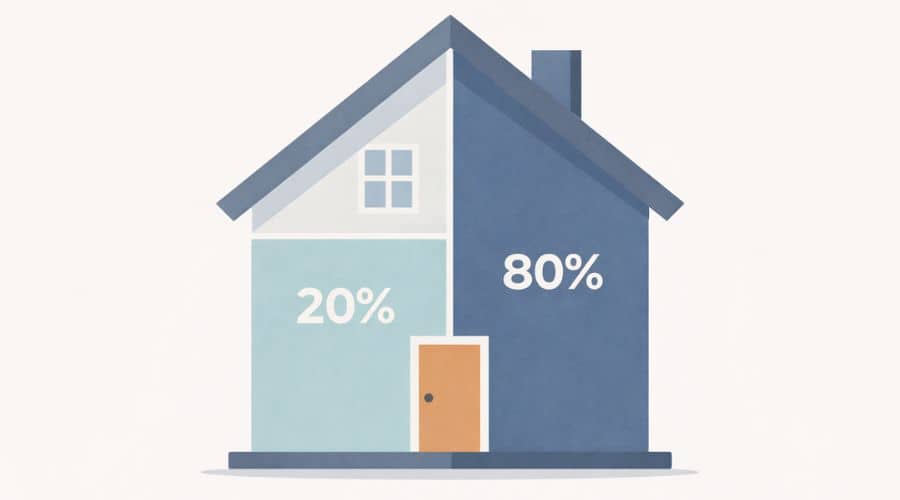
PMI is not arbitrary. It operates under a defined framework used by U.S. lenders, mortgage insurers, and federal consumer protection laws. Understanding this system helps explain when PMI applies, how long it lasts, and when it must legally end.
What Triggers PMI: Loan-to-Value (LTV) Ratio
What LTV Means in Real Terms
Loan-to-value (LTV) compares how much you borrow to how much the home is worth at the time of purchase or appraisal.LTV=Home ValueLoan Amount
- 80% LTV or lower → No PMI required
- Above 80% LTV → PMI usually required
Example
- Home price: $250,000
- Down payment: $25,000 (10%)
- Loan: $225,000
- LTV: 90%
- PMI: Required
Lenders rely on LTV because borrowers with less equity are more likely to default, especially during financial stress or falling home prices.
Who Sets PMI Rules?
PMI exists at the intersection of private insurance markets and federal consumer protections.
Key Parties Involved
- Mortgage lenders decide when PMI is required
- Private mortgage insurers price the risk
- Federal law regulates disclosure and cancellation rights
The most important federal law governing PMI is the Homeowners Protection Act (HPA) of 1998.
The Homeowners Protection Act (HPA): Your Legal Rights
What the HPA Does
The Homeowners Protection Act of 1998 sets national rules for:
- PMI disclosure
- Automatic PMI termination
- Borrower-requested PMI cancellation
These rules apply to most conventional mortgages originated after July 29, 1999.
Automatic PMI Cancellation (Mandatory)
Under federal law, PMI must automatically end when:
- The loan balance reaches 78% of the original home value
- The borrower is current on payments
This happens even if the homeowner does nothing. As long as payments are current, lenders are required to remove PMI automatically.
Borrower-Requested PMI Cancellation
Homeowners can request PMI removal earlier, usually when:
- The loan reaches 80% LTV
- The borrower has a good payment history
- The property has not declined in value
- Additional conditions set by the lender are met
Lenders may require:
- A written request
- Proof of property value
- An appraisal (borrower-paid)
PMI Disclosure Requirements
By law, lenders must provide:
- PMI cost disclosure at closing
- Annual PMI statements
- Clear explanation of cancellation rights
If a lender fails to follow HPA rules, borrowers can file complaints with federal regulators.
PMI and Your Monthly Mortgage Payment
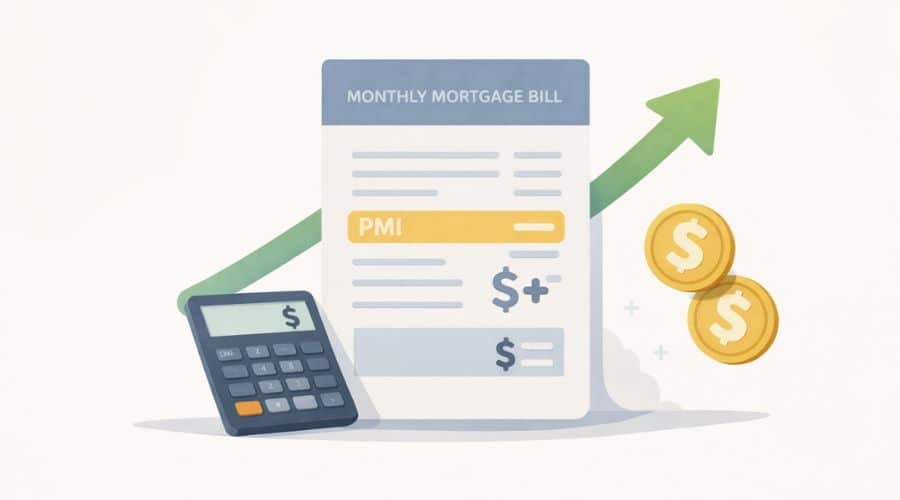
PMI directly increases the total housing cost, even though it does not reduce debt.
Example: Monthly Payment Impact
The example below shows how PMI increases the total monthly housing cost.
| Item | Without PMI | With PMI |
|---|---|---|
| Principal & Interest | $1,450 | $1,450 |
| Property Taxes | $300 | $300 |
| Homeowners Insurance | $100 | $100 |
| PMI | — | $140 |
| Total Monthly Payment | $1,850 | $1,990 |
Over five years, that $140 per month equals $8,400 — money that builds no equity. To see how PMI changes your own monthly payment and total loan cost, you can use our mortgage loan calculator.
PMI Is Risk-Based, Not Flat-Rate
Two borrowers buying identical homes can pay very different PMI amounts.
Key pricing factors include:
- Credit score (major driver)
- Down payment size
- Loan term (15 vs 30 years)
- Fixed vs adjustable rate
- Debt-to-income ratio (DTI)
This is why improving credit before applying for a mortgage can significantly reduce PMI costs.
PMI Does Not Affect Your Credit Score (Directly)
Paying PMI:
- Does not improve your credit score
- Does not harm your credit score
However:
- Missing mortgage payments (which include PMI) will damage credit
- Higher monthly payments can indirectly increase financial strain
Who PMI Is For — and Who Should Avoid It
PMI is not automatically “good” or “bad.” In some situations, it helps people become homeowners years earlier. In others, it adds unnecessary cost with little benefit.
The key is knowing when PMI makes sense — and when it doesn’t.
Who PMI Can Make Sense For
First-Time Homebuyers Without Large Savings
Many first-time buyers can afford monthly payments but struggle to save a full 20% down payment, especially in higher-cost housing markets. This is particularly common in major metro areas where home prices outpace wage growth.
PMI can be reasonable when:
- Home prices are rising faster than savings
- Rent is comparable to or higher than a mortgage payment
- The buyer plans to stay long enough to reach PMI removal thresholds
Example
A buyer with strong income and stable employment puts 5% down, pays PMI for a few years, and removes it after building equity through payments and appreciation.
Buyers With Strong Credit but Limited Cash
PMI pricing strongly favors borrowers with higher credit scores.
Borrowers with excellent credit often pay:
- Significantly lower PMI rates
- PMI that is removed sooner due to faster principal reduction
In these cases, PMI may cost less than delaying homeownership for several years.
Buyers Expecting Rising Income
PMI can be more tolerable when:
- Income is expected to increase
- The buyer plans to refinance or make extra principal payments
- PMI is a short-term cost, not a long-term burden
Who Should Be Cautious About PMI
Buyers With Tight Monthly Budgets
PMI increases the fixed monthly payment.
If a budget already feels stretched:
- PMI reduces flexibility
- Emergency savings may suffer
- Missed payments become more likely
In these cases, PMI can turn an affordable home into a financial strain.
Borrowers With Lower Credit Scores
Lower credit scores often mean:
- Higher interest rates
- Higher PMI premiums
- Slower equity growth
This combination can significantly raise total housing costs.
Short-Term Homeowners
If a buyer expects to sell within a few years:
- PMI costs may never be recovered
- Equity gains may not offset insurance payments
PMI is most efficient when the borrower stays long enough to remove it.
PMI vs Waiting for a 20% Down Payment
This decision is common — and highly personal.
Trade-Off Comparison
The comparison below highlights the most common trade-offs buyers face.
| Option | Advantage | Risk |
|---|---|---|
| Buy now with PMI | Enter market sooner | Higher monthly cost |
| Wait for 20% down | No PMI | Risk of rising home prices |
| Smaller home + no PMI | Lower cost | Compromised space/location |
There is no universal “right” choice. The right decision depends on:
- Local housing prices
- Income stability
- Emergency savings
- Time horizon
Common Mistakes Buyers Make With PMI
Assuming PMI Is Permanent
Many borrowers believe PMI lasts for the life of the loan.
For conventional loans, this is usually false.
Federal law requires cancellation under specific conditions.
Confusing PMI With FHA Mortgage Insurance
PMI and FHA mortgage insurance work very differently.
Confusing them can lead to costly loan choice mistakes.
Ignoring PMI When Comparing Loan Offers
Some buyers compare only:
- Interest rate
- Down payment
But a slightly higher rate with no PMI can be cheaper overall than a lower rate with PMI.
Pros and Cons of PMI
PMI is best evaluated as a trade-off, not a benefit. It lowers the upfront barrier to homeownership, but it increases ongoing costs. Seeing both sides clearly helps prevent emotional or rushed decisions.
Advantages of PMI
Allows Earlier Homeownership
The primary advantage of PMI is access.
PMI allows buyers to:
- Purchase with as little as 3%–5% down (depending on loan program)
- Avoid waiting years to save a full 20%
- Lock in housing before potential price increases
For some households, this timing advantage outweighs the added cost. This is especially true in markets where home prices rise faster than incomes.
Preserves Cash for Other Needs
Putting less money down can leave room for:
- Emergency savings
- Home repairs or furnishings
- Moving expenses
- Closing costs
In uncertain economic conditions, liquidity can matter as much as equity.
PMI Is Usually Temporary
Unlike some government-backed mortgage insurance:
- PMI on conventional loans can often be removed
- Federal law sets clear cancellation rules
- Borrowers regain the full benefit of each payment after removal
Disadvantages of PMI
Increases Monthly Housing Cost
PMI adds a recurring expense without reducing debt.
That means:
- Higher monthly obligations
- Less room for savings or investing
- Greater sensitivity to income disruption
Provides No Direct Benefit to the Borrower
PMI does not:
- Lower interest rates
- Build equity
- Protect the homeowner
It exists solely to reduce lender risk.
Cost Varies Widely Based on Credit
Borrowers with lower credit scores often face:
- Significantly higher PMI premiums
- Slower financial recovery from the added cost
In some cases, PMI can approach the cost of a car payment.
PMI Pros and Cons Table
The table below summarizes the key advantages and disadvantages of PMI.
| Aspect | Pros | Cons |
|---|---|---|
| Access to homeownership | Buy with low down payment | Higher monthly cost |
| Cash flexibility | Keep savings available | Less equity upfront |
| Duration | Often removable | Still paid upfront |
| Risk impact | Helps lender approve loan | No borrower protection |
| Cost predictability | Known at closing | Varies by credit profile |
PMI vs Higher Interest Rate (Lender-Paid PMI)
Some lenders offer lender-paid PMI, which removes the monthly PMI line item but raises the interest rate.
Key Trade-Off
| Monthly PMI | Lender-Paid PMI |
|---|---|
| Lower interest rate | Higher interest rate |
| Separate PMI charge | No visible PMI |
| Cancelable | Often not cancelable |
| Flexible long-term | Costly if rates drop |
This option can make sense in limited cases but requires careful math.
How to Avoid PMI Completely (Legal and Practical Options)
Avoiding PMI is not about loopholes or tricks. It comes down to structuring the mortgage differently or choosing loan programs that don’t require it. Each option has trade-offs that should be understood before committing.
Option 1: Make a 20% (or Larger) Down Payment
Why 20% Is the Threshold
At 80% loan-to-value (LTV), lenders consider the loan low enough risk to forgo PMI.
Example
- Home price: $400,000
- Down payment: $80,000 (20%)
- Loan amount: $320,000
- PMI: Not required
Pros
- No PMI from day one
- Lower monthly payment
- Immediate equity cushion
Cons
- Requires substantial savings
- Less cash available for emergencies
- May delay homeownership
Option 2: Use a VA Loan (If Eligible)
How VA Loans Work
VA loans are backed by the U.S. Department of Veterans Affairs and do not require PMI, even with zero down.
Eligibility is limited to:
- Veterans
- Active-duty service members
- Some surviving spouses
Instead of PMI, VA loans use a one-time funding fee (often financed into the loan).
When This Makes Sense
- Eligible borrowers with limited cash
- Long-term homeowners
- Buyers who qualify for favorable VA rates
Option 3: Use a Piggyback Loan (80-10-10 or Similar)
What a Piggyback Loan Is
A piggyback structure uses two loans:
- First mortgage at 80% LTV
- Second loan for part of the down payment
- Small cash down payment
Example (80-10-10)
- 80% first mortgage
- 10% second mortgage (HELOC or home equity loan)
- 10% down payment
Pros
- No PMI
- Faster equity access on first mortgage
Cons
- Higher interest on second loan
- More complex repayment
- Higher overall risk
This strategy requires careful budgeting and lender comparison.
Option 4: Choose Lender-Paid PMI Carefully
While not true “avoidance,” this option removes monthly PMI payments.
Key considerations:
- Higher interest rate
- PMI cost is embedded and harder to remove
- Less flexibility if refinancing later
This option can make sense for borrowers planning to sell or refinance relatively quickly. Because PMI is embedded in the interest rate, it usually cannot be removed later.
Option 5: Buy a Less Expensive Home
Lower home prices mean:
- Lower required down payment
- Faster path to 20% equity
- Lower PMI duration or elimination
This option is often overlooked but can materially improve long-term affordability.
Avoiding PMI vs Removing PMI Later
The table below compares common PMI avoidance and management strategies.
| Strategy | PMI at Start | Long-Term Cost |
|---|---|---|
| 20% down | No | Lowest |
| VA loan | No | Low (funding fee) |
| Piggyback loan | No | Moderate |
| Lender-paid PMI | No monthly | Often higher |
| Standard PMI | Yes | Temporary |
Avoidance is not always optimal. Sometimes short-term PMI is cheaper than long-term alternatives.
How to Remove PMI After You Have It (Step by Step)
For many homeowners, PMI is not permanent. Federal law and lender policies provide clear pathways to remove it, often sooner than people expect. Knowing the correct process matters, because PMI does not always disappear automatically at the earliest possible point unless the borrower takes action.
Two Legal Ways PMI Ends on Conventional Loans
PMI can end in one of two ways:
- Automatic termination (required by law)
- Borrower-requested cancellation (earlier, if conditions are met)
Both are governed by the Homeowners Protection Act. These rules apply only to conventional mortgages.
Method 1: Automatic PMI Termination (No Action Required)
When Automatic Termination Happens
PMI must automatically end when all of the following are true:
- The loan balance reaches 78% of the original home value
- The mortgage is a conventional loan
- The borrower is current on payments
This threshold is based on:
- The original purchase price or appraisal, whichever was used at closing
- Not the home’s current market value
Important Limitations
Automatic termination:
- Does not accelerate due to home appreciation
- Does not consider renovations
- Follows the original amortization schedule unless extra payments are made
If payments are late or missed, termination can be delayed.
Method 2: Borrower-Requested PMI Cancellation (Earlier Removal)
Many homeowners can remove PMI before the 78% point by requesting it.
Standard Requirements (Most Lenders)
While policies vary by lender, most require:
- Loan balance at or below 80% LTV
- Good payment history (often no late payments in the past 12 months)
- No subordinate liens (such as second mortgages)
- Proof that the property value has not declined
When an Appraisal Is Required
If you are relying on:
- Home price appreciation, or
- Significant home improvements
The lender may require a new appraisal, typically paid by the borrower.
Step-by-Step: How to Request PMI Removal
- Check your loan balance
Confirm whether you’ve reached 80% LTV. - Review lender PMI policy
Each lender publishes its own PMI cancellation rules. - Submit a written request
Most lenders require a formal request (online or by mail). - Order an appraisal (if required)
Cost varies by market and lender. - Receive written confirmation
PMI should be removed from future statements once approved.
PMI Removal Based on Appreciation vs Payments
| Removal Method | Faster? | Appraisal Needed? | Risk |
|---|---|---|---|
| Paying down principal | Slower | No | Low |
| Market appreciation | Faster | Often yes | Value may fluctuate |
Both methods are legitimate. The right approach depends on market conditions and cash flow.
How Extra Payments Affect PMI Removal
Extra principal payments can:
- Lower LTV faster
- Trigger earlier PMI cancellation
- Reduce total interest paid
However:
- Extra payments should only be made after emergency savings are secure
- PMI removal alone should not justify financial strain
PMI and Refinancing
Refinancing can remove PMI if:
- The new loan starts at 80% LTV or lower
- Home value has increased
- Sufficient equity has been built
But refinancing involves:
- Closing costs
- New interest rate risk
- Resetting the loan term
PMI removal through refinancing should always be evaluated in the context of total costs.
PMI Myths vs. Facts (Common Beginner Misunderstandings)
PMI is often misunderstood because it sits quietly inside a mortgage payment and isn’t well explained at closing. Clearing up these myths helps homeowners avoid bad assumptions and missed opportunities.
Myth 1: PMI Protects the Homeowner
Fact: PMI protects the lender, not the borrower.
If a foreclosure occurs:
- PMI may reimburse the lender for part of the loss
- The borrower still loses the home
- The borrower may still owe money, depending on state law and loan terms
PMI does not work like homeowners insurance or disability insurance.
Myth 2: PMI Is Required on All Mortgages
Fact: PMI applies mainly to conventional loans with less than 20% down.
PMI is not required for:
- VA loans
- USDA loans
- Conventional loans with 20% or more down
FHA loans use a different insurance system entirely.
Myth 3: PMI Lasts for the Entire Loan Term
Fact: PMI on most conventional loans is temporary.
Under federal law:
- PMI must automatically end at 78% LTV
- Borrowers can often request removal at 80% LTV
This is one of the most financially meaningful differences between PMI and FHA mortgage insurance.
Myth 4: You Must Refinance to Remove PMI
Fact: Refinancing is not required in many cases.
PMI can often be removed:
- Through regular payments
- Through appreciation and a lender-approved appraisal
- Without changing the loan or interest rate
Refinancing is only one option — not the default solution.
Myth 5: PMI Is the Same for Everyone
Fact: PMI pricing is risk-based.
Factors that affect PMI cost include:
- Credit score
- Down payment size
- Loan type
- Loan term
Two borrowers buying the same house can pay very different PMI amounts.
Common Beginner Mistakes With PMI
Ignoring PMI During Budgeting
Many buyers budget only for:
- Principal
- Interest
- Taxes
- Insurance
Leaving out PMI leads to payment shock.
Waiting Too Long to Request PMI Removal
Some homeowners qualify for PMI cancellation but keep paying simply because they never ask.
PMI removal is not always automatic at the earliest eligible point.
Assuming PMI Is Always Bad
PMI can be expensive — but in some cases:
- It enables earlier homeownership
- It costs less than rising home prices
- It can be removed relatively quickly
Context matters.
How PMI Affects Your Long-Term Finances
PMI doesn’t just change a monthly payment. Over time, it influences cash flow, savings behavior, housing equity, and financial flexibility. Understanding these long-term effects helps homeowners make better financial decisions.
PMI’s Impact on Total Housing Cost
PMI increases the true cost of owning a home, even though it does not change the loan balance.
Long-Term Cost Example
- Loan amount: $300,000
- PMI: $120 per month
- PMI duration: 5 years
Total PMI paid:
$120 × 60 months = $7,200 in total PMI payments
That money:
- Does not reduce principal
- Does not earn interest
- Does not build equity
PMI and Opportunity Cost
Every dollar spent on PMI is a dollar not used elsewhere.
Over several years, PMI payments could otherwise go toward:
- Emergency savings
- Retirement contributions
- Paying down higher-interest debt
- Home maintenance or improvements
his doesn’t mean PMI is always a mistake — but it does mean it carries a real trade-off.
Does PMI Affect Your Credit Score?
Direct Impact
PMI itself does not appear on your credit report.
It is not reported as a separate account to credit bureaus.
Indirect Impact
PMI can affect credit indirectly if it contributes to:
- Higher monthly obligations
- Missed or late mortgage payments
- Higher credit utilization elsewhere due to cash strain
Mortgage payment history is one of the most important factors in credit scoring.
PMI and Home Equity Growth
PMI does not slow equity growth mathematically — but it can feel like it does.
Why:
- The payment does not reduce principal
- Homeowners may have less ability to make extra payments
- Cash flow constraints can delay financial progress
Once PMI is removed, every payment dollar works more efficiently for the homeowner.
PMI in Rising vs Declining Housing Markets
Rising Markets
In appreciating markets:
- PMI may be removed sooner
- Appreciation can accelerate equity
- Short PMI periods may be manageable
Flat or Declining Markets
In slower markets:
- PMI may last longer
- Appraisals may not support early removal
- The cost becomes more noticeable over time
Market conditions matter, even though PMI rules are federally defined.
PMI and Financial Stress
Consumer research cited by the Consumer Financial Protection Bureau (CFPB) consistently shows that higher fixed expenses increase financial vulnerability during income disruptions.
PMI adds:
- A fixed monthly obligation
- No built-in flexibility
- No personal protection
This is why PMI should always be evaluated alongside:
- Emergency savings
- Job stability
- Household income variability
When PMI Is a Reasonable Long-Term Trade-Off
PMI can make sense when:
- It enables stable homeownership earlier
- It is temporary and planned for
- The borrower has strong cash reserves
- Removal is realistically achievable
PMI becomes a problem when:
- It stretches the budget
- It lasts longer than expected
- The borrower doesn’t understand removal rules
Frequently Asked Questions About What Is PMI in a Mortgage
These are real questions Americans commonly ask when dealing with PMI during the homebuying or homeownership process.
-
What does PMI stand for in a mortgage?
PMI stands for Private Mortgage Insurance. It is an insurance policy required on most conventional mortgages when the borrower puts down less than 20%. It protects the lender if the borrower defaults.
-
How much is PMI per month on an average mortgage?
PMI typically costs about 0.2% to 2% of the loan balance per year, divided into monthly payments.
For example:
– $250,000 loan
– 0.6% annual PMI
– About $125 per monthThe exact amount depends on credit score, down payment, and loan structure.
-
Can PMI be removed without refinancing?
Yes. For most conventional loans, PMI can be removed without refinancing if:
– The loan reaches 80% LTV and the borrower requests removal, or
– The loan reaches 78% LTV and payments are current (automatic removal)Refinancing is optional, not required.
-
Does PMI go away automatically?
Yes, but only at 78% LTV, based on the original value of the home and the loan’s amortization schedule.
If you want PMI removed earlier, you usually must request it.
-
Is PMI tax-deductible?
PMI deductibility has changed multiple times under federal tax law. The IRS determines whether PMI premiums qualify for a tax deduction in a given tax year.
As of the most recent confirmed IRS guidance, the deduction:
– Has expired in prior years
– Has sometimes been reinstated retroactively by CongressBecause this changes frequently and depends on income limits and filing status, homeowners should:
– Check the latest IRS rules for the applicable tax year
– Consult a qualified tax professional -
Is PMI the same as homeowners insurance?
No. They serve completely different purposes.
– Homeowners insurance protects the home and the homeowner
– PMI protects the lender onlyThey are separate and unrelated policies.
-
Can PMI be removed early if my home value increases?
Often, yes.
Many lenders allow PMI removal if:
– A new appraisal shows the home value increased
– The resulting LTV is 80% or lower
– The borrower meets payment history requirementsAppraisal costs are usually paid by the borrower.
-
Is PMI required if I put down 15%?
In most cases, yes.
PMI is typically required for:
– Any conventional loan with less than 20% down
Some lender-specific programs may vary, but 20% remains the standard threshold.
-
Is lender-paid PMI better than borrower-paid PMI?
Not always.
Lender-paid PMI:
– Removes the monthly PMI line item
– Usually comes with a higher interest rate
– Is often harder or impossible to remove laterIt can make sense for short-term ownership but may cost more over the long term.
Final Thoughts on PMI
PMI is one of the most misunderstood parts of the U.S. mortgage system.
When understood properly:
- It becomes a cost to manage, not a mystery
- It can be planned for, minimized, or eliminated
- It allows informed decisions instead of surprises
The most important factor is not whether PMI exists, but whether the homeowner understands their options and rights.
Disclaimer
This content is provided for educational and informational purposes only.
It is not legal, tax, or financial advice.
Mortgage rules, lender policies, tax laws, and individual financial situations vary.
Readers should consult a qualified mortgage professional, tax advisor, or financial professional before making personal financial decisions.
