
Choosing the right amount of life insurance is one of the most important — and most misunderstood — financial decisions Americans make. Too little coverage can leave families financially exposed, while too much can strain budgets unnecessarily. This guide explains how to think about life insurance coverage in a practical, realistic way based on real-life financial needs, not guesswork or generic rules.
Key Takeaways
- Life insurance is about income replacement and protection, not guessing or following a one-size-fits-all rule.
- The right amount depends on your income, debts, dependents, and future obligations, not just your age.
- Most Americans are underinsured, often because they underestimate long-term costs like child care, education, and surviving spouse income.
- There is no legal requirement for a specific coverage amount, but lenders, family needs, and financial realities often dictate practical minimums.
- Coverage needs change over time and should be revisited after major life events.
Why This Question Matters in Real Life

Many Americans buy life insurance the same way they buy a mattress — quickly, uncomfortably, and with a strong desire to be done with it.
Some people pick a random number.
Others follow advice like “10 times your salary” without knowing where that number came from.
Many assume employer-provided life insurance is enough — and later discover it barely covers funeral costs and short-term bills.
The real risk isn’t buying the “wrong” policy.
It’s leaving behind financial stress for people who depend on your income.
Life insurance exists to protect real lives — spouses trying to keep a home, children who still need food and education, and families suddenly missing a paycheck they relied on. For most families, the cost of getting this decision wrong is felt not immediately, but over many difficult years.
What “How Much Life Insurance” Really Means
It’s Not About You — It’s About Who Depends on You
The amount of life insurance you need is not a measure of personal worth.
It has everything to do with:
- Who relies on your income
- For how long
- And what financial obligations would remain if you were gone
If no one depends on your income, your needs may be minimal.
If others rely on you for years or decades, underestimating coverage can create serious hardship.
How Life Insurance Works in the United States (Brief Context)
Life insurance in the U.S. pays a tax-free death benefit to your beneficiaries in most cases, according to guidance from the Internal Revenue Service.
The money can generally be used for:
- Living expenses
- Mortgage or rent
- Debt repayment
- Childcare and education
- Final expenses
There are no federal laws requiring a specific coverage amount. The responsibility to choose an appropriate amount falls entirely on the policyholder. Because there is no mandated coverage amount, choosing the right level of protection becomes a personal financial responsibility.
The Core Question You’re Really Answering
If my income stopped tomorrow, how much money would my family need to stay financially stable?
That stability usually means:
- Staying in the same home
- Paying normal monthly bills
- Avoiding high-interest debt
- Maintaining basic quality of life
- Covering future obligations already in motion
Life insurance is not meant to create wealth.
It’s meant to buy time and financial breathing room.
The Four Building Blocks of Life Insurance Coverage
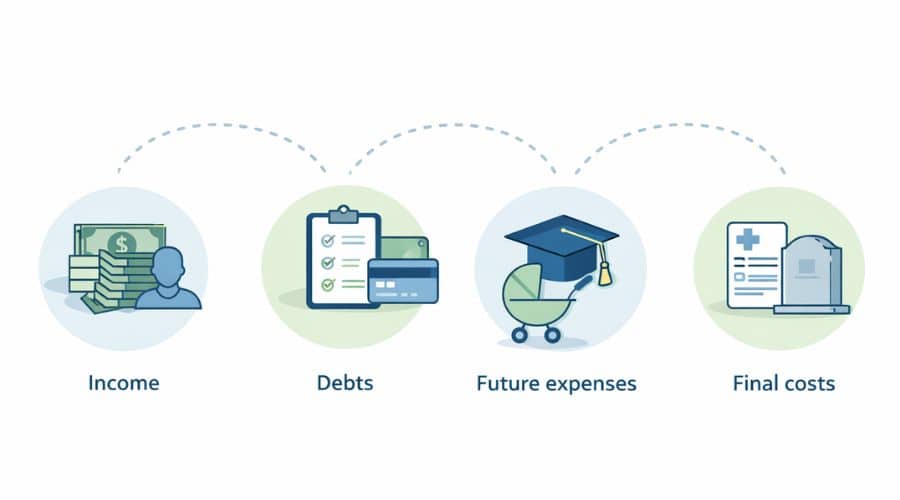
Every responsible life insurance calculation in the U.S. comes down to four core components.
1. Income Replacement
This is usually the largest portion of coverage.
Ask:
- How much income do I contribute each year?
- For how many years would my family need that income?
Many families need 10 to 20 years of income replacement, especially when children are young.
This is why simple rules like “10× salary” exist — but they are starting points, not answers.
2. Outstanding Debts
Life insurance often prevents survivors from having to sell assets or take on new debt.
Common debts include:
- Mortgage or rent obligations
- Auto loans
- Student loans (especially private loans)
- Credit card balances
- Personal loans or business-related debts
Some federal student loans may be discharged at death, but private loans often are not. Terms vary by lender.
3. Future Expenses
These are costs that haven’t happened yet — but almost certainly will.
Examples:
- Childcare
- College or trade school education
- Health insurance gaps
- Ongoing medical needs
- Elder care responsibilities
Ignoring future expenses is one of the most common underinsurance mistakes.
4. Final and Transition Costs
Even financially stable families face immediate expenses after a death.
Typical costs may include:
- Funeral and burial or cremation
- Medical bills not covered by insurance
- Legal and estate settlement expenses
- Short-term living expenses during the transition
According to U.S. consumer data, funeral costs alone often range from $7,000 to $12,000, depending on location and services.
A Simple, Responsible Way to Estimate Coverage

This method avoids guesswork while staying practical.
Step 1: Multiply Your Annual Income
- Choose 10–15 years for households with older children or strong savings
- Choose 15–20 years for households with young children or a non-working spouse
Step 2: Add Major Debts
- Mortgage balance
- Other long-term debts you want fully covered
Step 3: Add Future Obligations
- Estimated education costs
- Childcare or dependent care needs
Step 4: Subtract Existing Resources
- Savings
- Existing life insurance
- Other assets specifically set aside for dependents
The result is not exact — but it is grounded in reality.
Who Needs Life Insurance — and Who May Not

Not everyone needs life insurance at every stage of life. The real question is whether someone else would face financial problems if your income suddenly stopped. Life insurance is not universally necessary. In the U.S., the need for coverage depends less on age and more on financial responsibility to others.
People Who Typically Need Life Insurance
Married or Partnered Households With Shared Income
If your household relies on two incomes to function, life insurance helps ensure the surviving partner can:
- Pay ongoing bills
- Keep the home
- Avoid taking on high-interest debt
- Maintain basic financial stability during a difficult transition
Even when both partners work, the loss of one income can significantly disrupt long-term plans. This is true even when both partners earn similar incomes, because household expenses are rarely designed to be supported by one paycheck alone.
Parents With Dependent Children
Parents almost always need life insurance while children are financially dependent.
Coverage often helps with:
- Daily living expenses
- Childcare costs
- Education and training
- Housing stability
A common misconception is that stay-at-home parents don’t need life insurance. In reality, replacing unpaid labor like childcare, transportation, and household management can be expensive.
Single Parents
Single parents often need higher-than-average coverage because there is no second income to fall back on.
Life insurance may be the primary financial protection for:
- Guardianship arrangements
- Ongoing child support
- Education planning
- Housing continuity
For single parents, life insurance is often the most critical financial safety net available.
Homeowners With a Mortgage
A mortgage does not disappear when someone dies.
Life insurance can prevent:
- Forced home sales
- Foreclosure risk
- Relatives inheriting debt pressure
Some homeowners choose coverage that fully pays off the mortgage, while others aim to replace income so monthly payments remain manageable. The right approach depends on whether the priority is eliminating debt or preserving monthly cash flow.
Anyone With Co-Signed or Private Debt
Certain debts can transfer financial pressure to others, especially when loans are co-signed.
Common examples:
- Private student loans
- Joint personal loans
- Business-related obligations
Loan terms vary by lender, so assumptions can be risky.
People Who May Need Little or No Life Insurance
Single Adults With No Dependents
If no one relies on your income and you have minimal debt, your needs may be limited to:
- Final expenses
- Small outstanding obligations
In these cases, burial or final expense coverage may be sufficient. In these situations, the goal is usually to avoid burdening others rather than replacing long-term income.
Retirees With Independent Adult Children
Many retirees no longer need income replacement.
Life insurance at this stage is often used for:
- Estate planning
- Covering final expenses
- Leaving a specific legacy
Coverage decisions here are more personal and less income-driven.
People With Significant Assets Relative to Needs
If savings, investments, and passive income already cover:
- Living expenses
- Debts
- Future obligations
Then life insurance may serve a smaller, supplemental role. In these cases, insurance decisions are often about convenience and certainty rather than necessity.
Employer-Provided Life Insurance: Why It’s Usually Not Enough
Many Americans rely on workplace life insurance without realizing its limitations, a topic frequently explained by the Consumer Financial Protection Bureau.
Common Employer Coverage Amounts
Most employer plans offer:
- 1× annual salary
- Sometimes up to 2× salary
This coverage is often:
- Free or low-cost
- Easy to enroll in
- Automatically terminated if you leave the job
For most families, this amount covers only short-term expenses, not long-term income replacement.
Key Limitations to Understand
- Coverage is tied to employment
- Amounts are usually capped
- Portability options may be limited or expensive
- Benefits rarely adjust as family needs grow
Employer coverage works best as a supplement, not a primary plan.
Term Life vs. Permanent Life: How Type Affects Amount Needed
The type of policy influences how much coverage is practical and affordable.
Term Life Insurance
Term life provides coverage for a specific period (such as 10, 20, or 30 years).
It is commonly used for:
- Income replacement
- Mortgage protection
- Child-rearing years
Because term life is generally more affordable, it allows many families to carry higher coverage amounts when needs are greatest.
Permanent Life Insurance (Whole, Universal, Variable)
Permanent policies last for life and include a cash value component.
They are often used for:
- Estate planning
- Lifetime dependents
- Specific long-term financial strategies
Due to higher premiums, permanent policies usually provide lower death benefits for the same cost.
Because of higher costs, coverage amounts in permanent policies are usually more conservative and should be evaluated carefully.
Common Rules of Thumb — and Their Limits
You may hear simplified formulas, such as:
- 10× annual income
- 15× annual income
- Income × remaining working years
These rules exist because they’re easy — not because they’re precise.
They ignore:
- Existing savings
- Debt levels
- Childcare costs
- Regional cost-of-living differences
- Spousal earning potential
They can be useful starting points, but they should never be the final answer.
How Much Life Insurance Different Life Stages Typically Require

Life insurance needs are not static. They change as income, family structure, debt, and savings change. Below are realistic, U.S.-based scenarios that reflect how coverage needs usually evolve.
Early Career, No Dependents
Typical profile
- Single
- Renting
- Minimal debt
- No children or dependents
Common needs
- Final expenses
- Small outstanding debts
Typical coverage range
- $25,000–$100,000
At this stage, life insurance is often optional. If coverage is purchased, it’s usually inexpensive term insurance meant to avoid burdening family members with end-of-life costs. This type of coverage is mainly about avoiding financial burden on parents or relatives.
Married or Partnered, No Children
Typical profile
- Shared living expenses
- Joint lease or mortgage
- Dual income household
Common needs
- Temporary income replacement
- Debt coverage
- Housing stability
Typical coverage range
- $250,000–$750,000 per person
Even without children, losing one income can force major lifestyle changes. Coverage here often focuses on buying time, not permanent support. The goal here is usually temporary stability, not lifetime income replacement.
Families With Young Children
Typical profile
- One or more children under 18
- Mortgage or long-term rent
- Childcare and education expenses
- One income may dominate household earnings
Common needs
- Long-term income replacement
- Childcare and education funding
- Mortgage protection
- Health insurance continuity
Typical coverage range
- $500,000–$2,000,000+
This is where underinsurance is most common. Families often underestimate how long support will be needed and how expensive childcare and education can be in the U.S. This is the stage where choosing too little coverage can cause the most long-term damage.
Single Parents
Typical profile
- One income
- Children fully dependent
- Limited backup financial support
Common needs
- Full income replacement
- Guardianship support
- Education and housing security
Typical coverage range
- Often higher than two-parent households with similar income
Single parents typically need more conservative planning because there is no secondary income safety net. Because there is no second income, conservative planning becomes essential.
Mid-Career, Older Children
Typical profile
- Children approaching independence
- Mortgage partially paid
- Higher income and savings
Common needs
- Income replacement for a shorter period
- Remaining debts
- College costs (if not already funded)
Typical coverage range
- Often lower than early family years, but still substantial
This is often a good time to reassess and adjust coverage rather than let old policies run unchanged. This is often a good stage to reduce or restructure coverage rather than automatically increasing it.
Near Retirement or Retired
Typical profile
- Children financially independent
- Mortgage near payoff or paid
- Retirement income in place
Common needs
- Final expenses
- Estate planning
- Spousal support gaps (if any)
Typical coverage range
- Highly individual
- Often much lower than working years
At this stage, life insurance is less about income replacement and more about financial cleanup and certainty. At this stage, certainty and simplicity usually matter more than coverage size.
Pros and Cons of Carrying Higher Life Insurance Coverage

Choosing a higher coverage amount has real trade-offs. The goal is balance — not maximum coverage at all costs.
Pros & Cons Table
| Aspect | Higher Coverage | Lower Coverage |
|---|---|---|
| Income protection | Strong long-term stability | Limited time to adjust |
| Housing security | Lower risk of forced sale | Higher housing risk |
| Premium cost | Higher monthly cost | Lower monthly cost |
| Flexibility | More financial options for survivors | Fewer options |
| Overinsurance risk | Possible if needs are misjudged | Risk of hardship |
Higher coverage is generally safer during years of high dependency, even if it means higher premiums.
Common Mistakes That Lead to Underinsurance
Many Americans end up with too little coverage due to avoidable misunderstandings.
Relying Only on Employer Coverage
Employer policies are convenient, but they rarely replace long-term income needs and may disappear when employment ends.
Ignoring Childcare and Non-Income Labor
Stay-at-home parents contribute economic value through unpaid labor. Replacing that labor can cost tens of thousands of dollars per year.
Forgetting Inflation and Time
$500,000 today does not stretch as far over 15–20 years as many people expect, especially when healthcare and education costs rise.
Never Updating Coverage
Life insurance needs should be reviewed after:
- Marriage or divorce
- Birth or adoption of a child
- Home purchase
- Major income changes
Failing to update policies is one of the most common long-term mistakes. Most underinsurance problems come from inaction, not bad intentions.
Tax, Legal, and Financial Considerations in the U.S.
Life insurance is often misunderstood from a tax and legal standpoint. While it can be a powerful protection tool, its rules are specific and sometimes counterintuitive.
How Life Insurance Death Benefits Are Taxed
In most cases, life insurance death benefits are not subject to federal income tax when paid to beneficiaries, based on long-standing guidance from the Internal Revenue Service. This tax-free treatment is one of the main reasons life insurance is widely used for family protection.
However, important exceptions and edge cases exist.
Situations Where Taxes May Apply
- Interest earned if the insurer pays the benefit in installments rather than a lump sum
- Estate tax exposure if the policy is owned by the insured and total estate value exceeds federal exemption limits
- Certain business-owned or transferred policies that trigger special tax rules
Federal estate tax thresholds change over time and may differ from state estate or inheritance tax rules.
Beneficiary Designations Matter More Than Wills
Life insurance proceeds generally pass outside of probate.
This means:
- The beneficiary listed on the policy usually controls who receives the money
- A will does not override beneficiary designations
- Outdated beneficiaries can cause serious problems
Common mistakes include:
- Naming a former spouse
- Failing to update after remarriage
- Naming minors without a trust or guardian structure
Beneficiary choices should be reviewed regularly, especially after major life events. Regularly reviewing beneficiaries is one of the simplest ways to prevent serious legal and financial problems.
Life Insurance and Creditors
In many cases, life insurance death benefits are protected from creditors, but protection levels vary by state law.
Important distinctions:
- Protection rules differ by state
- Cash value in permanent policies may have different protections
- Naming individual beneficiaries often provides stronger protection than naming the estate
This is a legal area where state rules matter, and assumptions can be risky. Because creditor protection varies by state, assumptions can lead to costly mistakes.
Impact on Long-Term Financial Planning
Life insurance is often misunderstood as an investment. For most households, its primary role is risk management, not growth.
Where Life Insurance Fits Well
- Income protection during working years
- Stabilizing a household after loss
- Preventing forced asset sales
- Covering known future obligations
Where It Does Not Replace Other Tools
- Retirement savings
- Emergency funds
- Diversified investments
Understanding this distinction helps prevent misuse of life insurance in long-term planning.
Myths vs. Facts About Life Insurance Amounts
These myths often cause people to buy either too much coverage or far too little.
Myth: “10× My Salary Is Always Enough”
Fact:
Income multiples ignore family size, debts, cost of living, and savings. For some families, 10× may be excessive. For others, it’s dangerously low.
Myth: “My Spouse Can Just Go Back to Work”
Fact:
Re-entering the workforce often takes time and may come with lower pay, childcare costs, or health insurance gaps.
Myth: “Stay-At-Home Parents Don’t Need Coverage”
Fact:
Replacing unpaid labor can be costly. Childcare, transportation, and household management all have real market value.
Myth: “Life Insurance Is Only for Young People”
Fact:
While needs decline with age for many, older adults may still need coverage for final expenses, spousal protection, or estate planning.
Myth: “More Coverage Is Always Better”
Fact:
Excessive coverage can strain budgets and crowd out savings. The goal is adequate protection, not maximum coverage.
How Often Coverage Should Be Reviewed
Life insurance is not a “set it and forget it” decision.
Coverage should be reviewed after:
- Marriage or divorce
- Birth or adoption of a child
- Home purchase or refinance
- Significant income changes
- Approaching retirement
A review doesn’t always mean buying more — sometimes it means reducing or restructuring coverage. A review does not always mean spending more — it often means adjusting smarter.
A Step-by-Step Framework to Decide Your Coverage Amount
This framework is designed to be practical, realistic, and usable by everyday Americans without requiring complex financial models.
Step 1: Identify Who Relies on Your Income
Start by listing anyone who would face financial disruption if your income stopped.
This may include:
- A spouse or partner
- Children or stepchildren
- Aging parents
- Other dependents with special needs
If no one relies on your income, your coverage needs are likely limited.
Step 2: Define the Protection Timeframe
Determine how long support would realistically be needed.
Common timeframes include:
- Until children reach financial independence
- Until a spouse reaches retirement age
- Until a mortgage or major debt is paid off
Shorter timeframes usually point toward term life insurance, while lifelong needs may suggest permanent coverage. The longer the dependency period, the more coverage is typically needed.
Step 3: Calculate Annual Support Needs
Estimate the amount your household would need each year to maintain stability.
Consider:
- Housing
- Food and utilities
- Insurance and healthcare
- Transportation
- Childcare or education costs
This figure does not need to match your full income exactly, but it should reflect real household expenses.
Step 4: Add One-Time and Future Expenses
Include expenses that would not recur annually but still matter.
Examples:
- Mortgage payoff
- Education funding
- Medical or caregiving needs
- Final expenses
These amounts often explain why simple income multiples fall short.
Step 5: Subtract Available Resources
Reduce your coverage target by resources already in place.
These may include:
- Savings and emergency funds
- Existing life insurance policies
- Assets clearly designated for dependents
Do not subtract retirement accounts unless they are intended to be used immediately and without penalty. Only subtract resources that would realistically be used for immediate support.
Step 6: Stress-Test the Number
Ask:
- Would this amount allow my family to avoid selling the home?
- Would it reduce pressure to make rushed financial decisions?
- Would it provide time to adjust rather than forcing immediate change?
If the answer is no, the number may be too low.
Comparing Common Coverage Strategies
Different households use different approaches. Each has strengths and weaknesses.
Strategy Comparison Table
| Strategy | Best For | Key Strength | Key Limitation |
|---|---|---|---|
| Income multiple | Simple starting point | Easy to calculate | Ignores real expenses |
| Mortgage-focused | Home protection | Prevents foreclosure | May underfund income |
| Full needs-based | Families with dependents | Most accurate | Requires effort |
| Layered term policies | Growing families | Cost-efficient flexibility | More complex to manage |
Layered term coverage — using multiple policies with different end dates — is common among families managing changing needs over time.
When “Enough” Coverage Can Still Feel Uncomfortable
Many people hesitate to buy adequate coverage because it feels expensive or emotionally uncomfortable.
Common reactions include:
- Underestimating long-term costs
- Overconfidence in future earning potential
- Discomfort thinking about worst-case scenarios
These feelings are normal, but avoiding the decision doesn’t reduce the risk — it simply shifts it to others. Feeling uncomfortable often means the coverage is addressing a real risk.
What Life Insurance Is Not Meant to Do
Clarifying boundaries helps prevent misuse.
Life insurance is not designed to:
- Replace emergency savings
- Fund retirement
- Generate market-level investment returns
- Solve ongoing budgeting problems
Using it outside its intended role can create long-term financial strain.
Frequently Asked Questions (FAQ)
-
How much life insurance do most Americans need?
There is no single number that fits everyone. Many working families need coverage equal to 10–20 years of income, plus debts and future expenses. Single adults without dependents often need far less. The right amount depends on who relies on your income and for how long.
-
Is $500,000 of life insurance enough?
For some households, yes. For others, it falls short. $500,000 may cover:
– A modest mortgage balance
– Several years of income support
– Final expensesFor families with young children, high housing costs, or a single income, it may not provide long-term stability. Whether this amount is enough depends on household size, income stability, and long-term expenses.
-
How much life insurance do I need if I’m married with no kids?
Coverage is usually meant to:
– Replace part of lost income
– Cover shared debts
– Prevent major lifestyle disruptionMany couples choose coverage between $250,000 and $750,000 per person, depending on income and debt levels.
-
How much life insurance do parents need per child?
Life insurance is not calculated per child, but children significantly increase the need for income replacement.
Costs often include:
– Daily living expenses
– Childcare
– Education or trainingFamilies with multiple children usually need substantially higher coverage than households without dependents. The focus is total household support, not a fixed dollar amount per child.
-
Do stay-at-home parents really need life insurance?
Yes. Replacing unpaid labor such as childcare, transportation, and household management can be expensive. Coverage helps prevent financial strain on the surviving parent and supports continuity for children.
-
Should I buy life insurance through my employer only?
Employer coverage is helpful but usually limited. Most plans provide 1× salary, which rarely covers long-term needs. Relying solely on workplace coverage can leave families underprotected, especially if employment changes. Personal policies provide more control and usually remain in place even if employment changes.
-
Does life insurance pay out immediately?
Most insurers pay benefits within a few weeks after receiving a complete claim and death certificate. Delays can occur if documentation is incomplete or if the policy is contested.
-
Can I have more than one life insurance policy?
Yes. Many people carry multiple policies, especially layered term coverage. As long as disclosures are accurate, insurers generally allow multiple active policies.
-
How often should I update my life insurance amount?
Coverage should be reviewed after major life changes, such as:
– Marriage or divorce
– Birth or adoption of a child
– Buying a home
– Significant income changesEven without major changes, a review every few years is a responsible habit. Regular reviews help ensure coverage keeps pace with real life.
-
Is life insurance taxable for beneficiaries?
In most cases, life insurance death benefits are not subject to federal income tax, according to the Internal Revenue Service. Exceptions can apply in specific situations, such as interest payments or estate tax exposure.
-
Can life insurance help with estate planning?
Yes, especially for covering taxes, equalizing inheritances, or providing liquidity. Estate-related use is more common with permanent life insurance and should be evaluated carefully.

Final Thoughts
Life insurance decisions don’t need to be perfect — but they do need to be intentional.
The right amount is one that:
- Protects people who depend on you
- Buys time during financial disruption
- Prevents avoidable hardship
Revisiting your coverage as life changes is often more important than getting the number “exact” the first time. A thoughtful decision today can prevent years of financial stress for those you care about.
Disclaimer
This content is provided for educational and informational purposes only and is not intended as legal, tax, or financial advice. Life insurance needs vary based on individual circumstances, state laws, and policy terms. Readers should consult a qualified insurance professional, financial advisor, or tax professional before making decisions related to life insurance coverage.

1 thought on “How Much Life Insurance Do I Need?”