
Paying back student loans is one of the most common — and confusing — financial obligations Americans face. Two borrowers with the same loan balance can end up paying very different monthly amounts and total costs simply because they chose different repayment plans. That choice affects your cash flow today, your credit over time, and even whether some of your balance could be forgiven later.
Many people default to whatever plan their servicer assigns, not realizing they have options. Others pick the lowest payment without understanding the long-term trade-offs. This guide clears up the confusion and explains, in plain English, how U.S. student loan repayment plans actually work — so you can make informed decisions without guesswork.
Choosing the wrong repayment plan can quietly cost you tens of thousands of dollars over time — without you realizing it.
Key Takeaways
- Federal student loans offer multiple repayment plans with built-in protections; private loans usually do not.
- Your plan affects monthly payment size, total interest paid, and access to forgiveness or relief.
- Income-driven plans can lower payments, but may increase long-term interest costs.
- You can change federal repayment plans if your situation changes.
What Is a Student Loan Repayment Plan?
A student loan repayment plan determines:
- How much you pay each month
- How long you make payments
- How much interest you pay over time
- Whether forgiveness or relief programs apply
Repayment plans do not change your interest rate. They change how your balance is paid back over time.
In the United States, repayment options depend heavily on who issued the loan.
Federal vs. Private Student Loans (Critical Difference)
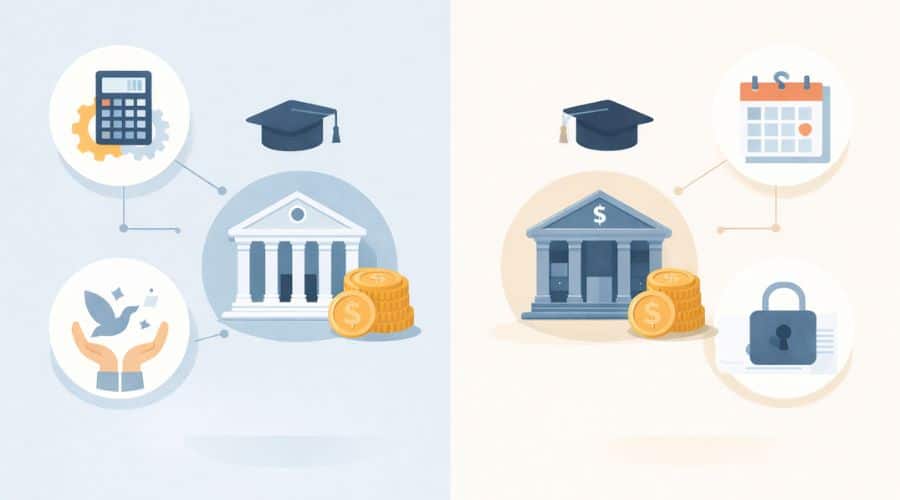
Understanding this distinction is essential.
Federal Student Loans
Issued by the U.S. Department of Education and governed by federal law. These loans offer: (Official details about federal student loan repayment plans are published by the U.S. Department of Education through Federal Student Aid.}
- Multiple repayment plans
- Income-based options
- Payment relief during hardship
- Forgiveness programs (if requirements are met)
These programs are administered under rules set by the :contentReference[oaicite:0]{index=0} and overseen by agencies such as the :contentReference[oaicite:1]{index=1}.
Private Student Loans
Issued by banks, credit unions, or online lenders. These loans typically:
- Have fixed repayment terms
- Offer few or no income-based options
- Do not qualify for federal forgiveness programs
Private lenders may allow temporary hardship arrangements, but those are voluntary, not guaranteed by law.
Everything that follows in this guide applies only to federal student loans unless stated otherwise. Private student loan repayment terms vary widely by lender, which is why they are not covered in detail in this guide.
When Repayment Normally Begins
Most federal loans enter repayment:
- Six months after you graduate
- Six months after you leave school
- Six months after dropping below half-time enrollment
This period is called a grace period. Interest may still accrue, depending on the loan type.
At the end of the grace period, borrowers are automatically placed into a Standard Repayment Plan unless they choose another option.
Overview of Federal Student Loan Repayment Plans
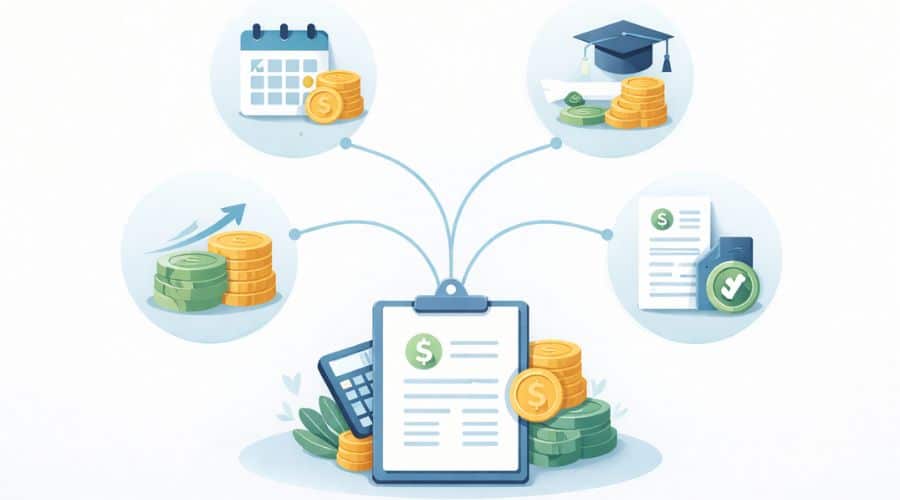
Federal student loan repayment plans are designed to match different income levels, career paths, and financial priorities.
1. Fixed-Payment Plans
Payments are predictable and based on your loan balance.
- Standard Repayment Plan
- Graduated Repayment Plan
- Extended Repayment Plan
2. Income-Driven Repayment (IDR) Plans
Payments adjust based on income and family size.
- SAVE Plan (current primary IDR option)
- Pay As You Earn (PAYE) (legacy)
- Income-Based Repayment (IBR)
- Income-Contingent Repayment (ICR)
Each plan serves a different financial situation. There is no single “best” plan for everyone.
Standard Repayment Plan (Default Option)
This is the plan most borrowers start with, often without realizing it.
How it works
- Fixed monthly payments
- Repayment term: 10 years
- Payments cover both principal and interest evenly
Who it fits best
- Borrowers with stable income
- Those who want to pay the least interest overall
- People not pursuing forgiveness
Key reality:
Because payments are higher than income-based plans, tthis option usually saves money long-term but offers less short-term flexibility.
Graduated Repayment Plan
Designed for borrowers who expect their income to rise.
How it works
- Payments start lower
- Payments increase every two years
- Repayment term: 10 years
Important warning
- You pay more interest than under the Standard Plan
- Early payments may not cover much principal
Extended Repayment Plan
Available only to borrowers with higher balances.
Eligibility
- More than $30,000 in federal student loan debt
How it works
- Fixed or graduated payments
- Repayment term: up to 25 years
Trade-off
- Lower monthly payments
- Significantly higher total interest cost
Income-Driven Repayment (IDR) Plans — Big Picture
IDR plans cap monthly payments as a percentage of your income and extend repayment timelines. They are often used by:
- Borrowers with lower or inconsistent income
- Those pursuing Public Service Loan Forgiveness (PSLF)
- People prioritizing cash-flow flexibility
However, lower payments today can mean higher costs later.
We’ll break down each IDR plan individually next, starting with the most relevant one.
The SAVE Plan (Saving on a Valuable Education)

The SAVE Plan is currently the primary income-driven repayment option for most federal borrowers. It replaced the older REPAYE structure and changed how payments and interest work.
Most new borrowers who enroll in an income-driven repayment plan today are placed into SAVE by default.
How SAVE Calculates Your Monthly Payment
Your payment is based on:
- Adjusted Gross Income (AGI)
- Family size
- Federal poverty guidelines
Payments are generally set at:
- 5% of discretionary income for undergraduate loans
- 10% of discretionary income for graduate loans
- A weighted average if you have both
Discretionary income is calculated as the amount of income above 225% of the federal poverty level. If your income falls below this threshold, your required monthly payment under SAVE can be $0. This higher threshold means many borrowers qualify for very low — sometimes $0 — payments.
What Makes SAVE Different
- Unpaid interest does not accumulate if your payment doesn’t cover it
- $0 payments still count toward forgiveness
- No penalty for married borrowers filing separately
This interest protection is a major change. Under older plans, low payments often caused balances to grow over time.
Forgiveness Under SAVE
- 20 years for undergraduate loans
- 25 years for graduate loans
- Shorter timelines may apply for smaller original balances
Forgiveness under IDR plans is governed by federal law. Any tax reporting related to forgiven amounts, if applicable, falls under rules set by the :contentReference[oaicite:0]{index=0}.
Important tax note:
Under current federal law, IDR forgiveness is not taxed at the federal level through 2025. Congress may change this in the future. Some states may still treat forgiven amounts as taxable income. State tax treatment varies by location.
Older Income-Driven Plans (Still Relevant for Some Borrowers)
While SAVE is dominant going forward, some borrowers remain on legacy plans.
PAYE (Pay As You Earn)
- Payments capped at 10% of discretionary income
- Forgiveness after 20 years
- Limited eligibility based on when you borrowed
PAYE payments are capped so they never exceed what you would pay under the Standard Plan.
IBR (Income-Based Repayment)
- Payments of 10% or 15%, depending on loan date
- Forgiveness after 20 or 25 years
- More widely available than PAYE
ICR (Income-Contingent Repayment)
- Payments based on income or a fixed formula
- Forgiveness after 25 years
- Often used by Parent PLUS borrowers (after consolidation)
ICR generally produces higher payments than other IDR options and is typically a last resort.
Parent PLUS borrowers must consolidate their loans before becoming eligible for ICR.
Comparing Federal Repayment Plans
The table below compares federal student loan repayment plans based on payment size, repayment length, interest cost, and forgiveness eligibility.
| Plan Type | Monthly Payment | Repayment Length | Interest Cost | Forgiveness Eligible |
|---|---|---|---|---|
| Standard | Highest | 10 years | Lowest | No |
| Graduated | Starts lower | 10 years | Higher | No |
| Extended | Lower | Up to 25 years | Much higher | No |
| SAVE (IDR) | Income-based | 20–25 years | Variable | Yes |
| PAYE | Income-based | 20 years | Variable | Yes |
| IBR | Income-based | 20–25 years | Variable | Yes |
| ICR | Income-based | 25 years | Higher | Yes |
Who Income-Driven Plans Are Best For
IDR plans often make sense if:
- Your income is low relative to your debt
- Your job income fluctuates
- You work in public service or nonprofit roles
- You need short-term payment relief
They may not be ideal if:
- Your income is high and stable
- You want to minimize lifetime interest
- You expect rapid income growth
Real-Life Examples

Example 1: Lower Income, High Balance
A borrower earning $38,000 with $60,000 in undergraduate loans may have a $0–$75 monthly payment under SAVE, compared to $600+ under Standard.
Example 2: Mid-Career Professional
A borrower earning $85,000 with $25,000 in loans often pays less overall using the Standard Plan than stretching payments under IDR.
These outcomes differ even with similar balances.
Actual payment amounts may vary based on family size, tax filing status, and future income changes.
Common Mistakes Borrowers Make
- Choosing the lowest payment without considering interest
- Forgetting to recertify income annually under IDR
- Assuming forgiveness is automatic
- Ignoring tax consequences
- Staying in a plan that no longer fits after income increases
Can You Change Repayment Plans?
Yes. Federal borrowers can:
- Switch plans at almost any time
- Move into or out of IDR
- Recalculate payments after income changes
Interest capitalization rules vary depending on the plan and timing.
In some cases, loan consolidation can affect how prior payments are counted toward forgiveness, depending on current federal rules.
How Repayment Plans Interact With Public Service Loan Forgiveness (PSLF)

For borrowers working in public service, repayment plan choice can directly affect whether forgiveness is possible.
What Is PSLF?
Public Service Loan Forgiveness (PSLF) allows eligible federal student loan borrowers to have the remaining balance forgiven after 120 qualifying monthly payments (10 years) while working full-time for a qualifying employer. Those 120 payments do not need to be consecutive, but they must meet all program requirements.
Qualifying employers generally include:
- Government organizations (federal, state, local, tribal)
- 501(c)(3) nonprofit organizations
- Certain other nonprofit public service organizations
PSLF rules are administered by the :contentReference[oaicite:0]{index=0} under federal law.
Which Repayment Plans Qualify for PSLF?
Only income-driven repayment (IDR) plans qualify for PSLF:
- SAVE
- PAYE
- IBR
- ICR
Standard Repayment technically qualifies, but because it pays off loans in 10 years, there is usually nothing left to forgive.
Why IDR + PSLF Often Go Together
PSLF forgives the remaining balance, not what you’ve already paid. For this reason:
- Lower monthly payments can increase the forgiven amount
- Higher payments reduce or eliminate the benefit
For many public service workers, SAVE produces the lowest qualifying payment while still counting toward PSLF.
Critical warning:
Payments only count if you are on a qualifying plan and working for a qualifying employer at the time of payment.
Payments made under non-qualifying plans or while working for non-qualifying employers do not count toward PSLF.
Employer Certification Is Not Automatic
Borrowers must submit employment certification forms periodically to:
- Confirm employer eligibility
- Track qualifying payments
- Correct errors early
Failure to certify does not stop payments from counting, but it can delay or complicate forgiveness later.
Submitting certification regularly helps catch errors early instead of discovering problems years later.
Long-Term Financial Impact of Repayment Plan Choices
Your repayment plan affects more than just your monthly bill.
Credit Impact
- On-time payments help build positive payment history
- Missed payments harm credit regardless of plan
- Loan balances themselves do not directly lower scores
Cash Flow vs. Total Cost Trade-Off
- Lower payments improve short-term flexibility
- Longer repayment increases interest paid
- Forgiveness shifts cost from borrower to federal program
There is no “free” option — every plan reflects a trade-off. The right choice depends on your income stability, career plans, and long-term goals.
How Repayment Plans Affect Major Life Decisions
Repayment choices often interact with:
- Buying a home
- Starting a family
- Changing careers
- Returning to school
- Retirement savings priorities
Lower payments may help monthly budgeting but can slow net worth growth if loans linger longer.
Myths vs. Facts About Student Loan Repayment Plans
| Myth | Reality |
|---|---|
| “Income-driven plans are always cheaper” | They often lower payments, but may increase total cost |
| “$0 payments don’t count” | $0 IDR payments do count toward forgiveness |
| “Forgiveness is automatic” | You must apply and meet strict requirements |
| “Changing plans resets forgiveness” | Prior qualifying payments usually still count |
| “Interest stops under IDR” | Interest may still accrue, depending on the plan |
When Switching Plans Makes Sense
Consider reevaluating your plan if:
- Your income increases or drops significantly
- Your household size changes
- You leave or enter public service
- You refinance or consolidate loans
- You approach forgiveness milestones
Federal rules allow flexibility, but timing matters.
Switching plans does not usually erase prior qualifying payments, but timing and loan status matter.
Pros & Cons of Federal Student Loan Repayment Options

Below is a simplified comparison of the main federal student loan repayment approaches to help you see the trade-offs at a glance.
| Approach | Pros | Cons |
|---|---|---|
| Standard (10-year) | Lowest total interest cost; predictable payments; fastest payoff | Higher monthly payments; less flexibility |
| Graduated | Lower payments early; helpful for early-career borrowers | Higher interest over time; rising payments can strain budgets later |
| Extended | Lower monthly payments for large balances | Much higher lifetime interest; long debt horizon |
| Income-Driven (SAVE, PAYE, IBR, ICR) | Payments adjust to income; protection during low-earning periods; forgiveness possible | Longer repayment; potential tax issues later; requires annual recertification |
Key warning:
Choosing a plan is not just about today’s payment. It shapes total cost, forgiveness eligibility, and long-term financial flexibility.
Common Beginner Misunderstandings (Cleared Up)
“Lower payment means better plan.”
Not always. Lower payments often increase total interest and extend debt for decades.
“I’m locked into one plan forever.”
Federal borrowers can usually change plans when circumstances change.
“Income-driven plans stop interest.”
Only certain protections apply (notably under SAVE). Interest rules differ by plan.
“Forgiveness is guaranteed if I wait long enough.”
Forgiveness requires strict compliance, documentation, and eligibility.
“Private loans work the same way.”
They do not. Most private loans lack income-based protections.
Frequently Asked Questions (FAQ)
-
What repayment plan is best for most borrowers?
There is no universal best plan. Borrowers with stable, sufficient income often pay less overall with the Standard Plan. Those with lower or variable income often benefit from income-driven plans.
-
Can I switch repayment plans later?
Yes. Most federal borrowers can change plans at any time. Past qualifying payments toward forgiveness typically still count, depending on the program.
-
Do $0 payments really count toward forgiveness?
Yes. Under income-driven plans, a $0 payment counts as a qualifying payment if you meet all other requirements.
-
Will income-driven repayment hurt my credit?
No, as long as payments are made on time. Payment history matters more than payment amount.
-
Is forgiven student loan debt taxable?
At the federal level, IDR forgiveness is not taxed through 2025 under current law. State tax treatment may vary, and future federal law could change.
-
Does marriage affect income-driven payments?
Yes. Household income and tax filing status can affect calculations, though SAVE removed some penalties that existed under older plans.
-
What happens if I forget to recertify my income?
Payments may increase, interest rules may change, and benefits can be lost temporarily. Recertification is required annually for IDR plans.
-
Are Parent PLUS loans eligible for income-driven plans?
Not directly. After consolidation, they may qualify for ICR, which usually results in higher payments than other IDR options.
-
What repayment plan do most borrowers start with by default?
Most federal borrowers are automatically placed into the Standard Repayment Plan unless they choose a different option.
Final Thoughts
Student loan repayment plans are not just administrative details. They shape your monthly budget, your long-term financial health, and — for some — whether forgiveness is even possible. Understanding the trade-offs allows you to choose deliberately instead of by default.
The right plan is the one that fits your income, goals, and life stage, not the one that simply offers the lowest payment today. Reviewing your repayment plan periodically can help ensure it still aligns with your financial situation.
Disclaimer
This content is for educational and informational purposes only. It does not constitute legal, tax, or financial advice. Student loan rules can change, and individual circumstances vary. Always consult a qualified financial, tax, or legal professional before making decisions about your student loans.
