Key Takeaways
A savings account is designed to store money safely, earn interest, and stay available for future needs—not for daily spending.
- Your money earns interest, usually compounded daily or monthly.
- Funds are FDIC or NCUA insured up to $250,000 per depositor, per institution.
- Savings accounts are best for emergency funds and short-term goals.
- They are not meant for frequent spending or bill payments.
- Interest rates and features vary widely by bank and credit union. Savings accounts focus on safety and access, not long-term wealth growth.
Why Savings Accounts Matter in Everyday American Life
Most Americans need a place to keep money that’s safe, separate from spending, and easy to reach when life happens — like car repairs, medical bills, or sudden job changes.
Without that separation, money meant for the future often gets spent on today’s expenses.
That’s one of the biggest reasons people struggle to build even small emergency funds.
A savings account solves that problem by:
- Keeping money out of daily transaction flow
- Paying some interest instead of zero
- Providing fast access when needed
It’s not about getting rich from interest.
It’s about protecting stability.
What a Savings Account Is (Plain English)
A savings account is a bank or credit union account where you:
- Deposit money you don’t plan to spend immediately
- Earn interest on your balance
- Can withdraw money when needed, with some limits
Unlike investment accounts, savings accounts:
- Do not fluctuate with the market
- Do not carry risk of loss (within insurance limits)
- Do not require long-term commitment
Think of it as a financial safety buffer, not a long-term growth tool.
How Savings Accounts Work in the U.S.
Where They Are Offered
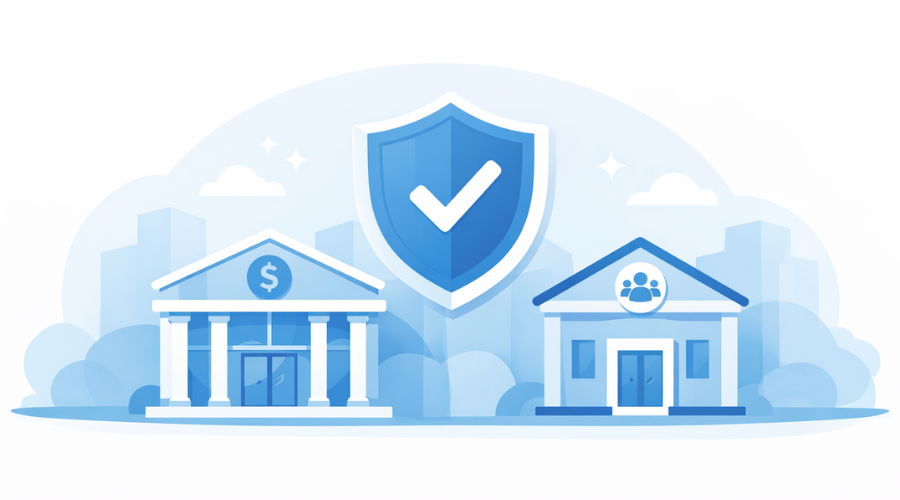
Savings accounts are offered by:
- Banks (national, regional, online-only)
- Credit unions
Both types are regulated and insured, but by different agencies:
| Institution Type | Insurance Provider | Coverage Limit |
|---|---|---|
| Bank | FDIC | Up to $250,000 per depositor |
| Credit Union | NCUA | Up to $250,000 per depositor |
Coverage limits apply per depositor, per institution, and per ownership category.
This insurance protects your money if the institution fails, not if you lose access due to fraud or personal mistakes.
How Interest Is Earned
When you keep money in a savings account, the bank:
- Uses those deposits to fund loans
- Pays you a small portion back as interest
Interest is usually:
- Calculated daily
- Paid monthly
Even though the rate may look small, compounding helps your balance grow slowly over time — especially when you add money regularly.
Typical Access Methods
Most savings accounts allow:
- Online transfers
- Mobile app access
- ATM withdrawals (sometimes limited)
- Transfers to checking accounts
However, they are not designed for frequent transactions, and many banks monitor excessive withdrawals.This is why checking accounts are used for daily spending, while savings are meant for storage.
Who Are Savings Accounts Best For?
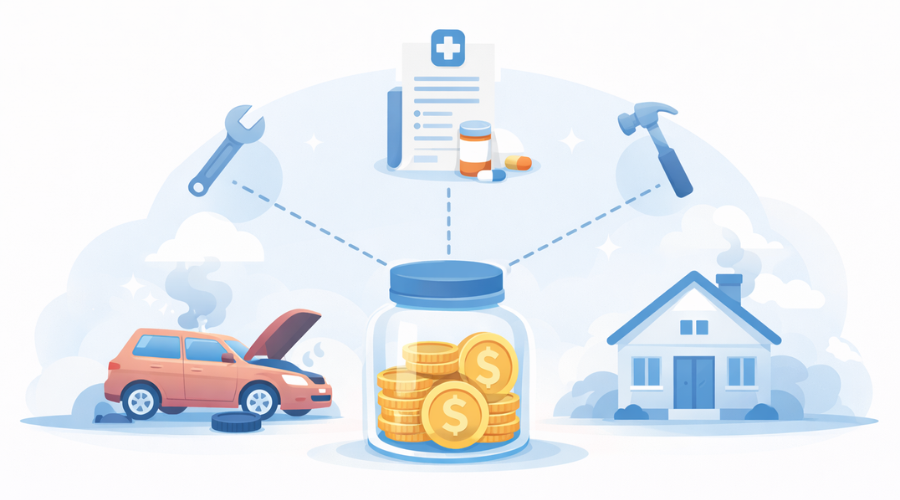
Savings accounts work well for people who want:
✔ Emergency Funds
Money set aside for:
- Medical expenses
- Car or home repairs
- Temporary income loss
Financial planners often suggest keeping 3–6 months of essential expenses in savings, though personal situations vary.
This emergency cushion is often recommended before starting serious investing.
✔ Short-Term Goals
Such as:
- Vacation savings
- Security deposits
- Moving costs
- Holiday spending
Any goal where you’ll need the money within a few months to a couple of years fits well in savings.
✔ People Who Want Zero Risk
If you cannot afford to lose any of the money:
- Savings accounts are safer than investments
- Balances don’t go down due to market swings
Who Should Not Rely on Savings Accounts for Growth
Savings accounts are not ideal for:
❌ Long-Term Wealth Building
Over long periods, interest usually:
- Fails to beat inflation
- Loses purchasing power slowly
That means savings alone is not enough for:
- Retirement
- College funds far in the future
- Long-term investing goals
Those goals typically require investment accounts, not savings accounts.
❌ Large Idle Balances With No Purpose
Keeping very large amounts in low-interest savings can:
- Reduce potential long-term growth
- Miss opportunities for better use of money
Savings accounts are best when the money has a clear short-term role. Money without a short-term purpose may be better placed in tools designed for long-term growth.
Real-Life Example
Maria, a retail worker in Texas, keeps:
- Her paycheck going into checking
- $4,000 in a savings account for emergencies
When her car transmission failed, she paid for repairs without:
- Credit card debt
- Payday loans
- Missing rent
Her savings didn’t make her richer —
but it protected her from financial damage.
That’s the real power of a savings account.
Types of Savings Accounts in the U.S.
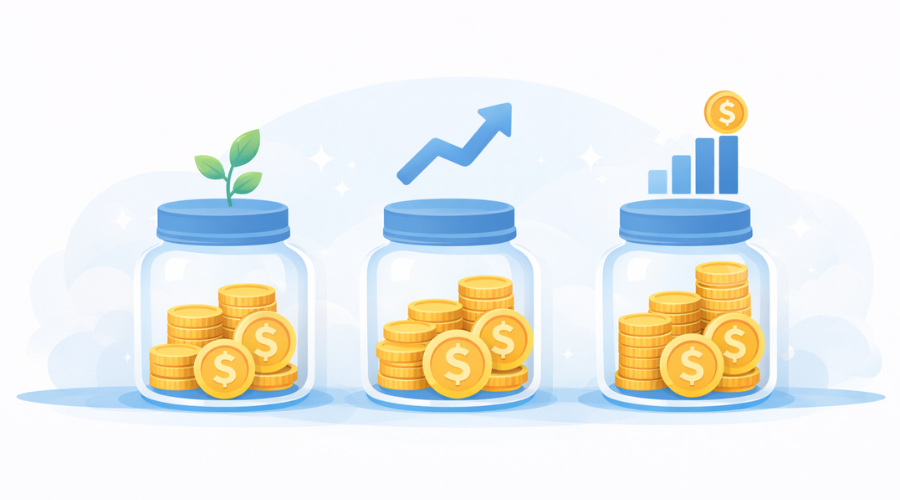
Not all savings accounts work the same way. Banks and credit unions offer different versions based on how people save, how much access they need, and how competitive the interest rate is.
Understanding the type matters because interest, fees, and convenience can be very different.
Traditional (Standard) Savings Accounts
These are the most common and are usually offered by:
- Large national banks
- Local community banks
- Credit unions
Typical features:
- Lower interest rates
- Easy in-branch access
- Linked to checking for transfers
- May have minimum balance requirements
Best for:
- People who prefer in-person banking
- Those who keep modest balances
- Customers who want everything at one bank
The main trade-off is that convenience often comes with lower earnings. These accounts are common at big retail banks where customers also keep their checking accounts.
High Yield Savings Accounts (HYSAs)
High yield savings accounts are mostly offered by:
- Online-only banks
- Some competitive credit unions
They pay significantly higher interest because:
- They don’t maintain expensive branch networks
- They compete nationally for deposits
Typical features:
- Much higher APY than traditional savings
- Online and mobile access only
- Transfers usually take 1–3 business days
- Fewer fees in many cases
Best for:
- Emergency funds
- Short-term savings with no daily access needs
- People comfortable with online banking
The money is still insured the same way, as long as the institution is FDIC or NCUA insured. Always confirm insurance coverage on the institution’s official website before depositing large amounts.
Money Market Savings Accounts (Not Money Market Funds)
Money market deposit accounts are still savings accounts, not investments.
They usually offer:
- Slightly higher interest than regular savings
- Limited check-writing or debit access
- Higher minimum balance requirements
Important distinction:
Money market funds are investment products.
Money market accounts are insured bank deposits.
Only deposit accounts qualify for FDIC or NCUA insurance.
This confusion causes many people to misunderstand the risk level.
Specialized or Goal-Based Savings Accounts
Some banks offer labeled savings accounts such as:
- Vacation savings
- Holiday savings
- Round-up savings
These usually:
- Function like normal savings accounts
- Simply separate money for mental budgeting
They don’t usually provide financial advantages, but they can help with behavioral discipline, which matters for many savers.
For people who struggle to stay consistent, labeled accounts can improve saving habits even without higher interest.
How Savings Account Interest Rates Are Set
Savings account rates are influenced by:
- Federal Reserve interest rate policy
- Competition among banks for deposits
- Overall economic conditions
When the Federal Reserve raises rates, banks often:
- Increase savings APYs
- Increase loan interest rates
When rates fall, savings APYs usually drop too.
Banks are not required to pass on the same increases, which is why:
- One bank may offer 0.01%
- Another may offer over 4% at the same time
Rates are a business decision, not a legal requirement.
What APY Really Means
Banks advertise savings rates as APY (Annual Percentage Yield).
APY includes:
- The interest rate
- The effect of compounding over a year
This allows fair comparison between accounts that compound:
- Daily
- Monthly
- Quarterly
A higher APY means you earn more over time, even if the base rate looks similar. This is why APY is more useful than just looking at the stated interest rate.
How Much Interest Can You Actually Earn?
Savings accounts are not meant for big income, but small differences add up.
Example (illustrative only):
| Balance | APY | Approx. Yearly Interest |
|---|---|---|
| $1,000 | 0.10% | About $1 |
| $1,000 | 4.00% | About $40 |
| $10,000 | 4.00% | About $400 |
For emergency funds, higher APY means:
- Your money keeps more of its value
- Inflation hurts less
But even high-yield savings still cannot match long-term investment returns.
Pros and Cons of Savings Accounts
Savings Account Advantages and Disadvantages
| Pros | Cons |
|---|---|
| Very safe (insured) | Low long-term growth |
| Easy access to funds | Rates can drop at any time |
| No market risk | Inflation can reduce buying power |
| Good for emergencies | Not suitable for retirement |
| Simple to manage | Some accounts have fees or minimums |
Savings accounts are excellent for stability, not for wealth creation.
Common Mistakes People Make With Savings Accounts
Mixing Spending and Saving
Keeping all money in checking often leads to:
- Accidental overspending
- No clear emergency buffer
Separating accounts creates psychological protection.
Chasing Rates Without Checking Insurance
Some people move money to unfamiliar institutions without verifying:
- FDIC or NCUA coverage
- Deposit limits
Insurance matters more than the extra fraction of interest.
Ignoring Fees and Minimum Balance Rules
Some savings accounts charge:
- Monthly maintenance fees
- Fees if balance drops below a threshold
Fees can cancel out earned interest entirely.
Treating Savings as Long-Term Investment
Savings accounts are not designed for:
- Retirement growth
- Wealth accumulation
Relying only on savings can slow long-term financial progress.
Withdrawal Limits and Transaction Rules

Savings accounts are designed for storing money, not for daily spending.
Because of that, banks place limits on how often and how easily money can be moved out.
These limits exist even when your money is fully insured. Understanding these rules helps avoid:
- Account freezes
- Unexpected fees
- Forced account conversions
Why Savings Accounts Have Activity Limits
Historically, U.S. banking rules required banks to:
- Separate “transaction accounts” (checking)
- From “savings deposits”
This was meant to:
- Keep banks stable
- Ensure enough funds stayed available for lending
Even though some federal rules were relaxed in 2020, many banks still enforce limits for operational and risk reasons.
So while the government no longer strictly mandates the old limits, your bank’s policy still controls your access. This is why two banks can treat the same type of withdrawal very differently.
Regulation D — What Changed and What Did Not
Before 2020, federal law limited certain savings withdrawals to six per month.
In 2020:
- The Federal Reserve removed the mandatory limit
- Banks were allowed to set their own policies
However:
- Many banks kept the six-transaction limit
- Some charge fees if you exceed it
- Some may convert the account to checking if abuse continues
So in practice, most people still experience monthly withdrawal limits.
Limits may apply only to certain types of electronic transfers, not all withdrawals.
Always check your bank’s deposit agreement for exact rules.
Which Transactions Usually Count Toward Limits
Typically counted:
- Online transfers to checking
- Automatic bill payments
- Mobile app transfers
- Phone-based withdrawals
Usually not counted:
- ATM withdrawals (depends on bank)
- In-person teller withdrawals
- Transfers made inside a branch
Policies vary by institution, which is why the same activity may be fine at one bank and restricted at another. For example, one bank may allow unlimited ATM withdrawals, while another may count them toward monthly limits.
What Happens If You Exceed the Limits
Depending on the bank, consequences may include:
- Excess transaction fees
- Warning notices
- Forced conversion to checking
- Account closure in rare cases
This is not about punishment.
Banks are required to classify accounts correctly under banking regulations.
Repeated excess activity simply signals that the account is being used like checking, not savings.
When a Savings Account Is Not the Right Tool
If you need money for:
- Daily purchases
- Regular bill payments
- Frequent transfers
Then savings is the wrong account type for that role.
Using checking for spending and savings for storage keeps:
- Account rules clean
- Financial tracking easier
- Banks satisfied with account classification
Holding Periods and Transfer Delays
Not all savings withdrawals are instant.
Depending on the bank:
- Transfers to checking may take hours or days
- External transfers may take 1–3 business days
- Newly deposited funds may be temporarily unavailable
This matters for emergency planning. Some people keep a small cash buffer in checking so urgent expenses do not depend on transfer timing.
True emergencies should consider:
- Whether funds are accessible quickly
- Whether a linked checking account exists
Are Savings Accounts Truly Liquid?
Compared to investments, yes.
Compared to checking, sometimes not fully.
Savings accounts are considered highly liquid, but not instant-cash accounts in every situation.
That’s why many people keep:
- Emergency funds in savings
- Daily buffer money in checking
This structure balances safety with access. It is a common setup recommended by many financial educators.
Can Banks Change Savings Account Rules?
Yes.
Banks can modify:
- Interest rates
- Withdrawal limits
- Fees
- Minimum balance requirements
They must provide notice, but customers are responsible for staying informed.
This is another reason to review account terms periodically.
Fees, Minimum Balances, and Hidden Costs
Savings accounts are often described as “free,” but many are not truly cost-free.
Small monthly charges can quietly cancel out the interest you earn.
Over time, these small fees can significantly reduce how much your savings actually grow.
Understanding how fees work is essential to protecting your savings.
Common Fees Found in Savings Accounts
Not all banks charge these, but many do.
Monthly Maintenance Fees
Charged simply for keeping the account open.
Typical range:
- $3 to $10 per month
Often waived if you meet conditions such as:
These waiver rules are usually listed in the account’s fee schedule or deposit agreement.
- Minimum daily balance
- Minimum monthly deposits
- Linking to another account
Excess Withdrawal Fees
Applied when you exceed transaction limits.
Common outcomes:
- Flat fee per extra transaction
- Fee after a set number of excess transfers
These fees discourage using savings like checking. Even a few extra transfers each month can trigger fees at some banks.
Low Balance Fees
Some banks charge if your balance drops below a set amount.
This can be especially harmful for:
- New savers
- People rebuilding finances because their balances may fluctuate more often.
Paper Statement or Inactivity Fees
Less common, but still seen at some institutions:
- Charges for mailed statements
- Fees if the account has no activity for long periods
Minimum Balance Requirements
Many savings accounts require:
- A minimum opening deposit
- A minimum ongoing balance
Examples of minimum rules may include:
- $25 to open the account
- $300 to avoid fees
- $1,000 to earn the advertised APY
If your balance drops below the threshold:
- Interest may drop
- Fees may apply
Always look at the balance required to earn the stated interest rate, not just to keep the account open. Some accounts advertise high APYs, but only apply that rate if your balance stays above a certain level.
How Fees Affect Long-Term Saving
Fees are especially damaging when balances are small.
Example:
- $5 monthly fee = $60 per year
- If your balance is $1,000 earning 2%, you earn $20
- You still lose $40 after fees
In that case, you would be better off with:
- A lower-interest account with no fees
Fees matter more than small APY differences when balances are modest. For many savers, avoiding fees is more important than chasing the highest advertised rate.
Why Some High-Yield Accounts Have Fewer Fees
Many online savings accounts:
- Do not charge maintenance fees
- Do not require high minimum balances
This is because:
- They operate with lower overhead
- They compete nationally for customers
However, they may trade off:
- In-person service
- Cash deposit options
So the account may be cheaper, but less flexible. This trade-off is acceptable for people who rarely need cash deposits or in-person help.
Joint Savings Accounts and Fees
When two people share a savings account:
- Balance requirements still apply to the total account
- Either person’s activity counts toward withdrawal limits
This matters for couples or families using shared emergency funds.
How to Protect Yourself From Savings Account Fees
Practical habits that help:
- Track your average monthly balance
- Understand waiver conditions clearly
- Review account terms once or twice per year
- Set alerts for low balances and review monthly statements for unexpected charges.
Banks change policies, and long-term accounts can slowly become less favorable over time.
Are Credit Unions Usually Cheaper?
Often, yes — but not always.
Credit unions may offer:
- Lower fees
- Lower minimum balances
- Member-focused policies
However:
- Interest rates are not always higher
- Online features may be more limited
Each institution must be evaluated individually.
Taxes and Savings Account Interest
Even though savings account interest usually feels small, the IRS still treats it as taxable income.
Understanding how it’s taxed prevents surprises at filing time.
This applies whether your account is at a bank or a credit union.
Is Savings Account Interest Taxable?
Yes.
Interest earned from savings accounts is considered:
- Ordinary income for federal tax purposes
It is taxed at your regular federal income tax rate.
There is no special tax treatment for bank interest the way some investments receive capital gains treatment.
When Banks Report Your Interest to the IRS
Banks and credit unions issue Form 1099-INT when:
- You earn $10 or more in interest during the year
They send this form to:
- You
- The IRS
Even if you earn less than $10 and do not receive a form, you are still legally required to report the income. The IRS explains how bank interest must be reported under its rules for taxable interest income.
Even if no form is issued, the income is still technically reportable under tax law.
How Interest Is Reported on Your Tax Return
Interest income is reported as:
- “Taxable interest” on your federal return
Most tax software imports this automatically if you enter your 1099-INT information. If you have multiple savings accounts, you may receive more than one 1099-INT form.
If you use a tax preparer, they will include it as part of your total income.
Do Savings Accounts Affect State Taxes?
It depends on the state.
Most states that have income tax:
- Also tax interest income
However:
- A few states do not tax income at all
- Some states exempt certain types of interest, but bank savings usually does not qualify for exemptions
State rules vary, and residents should check their state tax authority guidelines. This is especially important for people who move between states during the year.
How Taxes Reduce Your Effective Return
Your real earnings are what remains after taxes.
Example:
- APY: 4.00%
- Federal tax rate: 22%
Your after-tax return becomes roughly:
- 3.12%
This is another reason savings accounts are:
- For safety and access
- Not for maximizing growth
Taxes further reduce the already modest returns from savings accounts.
Are There Tax-Free Savings Accounts in the U.S.?
Not in the standard banking sense.
Accounts like:
- Roth IRAs
- Health Savings Accounts (HSAs)
Can offer tax advantages, but:
- They are not simple bank savings accounts
- They have eligibility rules and restrictions
Those accounts serve different financial purposes and should not be confused with regular savings. They are designed for long-term planning, not short-term cash storage.
Does Moving Money Between Accounts Trigger Taxes?
No.
Taxes apply only to:
- Interest earned
Not to:
- Transfers
- Withdrawals
- Deposits of your own money
Moving your money between checking and savings does not create a tax event.
Keeping Records for Tax Purposes
Most people rely on:
- Bank-issued 1099-INT forms
But it’s still wise to:
- Review your statements
- Confirm reported amounts especially if you changed banks or opened new accounts during the year.
Mistakes are rare, but they can happen.
Savings Accounts and Your Credit Score
A very common misconception is that having more money in savings helps your credit score.
In reality, savings accounts and credit scores are mostly separate systems.
Credit scores measure how you handle borrowed money, not how much cash you have.
Understanding this prevents false expectations and poor financial planning.
Do Savings Accounts Appear on Credit Reports?
No.
Savings accounts are not credit products, so they:
- Do not appear on credit reports
- Are not tracked by credit bureaus
- Do not affect payment history or utilization
Credit bureaus track how you manage borrowed money, not stored money. This is why even very large savings balances do not improve credit scores.
Can Having Savings Indirectly Help Your Credit?
Yes — indirectly and practically.
Savings can help you:
- Avoid missing bill payments
- Avoid using high-interest credit in emergencies
- Pay down balances faster
Those behaviors improve:
- Payment history
- Credit utilization
Which are major factors in credit scoring models.
So savings supports good credit behavior, even though the account itself is invisible to scoring systems. It works as a safety net that protects your payment history during emergencies.
Can Banks Check Your Credit When You Open a Savings Account?
Usually, no.
Most banks do not run:
- Hard credit inquiries
However, they may check:
- Identity verification databases
- ChexSystems or similar banking history systems
These checks relate to:
- Past account misuse
- Fraud prevention
They do not affect your credit score. However, being denied a bank account does not appear on your credit report either.
Can Savings Accounts Be Closed Due to Banking History?
Yes.
If someone has:
- Past overdraft abuse
- Unpaid bank fees
- Closed accounts with balances owed
Banks may deny new account openings, even for savings.
This is not a credit decision — it is a banking risk decision. These decisions are based on internal bank policies and consumer banking databases.
Does Closing a Savings Account Hurt Credit?
No.
Because savings accounts are not reported to credit bureaus:
- Opening or closing them has no credit impact
This is different from credit cards or loans, which affect account age and utilization.
Why This Distinction Matters
Some people try to:
- Save money to “build credit”
That does not work. Saving money is smart, but it is not a method for building a credit profile.
Credit improves through:
- On-time loan and credit card payments
- Responsible borrowing behavior
Savings improves:
- Financial stability
- Ability to handle emergencies
They support each other, but they are not the same tool.
What Actually Builds Credit (Briefly)
Without going into full credit education here:
- Credit cards
- Installment loans
- Timely payments
Are what build credit profiles.
These require borrowing and paying back money on time.
Savings accounts serve a different, equally important role — but not a scoring role.
Risks, Safety, and Account Protection
Savings accounts are among the safest places to store money, but “safe” does not mean “risk-free in every situation.”
Understanding what is protected — and what is not — helps prevent serious financial shocks.
Most risks come from fraud or access problems, not from the bank itself failing
What FDIC and NCUA Insurance Actually Protects
If your bank or credit union fails, insurance covers:
- Your deposited money
- Up to $250,000 per depositor, per institution, per ownership category
This includes:
- Savings accounts
- Checking accounts
- Certificates of deposit (CDs)
If the institution collapses, insured depositors typically:
- Receive their funds quickly
- Either through another bank or direct payment
This protection is backed by the U.S. government. You can learn more about coverage limits and protected account types on the FDIC’s official page about FDIC deposit insurance protection for savings accounts. Coverage applies automatically — you do not need to apply for insurance separately.
What Deposit Insurance Does NOT Protect
Insurance does not cover:
- Money lost to scams you authorized
- Transfers you sent to fraudsters
- Stolen credentials if funds are withdrawn and not recovered
- Losses in investment products sold by the bank
Insurance only applies to:
- Institutional failure
- Not personal transaction mistakes
The FDIC also explains which situations are not covered under deposit insurance in its FAQ on types of accounts covered by FDIC insurance.
This is why staying alert to scams and account activity is just as important as choosing an insured bank.
Fraud Risks and Unauthorized Access
Savings accounts can be targeted by:
- Phishing attacks
- Stolen login credentials
- SIM swap phone fraud
Banks usually offer protections for:
- Unauthorized transactions
But recovery can depend on:
- How quickly you report the activity
- Whether the transaction is classified as authorized or unauthorized
Delays in reporting can limit reimbursement rights. Many banks require fraud to be reported within a specific time window to qualify for protection.
Account Freezes and Suspicious Activity Reviews
Banks may freeze accounts if they detect:
- Unusual transfers
- Identity mismatches
- Possible fraud patterns
During reviews:
- Funds may be temporarily inaccessible
- Documentation may be required
While frustrating, these freezes are part of federal anti-money-laundering rules and fraud prevention systems. Most reviews are temporary and are lifted once verification is complete.
What Happens If a Bank Itself Has Problems
Bank failures are rare but possible.
When they happen:
- FDIC or NCUA takes control
- Another institution often assumes the accounts
Most customers:
- Regain access to funds quickly
- Often within days
Balances above insurance limits, however:
- May not be fully recovered
This is why spreading very large balances across institutions can matter. This strategy is mainly relevant for people with balances above standard insurance limits.
Online Banks vs Branch Banks: Safety Differences
From an insurance standpoint:
- There is no difference if both are insured
From a practical standpoint:
- Branch banks offer in-person problem resolution
- Online banks rely on digital customer service
Some people prefer:
- Human access during urgent situations
Others prioritize:
- Higher interest rates and lower fees
Safety comes from insurance, not physical buildings.
Protecting Yourself as a Saver
Basic protective steps include:
- Using strong, unique passwords
- Enabling two-factor authentication
- Monitoring account alerts
- Reviewing statements regularly and setting up instant alerts for withdrawals or large transfers.
Most fraud losses occur when:
- Access problems go unnoticed for too long
Early detection is the strongest protection tool.
The Role of Savings Accounts in Long-Term Financial Planning
Savings accounts are not where long-term wealth is built, but they are where long-term financial stability begins.
They act as the foundation that allows other financial plans to work safely.
Without this foundation, even good investment plans can fall apart during emergencies.
Why Emergency Savings Comes Before Investing
Investing without emergency savings creates risk.
Without cash reserves, people may be forced to:
- Sell investments during market drops
- Use high-interest credit
- Miss important payments
Savings accounts provide a buffer that protects:
- Investments
- Credit health
- Monthly cash flow
That protection is more valuable than slightly higher returns early on. This is why many financial plans prioritize building emergency savings first.
How Much Should Be Kept in Savings?
There is no single number that fits everyone, but many financial educators suggest:
- 3 to 6 months of essential living expenses
“Essential” usually means:
- Housing
- Utilities
- Food
- Insurance
- Minimum debt payments
People with:
- Irregular income
- Single income households
- Health risks
Often benefit from keeping more than six months available. The goal is to cover unavoidable expenses if income is disrupted.
Separating Emergency Savings From Goal Savings
Not all savings serve the same purpose.
Many people use:
- One account for emergencies
- Another for planned expenses
This separation helps prevent:
- Using emergency money for optional spending
- Losing track of priorities
Some banks allow multiple labeled sub-accounts under one login, which can simplify tracking. This can help people see exactly what each portion of their savings is meant for.
When It Makes Sense to Move Money Out of Savings
Money that is:
- Not needed for emergencies
- Not needed in the short term
May be better suited for:
- Retirement accounts
- Education savings
- Long-term investments
Savings accounts are best when the money has:
- A short-term use
- A safety function
Keeping long-term money in savings can slowly reduce purchasing power over time. Gradually shifting excess funds to long-term accounts can support future goals.
How Inflation Affects Savings
Inflation reduces the value of money.
If:
- Savings earns 2%
- Inflation is 3%
Then your real buying power decreases, even though the balance grows.
This does not mean savings are useless.
It means savings are about stability, not growth. Investments are typically used for growth, while savings are used for protection.
Savings as a Stress-Reduction Tool
Beyond math, savings provide:
- Decision flexibility
- Reduced financial anxiety
- More control during setbacks
This is why savings is often linked to:
- Better debt management
- More consistent investing
- Fewer financial emergencies
Its value is not only financial — it is practical and psychological. This emotional stability often leads to better long-term financial decisions.
Life Events Where Savings Become Critical
Savings accounts often carry people through:
- Job transitions
- Medical recovery periods
- Relocation costs
- Family emergencies
Unexpected travel or caregiving expenses
When those moments happen, access to cash matters more than market performance.
Myths vs Facts About Savings Accounts
A lot of confusion around savings accounts comes from outdated advice, social media shortcuts, and mixing up different financial tools.
Clearing up these myths helps people make better decisions with less frustration.
Many myths also come from treating savings and investing as the same thing, when they serve different purposes.
Myth 1: “Savings Accounts Are Useless Because Interest Is Low”
Fact: Savings accounts are not meant to build wealth.
They are meant to protect stability.
Their value comes from:
- Safety
- Liquidity
- Reliability
Even when interest is low, savings accounts still:
- Prevent debt during emergencies
- Protect against missed bills
- Provide fast access to cash
That role cannot be replaced by investments. Investments can grow money, but they cannot guarantee immediate access during emergencies.
Myth 2: “More Savings Automatically Means Better Credit”
Fact: Credit scores do not measure savings balances.
Credit scoring models track:
- Payment history
- Credit utilization
- Account age
- Credit mix
Savings helps indirectly by preventing missed payments, but the account itself does not improve scores. Credit history improves only when borrowed money is paid back on time.
Myth 3: “All Savings Accounts Have the Same Rates”
Fact: Rates vary widely between institutions.
Differences exist because of:
- Business models
- Competition levels
- Operating costs
Two people can hold savings accounts at the same time and earn completely different interest on the same balance. This is why comparing rates before opening an account can make a noticeable difference.
Myth 4: “Money Market Accounts Are Risky Like Investments”
Fact: Money market deposit accounts are insured savings products.
They are not the same as:
- Money market mutual funds
Deposit accounts are covered by FDIC or NCUA insurance, while funds are investment products that carry some risk.
The similar names cause frequent confusion. Always check whether an account is labeled as a deposit account or an investment product.
Myth 5: “Banks Can Take Your Savings Whenever They Want”
Fact: Banks cannot take customer deposits arbitrarily.
However, they can:
- Freeze accounts during investigations
- Restrict access due to legal requirements
- Close accounts under their deposit agreements
These actions are regulated and usually tied to fraud prevention or compliance, not random seizure. Customers are generally notified and given instructions when action is required.
Myth 6: “It’s Better to Keep Emergency Cash at Home”
Fact: Physical cash at home is not insured.
It is vulnerable to:
- Theft
- Fire
- Natural disasters
- Simple loss
Banks provide both:
- Insurance protection
- Easier replacement if something goes wrong
Keeping large emergency reserves in cash is usually riskier than keeping them in insured accounts. Small amounts of cash for short-term needs can be useful, but long-term reserves are safer in banks.
Common Beginner Misunderstandings
Confusing Saving With Investing
Many beginners expect:
- High returns from savings
This leads to disappointment and poor comparisons.
Savings is about:
- Access
- Safety
Investing is about:
- Growth
- Risk tolerance
- Long-term planning
They solve different problems. Mixing these roles often leads to poor expectations and financial stress.
Keeping All Money in One Account
When checking and savings are mixed:
- Emergency money gets spent
- Tracking becomes harder
Separation improves financial control even if total income stays the same. It also makes budgeting and tracking expenses much easier.
Waiting to Save Until Income Is “High Enough”
Many people delay saving because they think:
- Small amounts don’t matter
But consistency matters more than size.
Small, regular deposits build habits that continue when income grows. This approach is more sustainable than trying to save large amounts all at once.
Believing Banks Always Offer the Best Option Automatically
Banks do not upgrade customers to better savings products automatically.
Rate improvements often require:
- Opening new account types
- Moving funds manually
Assuming the bank is optimizing for you is usually incorrect.
Why Online Advice Can Be Misleading
Short-form financial content often:
- Focuses only on returns
- Ignores risk management
- Skips regulatory realities
This leads to advice that works well on paper but fails during:
- Job loss
- Medical emergencies
- Economic downturns or unexpected personal emergencies
Savings accounts may look boring, but they are built for the exact moments when things go wrong.
Best Practices for Using Savings Accounts Wisely
Having a savings account is helpful, but how it is used matters just as much as where it is opened.
Good habits turn savings into a reliable financial tool instead of just a place where money sits.
Small changes in how you manage savings can make a big difference over time.
Automate Savings Whenever Possible
Automatic transfers remove the need for constant decisions.
Common methods include:
- Scheduled transfers from checking after each paycheck
- Percentage-based savings rules
- Round-up features on debit purchases
Automation helps because:
- It builds consistency
- It reduces temptation to skip saving
Even small automatic amounts can grow into meaningful reserves over time. Automation also helps people save even when they are busy or stressed.
Keep Emergency Money Easy — But Not Too Easy
Emergency funds should be:
- Accessible when needed
- Not mixed with daily spending
Best structure for many people:
- Checking for spending
- Savings for emergencies
- Transfers between them when necessary while keeping savings separate from everyday debit card spending.
If accessing savings requires several steps, people may:
- Delay necessary expenses
- Rely on credit instead
If it is too easy, money may disappear on non-emergencies.
Review Interest Rates Periodically
Savings rates change frequently.
What was competitive last year may now be:
- Far below market averages
Checking once or twice per year is usually enough to:
- Ensure your money is not falling behind unnecessarily
This does not mean constantly chasing small differences, but very large gaps can matter. If your rate is far below average, switching accounts can increase earnings without increasing risk.
Use Separate Accounts for Separate Goals
When savings serves multiple purposes, clarity helps.
Some people use:
- Emergency fund savings
- Travel savings
- Large purchase savings
Separating balances helps:
- Prevent accidental spending
- Track progress toward goals
This can be done using:
- Multiple accounts
- Sub-accounts if offered by the bank or separate savings accounts with different nicknames.
Avoid Frequent Withdrawals for Non-Emergencies
Using savings for routine expenses often leads to:
- Slower growth
- Loss of emergency protection
If withdrawals happen regularly, it may signal:
- Budget issues
- Income shortfalls
- Underestimated expenses
Savings should protect against surprises, not fund predictable bills. Regular expenses are better handled through budgeting and checking accounts.
Keep Backup Access Options
In urgent situations, access problems can be costly.
Helpful preparations include:
- Linking savings to checking
- Keeping debit card access if available
- Knowing transfer timelines and keeping customer service contact information easily available.
Emergencies are not the time to learn how your bank processes withdrawals.
Periodically Re-Evaluate Your Emergency Fund Size
Life changes over time.
Emergency savings should be adjusted when:
- Expenses increase
- Income becomes unstable
- Family size changes
A fund that was sufficient years ago may no longer match current needs. Reviewing your emergency fund after major life changes is especially important.
Avoid Letting Large Balances Sit Without Purpose
Once emergency and short-term needs are covered, additional funds may:
- Benefit from other financial tools
Savings should serve a role, not become a permanent holding place for money with no short-term purpose. Long-term financial goals usually require different types of accounts.
Frequently Asked Questions About Savings Accounts
These are real, common questions Americans search when trying to understand how savings accounts work in everyday life. Answers may vary slightly by bank and personal situation, but these guidelines apply to most savers.
How much money should I keep in a savings account?
Most financial educators suggest keeping three to six months of essential living expenses in savings for emergencies.
However, the right amount depends on:
– Job stability
– Household income sources
– Health and family responsibilities
Someone with irregular income or higher risk of job loss may need a larger buffer. The goal is to cover essential expenses if income stops temporarily.
Can I lose money in a savings account?
You will not lose money due to market changes if your account is within FDIC or NCUA insurance limits.
However, you could lose money through:
– Fees
– Fraud if not reported promptly
– Unauthorized transfers not recovered
So while the balance does not fluctuate, good account management still matters. Choosing accounts with low fees and strong security features reduces these risks.
Is it better to keep savings at a bank or credit union?
Both can be equally safe if insured.
Differences usually come down to:
– Interest rates
– Fees
– Customer service
– Convenience
Some credit unions offer lower fees, while some banks offer better digital tools. The best option depends on your needs, not the institution type. Comparing specific accounts is more useful than choosing based on name alone.
How often can I withdraw from a savings account?
Federal law no longer mandates strict limits, but many banks still allow only a limited number of certain withdrawals per month.
Exceeding those limits may lead to:
– Fees
– Account conversion to checking
Always check your bank’s current policy. Limits often apply only to certain electronic transfers, not all withdrawals.
Should I keep my emergency fund in a high-yield savings account?
Many people choose high-yield savings for emergency funds because they offer:
– Higher interest
– Similar safety through insurance
The main consideration is whether you are comfortable with:
– Online-only access
– Transfer timelines
As long as access is reasonably fast, high-yield savings is commonly used for emergencies. Many people keep emergency savings split between checking and high-yield savings for faster access.
Does the government track my savings account?
Banks report:
– Interest income to the IRS
– Certain large or suspicious transactions under federal law
But everyday saving activity is not monitored for routine purposes. Reporting focuses on tax compliance and fraud prevention, not personal spending habits. Normal saving activity does not trigger routine monitoring.
Can I open multiple savings accounts?
Yes.
There is no legal limit to how many savings accounts a person can have, as long as:
– Each account follows bank policies
– Insurance limits are not exceeded at one institution
Multiple accounts are often used for budgeting and goal separation. This can help people stay organized and avoid using emergency money for planned spending.
What happens to my savings if my bank closes?
If your bank or credit union fails:
– The FDIC or NCUA steps in
– Another institution usually assumes the accounts
– Insured funds are protected up to legal limits
Most customers regain access to money quickly, often within days. Payments, direct deposits, and debit cards are usually transferred to the new bank automatically.
Are online savings accounts safe?
They are just as safe as traditional banks if they are properly insured.
What matters is:
– Insurance coverage
– Security practices
– Fraud monitoring systems and strong customer authentication tools.
Physical branches are not required for deposit safety.
Can minors have savings accounts?
Yes.
Many banks and credit unions offer:
– Custodial savings accounts for minors
An adult usually:
– Manages the account
– Controls withdrawals until the child reaches legal age
Rules vary by state and institution. Parents should compare account features and fees before opening custodial accounts.
Will savings accounts ever have zero interest?
It is possible during very low interest rate environments.
In past periods, many savings accounts paid:
– Near-zero interest
Rates depend heavily on Federal Reserve policy and economic conditions, not on individual bank generosity. This is why savings rates rise and fall over time across most banks together.
Final Thoughts on Using Savings Accounts Responsibly
Savings accounts do not promise excitement or fast growth, but they provide something far more important: financial stability when life becomes unpredictable. This stability allows people to handle financial setbacks without immediately turning to debt.
They protect people from turning short-term problems into long-term financial damage.
When used correctly, savings accounts help:
- Absorb emergencies
- Support healthy credit behavior
- Reduce reliance on high-interest debt
- Create room for better long-term financial decisions
- Protect monthly budgets during unexpected expenses
They are not a replacement for investing, but they are the foundation that makes investing safer, more consistent, and more sustainable.
For many households, a properly maintained savings account is the difference between handling a setback calmly and falling into financial crisis. Even small emergency funds can reduce financial stress and give people more control during difficult periods.
Disclaimer
This content is provided for educational and informational purposes only.
It does not constitute legal, tax, or financial advice. Laws, regulations, and financial products can change over time.
Financial decisions depend on individual circumstances, including income, debts, location, and personal goals.
Readers should consult a qualified financial advisor, tax professional, or legal expert before making decisions that could affect their financial situation. Individual banks and credit unions may also have specific policies that differ from general guidelines.

3 thoughts on “What Is a Savings Account? How It Works, Benefits, and Rules in the U.S. (2026 Guide)”