Key Takeaways
- U.S. credit scores are calculated using data from your credit reports, not your income or savings.
- Payment history and credit utilization are the two most influential factors.
- Most lenders rely on FICO® Scores, while some use VantageScore®—both follow similar principles.
- Consistent on-time payments and low credit card balances influence credit scores far more than short-term tactics.
- Your score can change monthly or even weekly as new information is reported.
- Credit scores are one factor lenders consider—approval decisions also depend on income, debts, and lender-specific policies.
Why credit score calculations matter in everyday American life
How is credit score calculated is a common question, because credit scores quietly shape many everyday financial outcomes in the U.S. They influence whether you qualify for a credit card, how much interest you pay on a car loan or mortgage, and sometimes even whether a landlord approves your rental application.
Yet many people are unclear about how a credit score is actually calculated, which leads to common mistakes—like closing old cards too quickly, paying the wrong balance amount, or assuming income affects the score. Understanding the calculation removes guesswork and helps you make decisions that reliably improve your credit over time. In some situations, credit reports (not scores) may also be reviewed during background checks, where allowed by law.
What a credit score is (plain English)
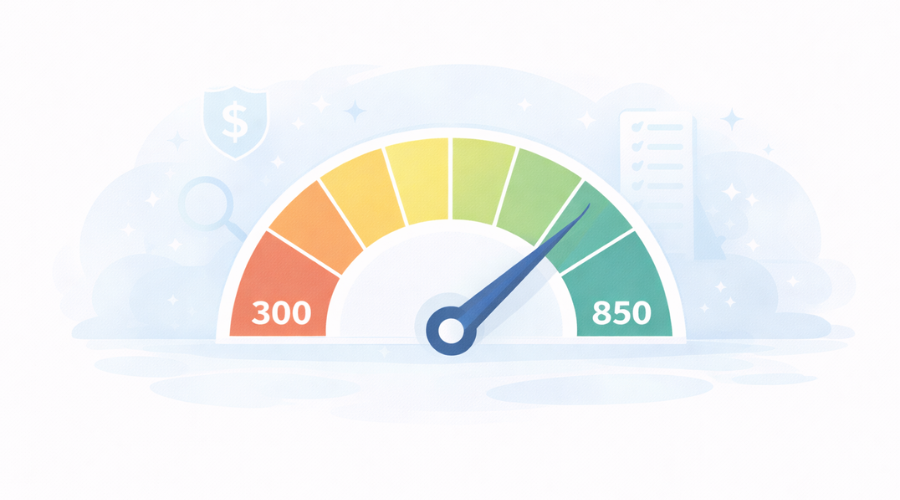
A credit score is a three-digit number that predicts how likely you are to repay borrowed money on time. In the United States, it is calculated using information from your credit reports, which are maintained by the three major credit bureaus: Equifax, Experian, and TransUnion. Understanding how a credit score is calculated helps explain why certain actions affect your score more than others.
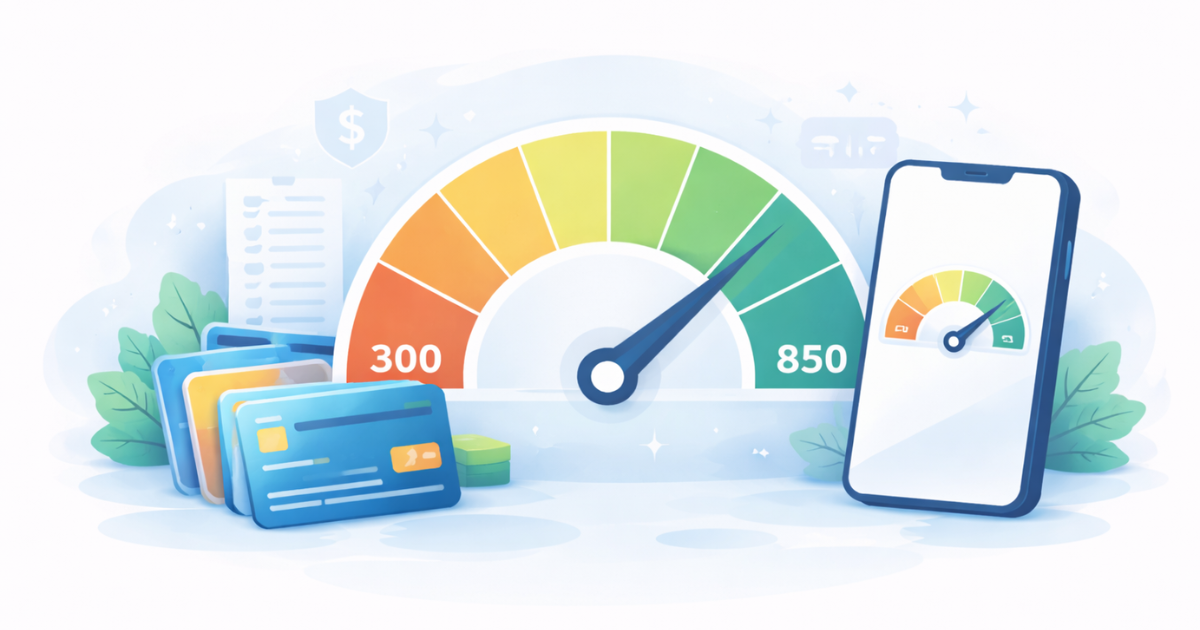
Most scores fall between 300 and 850. A higher number signals lower risk to lenders.
Common myth to clear upfront Important clarification:
Your credit score is not based on:
- Your income
- Your job title
- Your bank account balance
- Your age
- Your marital status
It is based only on how you’ve handled credit in the past.
Who calculates credit scores in the U.S.
Credit bureaus collect data, but they do not calculate your score. Scoring companies do.
The two dominant scoring models are:
- FICO (used by the majority of U.S. lenders)
- VantageScore (used by some banks and many free credit monitoring tools)
Each model uses a proprietary formula, but the core factors are similar across both systems. Lenders choose which scoring model to use based on industry standards and their internal risk policies.
The five factors used to calculate a credit score (FICO model)
FICO publicly discloses the relative weight of each category. Exact formulas are proprietary, but these ranges are well established.
| Factor | Approximate Weight |
|---|---|
| Payment History | 35% |
| Credit Utilization (Amounts Owed) | 30% |
| Length of Credit History | 15% |
| Credit Mix | 10% |
| New Credit (Inquiries) | 10% |
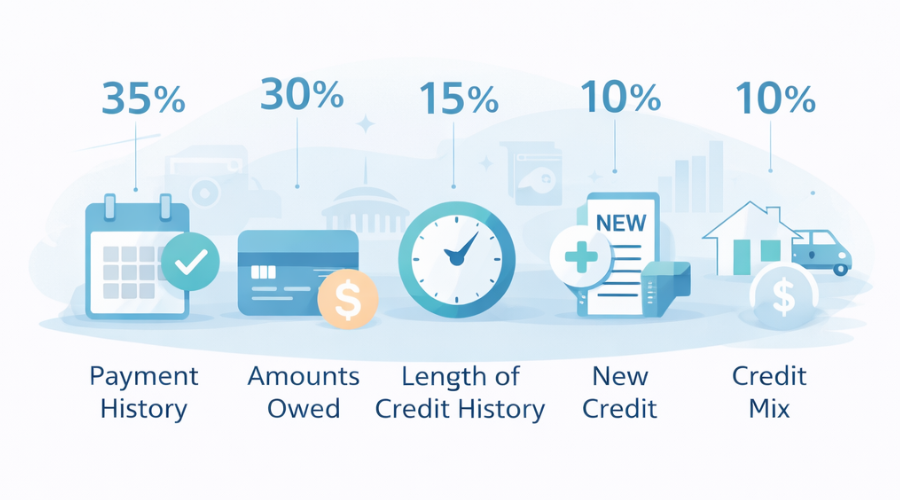
These percentages explain why certain actions matter more than others. Together, these five categories explain nearly all meaningful changes in a typical U.S. credit score.
1. Payment history (≈ 35%)
Payment history tracks whether you pay your credit obligations on time.
It includes:
- Credit cards
- Auto loans
- Mortgages
- Student loans
- Collections and charge-offs
What helps your score
- Paying at least the minimum amount by the due date
- Maintaining a long record of on-time payments
What hurts your score
- Late payments (30, 60, 90+ days)
- Accounts sent to collections
- Charge-offs
- Bankruptcies
Key warning: A payment that is even one day late may trigger fees, but it usually affects your credit report only after 30 days past due. Once reported, late payments can stay on your report for up to seven years, though their impact fades over time.
2. Credit utilization (≈ 30%)
Credit utilization measures how much of your available revolving credit you are using.
Basic formula:
Total credit card balances ÷ Total credit card limits = Utilization ratio
Example
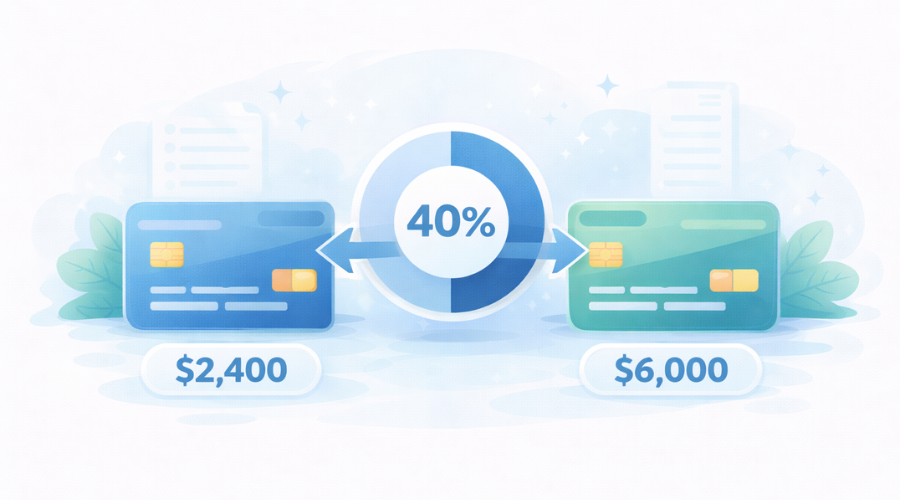
If you have:
- $2,000 total balance
- $10,000 total credit limit
Your utilization is 20%.
Why this matters
High utilization suggests financial strain, even if you pay on time.
General U.S. benchmarks (not official rules):
- Under 30% → usually acceptable
- Under 10% → strongest scores
- Over 50% → often damaging
Important nuance: Utilization is calculated per card and across all cards. One maxed-out card can hurt even if your total utilization looks reasonable.
Most card issuers report balances to credit bureaus based on the statement closing date, not the payment due date.
3. Length of credit history (≈ 15%)
This factor reflects how long you’ve been using credit.
It considers:
- Age of your oldest account
- Age of your newest account
- Average age of all accounts
Why older is usually better
Longer histories give lenders more data to assess consistency and risk.
Common mistake: Closing an old credit card can reduce your average account age and increase utilization—both of which may lower your score.
4. Credit mix (≈ 10%)
Credit mix looks at the variety of credit types you’ve managed.
Examples include:
- Revolving credit (credit cards)
- Installment loans (auto, student, mortgage)
You do not need every type of loan to have good credit. This factor simply rewards demonstrated ability to manage different credit structures responsibly.
5. New credit and inquiries (≈ 10%)
When you apply for credit, a hard inquiry may appear on your report.
What counts
- Credit card applications
- Loan applications
What does not count
- Checking your own credit
- Prequalification offers
- Soft background checks
Key facts:
- Hard inquiries usually affect your score for less than one year
- Multiple inquiries for the same loan type (auto or mortgage) within a short window are often treated as one inquiry for scoring purposes
How Credit Scores Are Calculated Using Your Credit Report Data
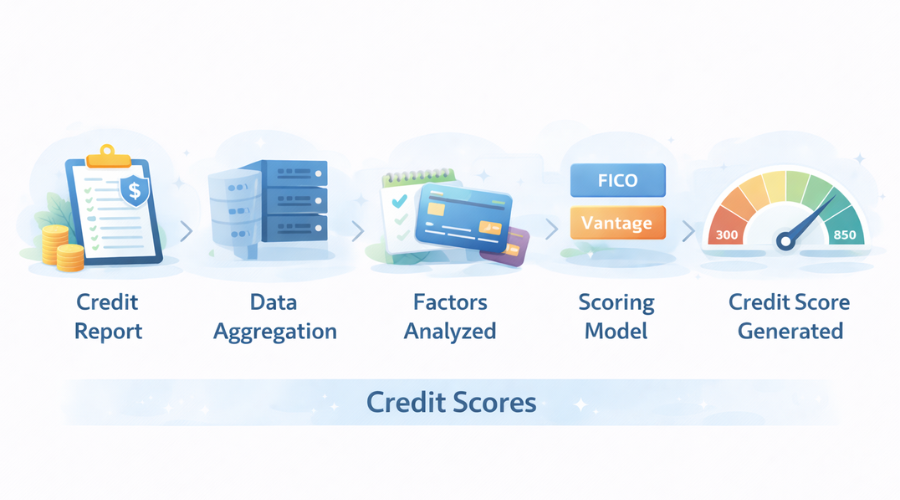
Your credit score is recalculated whenever new information is added to your credit report. This typically happens when lenders report account activity to the credit bureaus—most often once per billing cycle, though some lenders report more frequently.
Where the data comes from
Lenders such as banks, card issuers, and loan servicers report account information to one or more of the three credit bureaus. That data includes:
- Current balances
- Payment status
- Credit limits
- Account opening dates
- Any negative events (late payments, collections, charge-offs)
Not all lenders report to all three credit bureaus, and reporting frequency can vary by lender and account type.
Scoring models then analyze this data using their formulas. Not all lenders report to all three bureaus, which is why reports may differ.
Important: If an account does not appear on your credit report, it cannot affect your credit score in any way—positively or negatively.
Why your credit score can differ across bureaus
It is common—and normal—to have slightly different credit scores depending on which bureau’s data is used. These differences are usually small and do not indicate a problem or error.
These variations usually narrow over time as reporting updates sync across bureaus.
Reasons include:
- A lender reports to only one or two bureaus, not all three
- Updates reach bureaus at different times
- Small data discrepancies (dates, balances, account status)
As a result, you may have:
- Three different credit reports
- Multiple credit scores even within the same scoring model
This is not an error—it reflects how the U.S. credit reporting system works.
How often credit scores change
They can change when:
- A new payment is reported
- A balance increases or decreases
- A new account is opened
- An account is closed
- A negative item ages or drops off
There is no set schedule for score changes. Some people see movement weekly; others monthly.
Key takeaway: Credit scores respond to patterns, not single actions. Consistency matters more than quick wins. Short-term fluctuations are normal and usually stabilize with consistent behavior.
Real-life U.S. example: how one month can change a score
Scenario:
A cardholder has:
- One credit card with a $5,000 limit
- A $2,000 balance (40% utilization)
- Perfect payment history
Month 1
- Utilization: 40%
- Score impact: Neutral to slightly negative
Month 2 (after paying balance down to $500)
- Utilization: 10%
- Score impact: Often positive, sometimes significantly. Actual point changes vary depending on the individual credit profile.
Nothing else changed—no new accounts, no missed payments.
The score moved because credit utilization changed, which carries heavy weight.
Myths vs facts about credit score calculations
| Myth | Fact |
|---|---|
| Checking your credit lowers your score | Checking your own credit does not affect your score |
| Income improves your credit score | Income is not used in score calculations |
| Carrying a balance helps your score | You do not need to carry a balance to build credit |
| Closing cards always helps | Closing cards can hurt utilization and credit age |
| Paying early boosts your score automatically | On-time status matters, not early timing |
Common beginner misunderstandings that hurt scores
Believing zero balance reporting is automatic
If you don’t use a card, it may report no activity—not a paid balance. Small usage can help ensure positive reporting.
Focusing only on total utilization
Per-card utilization matters too. One maxed card can lower your score even if overall usage is modest.
Opening multiple accounts quickly
Too many new accounts in a short time increases inquiries and lowers average account age.
Ignoring small late payments
Even a single reported late payment can outweigh months of good behavior.
How credit scores affect real financial outcomes
Your credit score influences:
- Interest rates on loans and credit cards
- Approval decisions
- Required security deposits
- Insurance pricing in some states
- Rental applications
Important: Lenders typically use credit scores as one factor among many, not the sole decision point.
Consumer protection oversight in the U.S. is handled in part by the Consumer Financial Protection Bureau, which enforces fair credit reporting and lending practices.
Pros and cons of the U.S. credit scoring system
| Pros | Cons |
|---|---|
| Standardized risk measurement | Not always intuitive |
| Encourages consistent payment behavior | Penalizes short-term mistakes |
| Widely accepted by lenders | Uses proprietary formulas |
| Can improve with good habits | Slow recovery from major negatives |
What credit score calculations do not measure
Credit scores do not reflect:
- Financial literacy
- Savings discipline
- Net worth
- Emergency preparedness
They are risk models, not judgments of financial character.
At this stage, the foundation of how credit scores are calculated in the USA is fully clear—from data sources to real-world effects and misconceptions.
FICO® vs. VantageScore®: how the calculations differ (and why it matters)
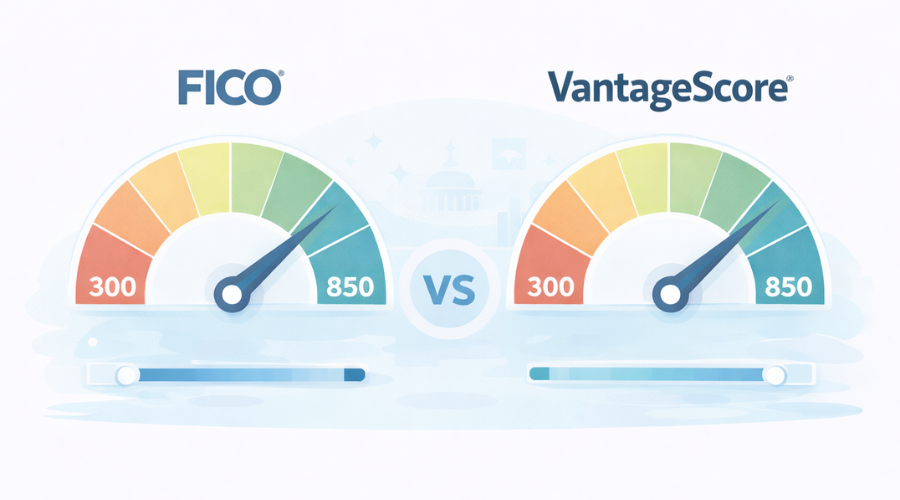
Both scoring systems analyze similar credit report data, but they weigh behaviors slightly differently and apply different scoring rules. That’s why the same credit report can produce different numbers.
Both models are designed to predict credit risk, not to judge financial responsibility.
Key structural differences
| Area | FICO® Scores | VantageScore® |
|---|---|---|
| Lender usage | Most banks and mortgage lenders | Some banks, many free tools |
| Score range | 300–850 | 300–850 (newer versions) |
| Payment history emphasis | Very strong | Very strong |
| Utilization sensitivity | High | High, sometimes more forgiving |
| Minimum credit history | Typically ~6 months | As little as 1–2 months (model-dependent) |
Practical takeaway: You don’t need to optimize separately for each model. Healthy credit behavior improves both.
Step-by-step: how a credit score is calculated each month
This simplified flow shows what happens behind the scenes:
- You use credit (charges, payments, balances change).
- Lenders report updates to credit bureaus (often monthly).
- Credit reports update with new balances, statuses, and dates.
- Scoring models recalculate your score using updated data.
- Lenders see a snapshot when they check your credit.
Important: There is no manual “approval” of a score. It is generated automatically from reported data.
How negative items are treated over time
Negative events do not affect your score forever at full strength.
Typical reporting timelines (U.S.)
| Item | How long it can remain |
|---|---|
| Late payments | Up to 7 years |
| Collections | Up to 7 years |
| Charge-offs | Up to 7 years |
| Chapter 7 bankruptcy | Up to 10 years |
| Hard inquiries | 2 years (score impact usually < 12 months) |
Key insight: As negative items age, their impact weakens, especially when outweighed by recent positive behavior.
How joint accounts and authorized users affect calculations
Authorized users
If you are added as an authorized user:
- The account may appear on your report
- Payment history and utilization may affect your score
- Responsibility for the debt remains with the primary holder
Joint accounts
For true joint accounts:
- Both parties are legally responsible
- Late payments affect both credit reports
Caution:
Being associated with someone else’s poor payment behavior can hurt your score even if you personally pay on time elsewhere.
State laws vs. federal scoring rules
Credit scoring models are national, not state-based. However:
- Some states limit how scores are used (for example, in insurance pricing)
- Consumer reporting rights are federally protected
- Disputes follow standardized processes regardless of state
If a lender violates reporting rules, consumers have rights under federal law.
How to read your credit report with score factors in mind
When reviewing your report, scan for:
- Accuracy: incorrect balances, duplicate accounts, wrong dates
- Utilization clues: cards near their limits
- Age distribution: very new accounts lowering average age
- Payment patterns: any reported delinquencies
Errors on reports can lead to incorrect score calculations until corrected.
Frequently Asked Questions (FAQ) For How Is Credit Score Calculated
How long does it take for a payment to affect my credit score?
Usually one billing cycle after the lender reports the payment. Some lenders report more frequently.
Does paying the statement balance vs. current balance matter?
Yes. The balance reported to bureaus—often the statement balance—matters more than what you pay later.
Why did my score drop even though I paid on time?
Common reasons include:
Higher reported utilization
A new account lowering average age
A hard inquiry appearing
Can closing a credit card increase my score?
Sometimes, but often no. Closing cards can increase utilization and reduce credit age.
Is it bad to have no credit card balance?
No. You can build and maintain strong credit without carrying interest-bearing debt.
Do rent and utility payments affect credit scores?
Only if reported. Some services report them; many do not. Unreported payments don’t affect scores.
Key reminders before making credit decisions
- Credit scores reflect patterns, not intent
- Improvements are often gradual, not instant
- Avoid decisions based on myths or social media tips
Disclaimer
This content is provided for educational and informational purposes only. It does not constitute legal, tax, or financial advice. Credit rules, reporting practices, and scoring impacts can vary by individual circumstances and over time. For guidance specific to your situation, consult a qualified financial, tax, or legal professional.

1 thought on “How Is Credit Score Calculated in the USA? (FICO & VantageScore Explained)”