What a High Yield Savings Account Is — and Why It Matters
For many Americans, a “savings account” still means the basic account they opened years ago at a local bank — one that earns almost no interest. For a long time, that was simply how the system worked. Interest rates were low across the economy, and banks had little incentive to pay more.
That has changed. Today, many banks and credit unions offer high yield savings accounts, often paying many times more interest than traditional savings accounts. Yet confusion remains. Some people worry these accounts are risky. Others assume there must be a catch. And many simply don’t understand how they fit into a real-world money plan.
Understanding how high-yield savings accounts work — and when they actually make sense — can help you protect your cash, earn more interest, and avoid common mistakes.
What Is a High Yield Savings Account?
A high yield savings account (HYSA) is a savings account that pays a significantly higher interest rate than the national average for standard savings accounts.
In plain terms:
- You deposit money, just like any savings account
- The bank pays you interest on that money
- The interest rate is higher than what most traditional banks offer
Despite the name, a high-yield savings account is not an investment product. It is still a savings account, governed by U.S. banking rules and consumer protections.
How “High-Yield” Is Defined in Practice
There is no legal definition of “high-yield.” Banks use the term to describe accounts that pay rates well above the industry average.
In general:
- Traditional savings accounts often pay near 0% to very low interest
- High-yield savings accounts usually pay multiple percentage points higher, depending on market conditions
Rates change over time and move with broader interest rate trends in the U.S. economy.
How High-Yield Savings Accounts Work in the United States
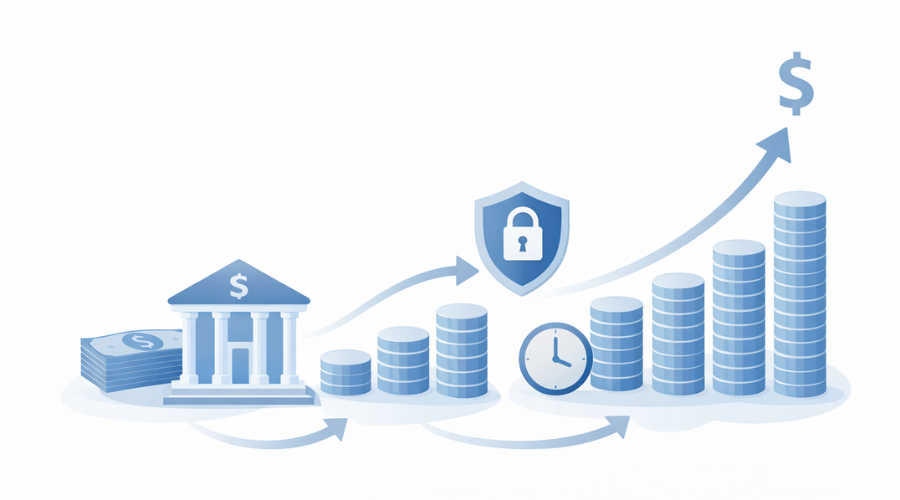
In practice, HYSAs work the same way as regular savings accounts, with a few important differences.
Where These Accounts Are Usually Offered
Most high-yield savings accounts are offered by:
- Online-only banks
- Digital divisions of large banks
- Some credit unions
Because online banks don’t maintain large branch networks, they often have lower operating costs, which allows them to pay higher interest rates to customers.
How Interest Is Earned
Interest on a high-yield savings account is typically:
- Calculated daily
- Paid monthly
The amount you earn depends on:
- Your account balance
- The stated annual percentage yield (APY)
- How long the money stays in the account
Even small APY differences can add up over time, especially for emergency funds or short-term savings goals.
Safety and Federal Protection
One of the most important things to know is that high-yield savings accounts are federally insured…
- Banks are typically insured by the FDIC
- Credit unions are typically insured by the NCUA
This insurance generally covers deposits up to the legal limit per depositor, per institution, including principal and earned interest.
This means a high-yield savings account is not inherently riskier than a regular savings account when it is held at a properly insured institution.
Why High-Yield Savings Accounts Exist at All
Banks do not offer higher interest out of generosity. They do it for practical reasons.
High-yield savings accounts help banks:
- Attract new deposits
- Compete with other online banks
- Retain customers without offering branches
For consumers, the result is a savings option that:
- Preserves capital
- Provides liquidity
- Earns more than idle cash
Common Misunderstandings
Before going deeper, it helps to clear up a few early misconceptions:
- “High-yield means high risk.”
Not when the account is federally insured. - “It’s basically an investment.”
It is not. Returns are limited but stable. - “Rates are locked forever.”
They are not. Rates can change at any time. - “Only wealthy people benefit.”
Anyone with savings can benefit, even with modest balances.
Why This Topic Matters for Everyday Americans
High-yield savings accounts often play a critical role in:
- Emergency funds
- Short-term savings goals
- Holding cash safely while planning next steps
Using the wrong account can quietly cost you money through lost interest, even if everything else in your financial life feels “fine.”
Understanding the basics puts you in a position to make smarter decisions — not bigger risks.
Who High-Yield Savings Accounts Are For — and Who Should Avoid Them
High-yield savings accounts are useful tools, but they are not universal solutions. Whether one makes sense depends on how you use your money, how soon you’ll need it, and what role that cash plays in your financial life.
Understanding where HYSAs fit — and where they don’t — helps avoid disappointment and misuse.
Who a High-Yield Savings Account Is Best For
1. People Building or Holding an Emergency Fund
For most Americans, an emergency fund is non-negotiable. Money set aside for:
- Job loss
- Medical bills
- Car or home repairs
- Unexpected travel
needs to be:
- Safe
- Liquid (easy to access)
- Not exposed to market swings
A high-yield savings account fits this role well because:
- Your money is not invested in the market
- You can access funds quickly
- You earn more interest than a traditional savings account
Who Should Be Careful With High-Yield Savings AccountsAn emergency fund is not about growth — it’s about stability. A HYSA balances safety with modest earnings.
2. Short-Term and Medium-Term Savers
If you’re saving for something within the next few months or years — such as:
- A down payment
- A vacation
- A wedding
- A major purchase
a high-yield savings account often makes sense for this type of goal.
Why?
- Market investments can lose value in the short term
- Locking money into long-term products may reduce flexibility
- HYSAs allow you to earn interest while staying ready
This is especially important when timing matters.
3. People Parking Cash Temporarily
Sometimes money is in transition:
- Proceeds from selling a home
- A bonus you haven’t allocated yet
- Funds waiting to be invested later
A high-yield savings account can serve as a temporary holding place, helping your money earn something while you decide your next move.
4. People Who Want Simplicity and Low Stress
Not everyone wants to actively manage investments or track market movements.
For people who value:
- Predictability
- Ease of use
- Clear balances
a HYSA offers peace of mind without complexity.
Who Should Be Careful With High-Yield Savings Accounts
1. Long-Term Investors Seeking Growth
If your goal is long-term wealth building — such as retirement savings decades away — a high-yield savings account is usually not sufficient.
Why?
- Over long periods, interest often struggles to outpace inflation
- Growth potential is limited
- Purchasing power can erode over time
A HYSA protects money. It does not meaningfully grow wealth over decades.
2. People Who May Need Frequent In-Person Banking
Many high-yield savings accounts are offered by online banks with:
- No physical branches
- Limited cash deposit options
If you regularly:
- Deposit cash
- Rely on in-branch services
- Prefer face-to-face assistance
an online-only HYSA may not be the best fit.
3. People Who Struggle With Over-Accessing Savings
Easy access can be helpful — but it can also work against you.
If you:
- Frequently dip into savings for non-emergencies
- Have trouble separating spending money from savings
then the convenience of a HYSA could work against you.
In some cases, a slightly less accessible account structure helps protect savings behaviorally.
Real-Life Example Scenarios
Example 1: Emergency Fund Holder
Maria keeps six months of living expenses in a high-yield savings account. She earns interest while knowing the money is available if she loses her job or faces medical bills.
Example 2: Short-Term Goal Saver
David plans to buy a car in 12 months. He avoids investing the money because market swings could hurt his timeline. A HYSA gives him modest growth with minimal risk.
Example 3: Long-Term Investor
Angela saves for retirement in tax-advantaged investment accounts. She uses a HYSA only for emergency savings, not for long-term wealth growth.
A Common Beginner Mistake
One of the most frequent misunderstandings is treating a high-yield savings account as a replacement for investing.
That’s simply not what a HYSA is designed to do.
A healthy financial system often uses:
- Savings accounts for safety and short-term needs
- Investments for long-term growth
Confusing the two can lead to missed opportunities or unnecessary risk.
In short:
- High-yield savings accounts are ideal for safety-focused money
- They are not designed for long-term wealth building
- Who you are and what you’re saving for matters more than the rate
Pros and Cons of High-Yield Savings Accounts (The Real Trade-Offs)
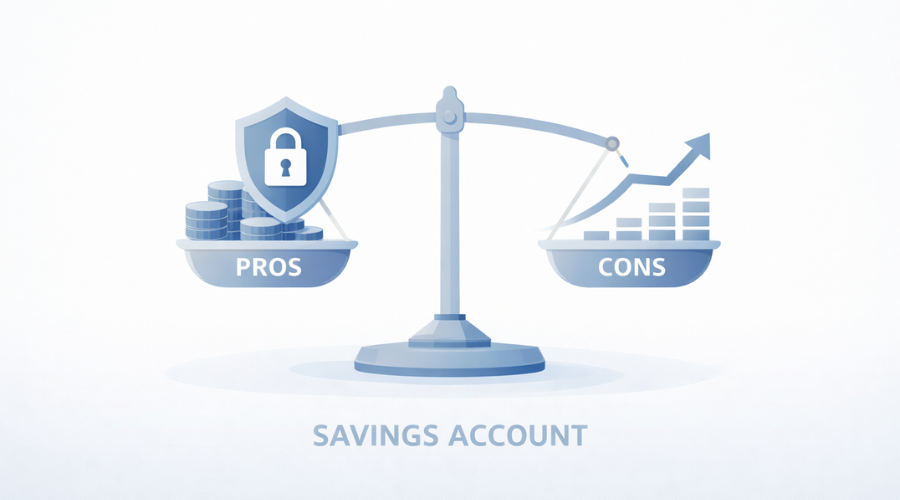
High-yield savings accounts are often described as “better” savings accounts. That’s only partly true. They come with clear advantages — and equally important limitations.
Understanding both sides helps you use them correctly, rather than reacting to hype.
Advantages of a High-Yield Savings Account
1. Higher Interest Than Traditional Savings
The most obvious benefit is the interest rate.
Compared to many traditional savings accounts, a HYSA:
- Pays meaningfully more interest
- Helps reduce the opportunity cost of holding cash
- Rewards patience rather than short-term speculation
While it won’t make you rich, it prevents your money from sitting completely idle.
2. Strong Safety for Cash Holdings
When held at a federally insured institution, a high-yield savings account offers:
- Principal protection
- Insurance up to legal limits
- No market exposure
This makes it suitable for money that cannot afford losses, even temporary ones.
Safety applies only when the institution is properly insured. Always verify coverage.
3. High Liquidity and Flexibility
Most HYSAs allow you to:
- Withdraw funds electronically
- Transfer money to checking accounts
- Access savings without penalties
This flexibility is critical for:
- Emergency funds
- Short-term needs
- Uncertain timelines
4. Simplicity and Transparency
HYSAs are generally:
- Easy to understand
- Easy to track
- Easy to explain
There are no complex formulas, lock-up periods, or performance surprises.
For many people, this simplicity reduces financial stress.
Disadvantages and Limitations
1. Interest Rates Are Variable
One of the most misunderstood aspects of high-yield savings accounts is that rates can change at any time.
Banks adjust APYs based on:
- Federal interest rate changes
- Competitive pressure
- Internal funding needs
There is no guarantee today’s rate will exist tomorrow.
2. Limited Growth Potential
Even at higher rates, HYSAs:
- Rarely beat inflation consistently over long periods
- Do not compound like long-term investments
- Protect value more than they meaningfully grow it
This makes them unsuitable for goals that are decades away.
3. Inflation Risk Over Time
Although safer than holding cash in a checking account, a HYSA can still lose purchasing power if inflation exceeds the interest earned.
This risk is subtle but real, especially when:
- Inflation rises quickly
- Rates lag behind economic changes
4. Fewer In-Person Services
Many high-yield savings accounts are offered online only.
This often means:
- No branch access
- Delays for cash deposits
- Reliance on digital tools
For some users, this trade-off is acceptable. For others, it’s a deal-breaker.
5. Behavioral Risks
Ease of access can encourage:
- Unnecessary withdrawals
- Treating savings like spending money
- Erosion of emergency funds
The account itself isn’t the problem; behavior often is.
Pros vs Cons Summary Table
| Aspect | Benefit | Limitation |
|---|---|---|
| Interest | Higher than standard savings | Still limited growth |
| Safety | Federally insured | Must verify coverage |
| Access | Easy withdrawals | Can tempt overspending |
| Stability | No market risk | Inflation can erode value |
| Convenience | Simple and clear | Often online-only |
The Balanced Perspective
A high-yield savings account works best when you:
- Use it for the right purpose
- Understand its limitations
- Pair it with other financial tools
It is not a shortcut or an investment replacement. It is a supporting tool in a broader financial system.
Risks, Downsides, and Common Mistakes to Avoid
High-yield savings accounts are low-risk tools, but low risk does not mean no risk. Most problems come not from the account itself, but from misunderstandings about how it should be used.
This section looks at the issues that quietly cause people to lose money, flexibility, or financial discipline over time.
Key Risks to Be Aware Of
1. Rate Volatility Risk (Not Loss of Principal)
The biggest risk with a HYSA is rate uncertainty, not losing your money.
- The bank can lower the APY at any time
- Rates often change without much notice
- A competitive rate today may be average tomorrow
In real terms, this means you can’t plan long-term returns based on today’s rate.
A HYSA should never be used for:
- Guaranteed future growth assumptions
- Long-term return planning
- Rate chasing as a strategy
2. Inflation Risk (The Silent One)
Even when your balance grows, your purchasing power may not.
If:
- Inflation is higher than your APY
- Rates fail to adjust quickly
then your savings can buy less, not more, over time.
This doesn’t make HYSAs bad; it simply defines what they’re best used for.
3. Access and Timing Risk
While HYSAs are liquid, access is not always instant.
Possible delays include:
- Transfer processing times
- Verification holds
- Bank-specific withdrawal policies
For this reason, a HYSA should not replace a checking account used for daily spending.
And keep:
Keep spending money separate.
Common Mistakes People Make With High-Yield Savings Accounts
Mistake 1: Treating a HYSA Like an Investment
This is the most common and costly mistake.
A HYSA:
- Preserves money
- Earns modest interest
- Does not build wealth
Using it instead of long-term investments can lead to missed opportunities, not added safety.
Mistake 2: Constantly Chasing the Highest Rate
Some people move money every time they see a slightly higher APY elsewhere.
Problems with this approach:
- Time and effort outweigh benefits
- Rates change frequently
- Introductory rates may expire
- Transfers can create delays and errors
Stability often matters more than squeezing every basis point.
Mistake 3: Ignoring Insurance Coverage Limits
Federal deposit insurance has limits per depositor, per institution.
Mistakes include:
- Holding too much money at one uninsured institution
- Assuming all accounts are automatically insured
- Forgetting that interest counts toward coverage limits
It’s important to confirm that the institution is insured and your total balances stay within coverage limits.
Mistake 4: Using One Account for Everything
Mixing:
- Emergency savings
- Short-term goals
- Spending buffers
in one HYSA can cause confusion and overspending.
Clear separation improves financial behavior.
Mistake 5: Forgetting About Taxes
Interest earned in a high-yield savings account is taxable income at the federal level.
Many people:
- Forget to account for taxes
- Overestimate their “real” return
- Are surprised at tax time
Taxes are covered in detail in the next section.
Practical Habits That Help
To use a HYSA responsibly:
- Assign it a specific purpose
- Avoid frequent withdrawals
- Review rates periodically, not obsessively
- Pair it with checking and investment accounts
- Factor in taxes and inflation
In practice:
- The biggest risks are behavioral and inflation-related, not safety-related
- A HYSA should support your financial system, not replace it
- Clear purpose prevents misuse
Taxes, Legal Rules, and U.S. Regulatory Considerations
High-yield savings accounts feel simple — and functionally, they are — but they still operate inside the U.S. tax and banking system. Ignoring this side can lead to confusion at tax time or false assumptions about “net returns.”
This section explains what actually applies under U.S. law, without unnecessary complexity.
How Interest From a HYSA Is Taxed in the U.S.
Interest Is Taxable at the Federal Level
Interest earned in a high-yield savings account is considered ordinary income under U.S. tax law.
That means:
- It is not capital gains
- It is not tax-deferred
- It is taxed at your regular federal income tax rate
Even if you do not withdraw the interest, it is still taxable in the year it is credited to your account.
How Banks Report Your Interest
If you earn interest above the reporting threshold:
- Your bank will issue Form 1099-INT
- A copy is sent to you and to the IRS
- The amount must be included on your federal tax return
Even if you do not receive a form due to a low amount, the income may still be taxable. Reporting rules and tax obligations are not the same thing.
State and Local Taxes
State treatment varies:
- Some states tax savings interest
- Some states do not tax personal income at all
There is no universal rule. Your actual tax impact depends on where you live and your total income.
How Taxes Affect “Real” Returns
A common misunderstanding is focusing only on the posted APY.
What actually matters is:
- APY
- Minus federal taxes
- Minus any applicable state taxes
- Minus inflation
This doesn’t make HYSAs unattractive; it simply places them in the correct role—preservation, not aggressive growth.
FDIC and NCUA Insurance Rules (High-Level)
High-yield savings accounts are typically insured when held at:
- FDIC-insured banks
- NCUA-insured credit unions
Insurance generally:
- Covers deposits up to the legal limit
- Includes principal and earned interest
- Applies per depositor, per institution, per ownership category
It’s important to understand that insurance does not protect against inflation, rate reductions, or behavioral mistakes—it only protects against institutional failure.
Are There Withdrawal Limits or Penalties?
Historically, federal rules limited certain savings withdrawals per month. While enforcement has changed, many banks still:
- Impose internal limits
- Restrict certain transaction types
- Reserve the right to reclassify accounts
You should always review:
- Account disclosures
- Transfer policies
- Internal bank rules
These are bank policies, not universal laws.
No Built-In Tax Advantages
Unlike retirement accounts:
- HYSAs offer no tax shelter
- No deductions
- No deferrals
- No credits
This is why they are best used for accessible savings, not long-term tax planning.
Legal Safety vs Financial Strategy
From a legal standpoint:
- High-yield savings accounts are straightforward
- Well-regulated
- Designed for consumer protection
From a strategy standpoint:
- They are a tool, not a complete financial plan.
- Best used intentionally, not passively
- Most effective when paired with other account types
In practice:
- HYSA interest is taxable income
- Taxes reduce real returns
- Insurance protects deposits, not purchasing power
- There are no built-in tax advantages
How High Yield Savings Accounts Compare — and How to Use Them Correctly
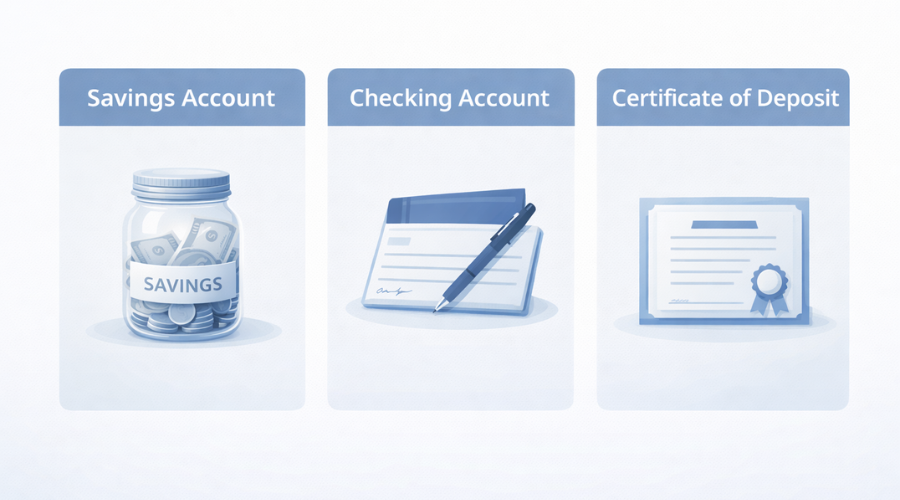
High-yield savings accounts make the most sense when you understand what they are competing with and how they fit into a broader money system. This section puts HYSAs side by side with common alternatives and explains how to use them in a practical way that reduces common mistakes.
HYSA vs Other Common Places to Keep Cash
High Yield Savings Account vs Traditional Savings
What’s different:
- Interest rate (higher vs very low)
- Often online-only vs branch-based
- Similar safety and insurance when properly covered
What’s the same:
- Savings account structure
- Liquidity
- Federal insurance rules
If you already keep savings in a traditional account, moving to a HYSA is often a functional upgrade rather than a new strategy.
High-Yield Savings Account vs Checking Account
Checking accounts are built for:
- Spending
- Bill payments
- Frequent transactions
HYSAs are built for:
- Storing money
- Earning interest
- Limited movement
In simple terms, checking accounts handle money flow, while HYSAs are better for storing cash.
Keep this line (excellent):
Mixing the two increases the chance of overspending savings.
High Yield Savings Account vs Certificates of Deposit (CDs)
| Feature | HYSA | CD |
|---|---|---|
| Liquidity | High | Low to medium |
| Rate stability | Variable | Usually fixed |
| Penalties | Rare | Common for early withdrawal |
| Best for | Flexible savings | Locked-in timelines |
If flexibility matters, HYSAs usually make more sense. If you can lock money away for a known period, CDs may offer more predictability.
High Yield Savings Account vs Money Market Accounts
Money market accounts often:
- Look similar to HYSAs
- Offer competitive rates
- Include limited check-writing or debit access
Differences depend heavily on the institution.
Naming conventions vary, so it’s important to look at insurance status, fees, and access rules—not just the product name.
Step-by-Step: Using a HYSA the Right Way
This is a behavior-first approach, not a rate-chasing one.
Step 1: Define the Purpose Clearly
Decide what the money is for:
- Emergency fund
- Short-term goal
- Temporary holding
If you can’t explain the purpose in one sentence, the account will likely be misused.
Step 2: Separate It From Daily Spending
Link the HYSA to:
- A checking account for transfers
- Not to debit cards or spending tools (if avoidable)
Friction helps protect savings.
Step 3: Automate Thoughtfully
Automation works best when:
- Transfers are predictable
- Withdrawals are intentional
- You review balances periodically
Avoid constant tinkering.
Step 4: Review Rates Periodically, Not Constantly
A reasonable cadence:
- Every few months
- Or when economic conditions change meaningfully
Chasing every short-term rate change rarely improves outcomes.
Step 5: Reassess as Life Changes
Your HYSA balance may need adjustment when:
- Income changes
- Expenses increase or decrease
- Goals shift
- Family circumstances change
The account should evolve with your life.
Myths vs Facts
Myth: High yield savings accounts are “too good to be true.”
Fact: They reflect lower overhead and competitive banking, not hidden risk.
Myth: You should move money every time you see a higher rate.
Fact: Rate stability and usability often matter more than small differences.
Myth: HYSAs replace investing.
Fact: They serve entirely different purposes.
In practice:
- HYSAs are storage tools, not growth engines
- They work best alongside checking and investment accounts
- Correct usage matters more than the headline rate
Frequently Asked Questions About High-Yield Savings Accounts
Below are questions people commonly search for when trying to understand high-yield savings accounts in the U.S.
What is considered a good APY for a high-yield savings account?
A “good” APY is relative rather than absolute. It depends on:
– Current U.S. interest rate environment
– What large, competitive banks are offering at the same time
Rather than chasing the highest number, compare:
– The rate to the national average
– Whether the rate is promotional or ongoing
– The bank’s history of adjusting rates over time
A reasonable, consistently competitive rate is often better than a temporarily high one.
Are high-yield savings accounts safe during a recession?
When held at a federally insured bank or credit union, the safety of your deposits does not depend on the economy.
What can change during a recession:
– Interest rates may fall
– APYs may decrease
What does not change:
– Federal deposit insurance coverage
– Your principal balance (absent withdrawals)
Safety and return are separate issues.
Can I lose money in a high yield savings account?
You generally cannot lose principal due to market movements.
However, you can lose value indirectly through:
– Inflation outpacing interest
-Taxes reducing net returns
– Behavioral mistakes (withdrawing savings unnecessarily)
The risk is erosion, not sudden loss.
How often do HYSA interest rates change?
There is no fixed schedule for rate changes.
Banks may adjust rates:
– When federal interest rates change
– In response to competition
– Based on internal funding needs
Rates can change multiple times a year — or remain stable for long periods.
Is interest earned daily or monthly?
Interest is usually:
– Calculated daily
– Paid monthly
Daily calculation benefits you when balances fluctuate, but the difference is usually modest for most savers.
Do high-yield savings accounts affect my credit score?
No.
Savings accounts:
– Are not reported to credit bureaus
– Do not involve borrowing
– Do not impact credit utilization or payment history
They exist entirely outside the credit scoring system.
Can I have more than one high-yield savings account?
Yes, you can.
Some people use multiple accounts to:
– Separate goals
– Manage insurance limits
– Improve organization
The key is clarity, not quantity.
Is a HYSA better than keeping cash in checking?
For money you do not plan to spend soon, usually yes.
Checking accounts prioritize:
– Access
– Transactions
HYSAs prioritize:
– Preservation
– Interest
Using each account for its intended role improves outcomes.
Should I move all my savings into a high-yield account?
Not necessarily.
Before moving money, consider:
– Access needs
– Bank transfer timing
– How much liquidity you truly need
A partial move is often more practical than an all-or-nothing approach.
Are online-only high-yield savings accounts legitimate?
Yes, many are.
Legitimacy depends on:
-Federal insurance
– Clear disclosures
– Regulatory compliance
Being online-only does not make a bank unsafe — lack of insurance does.
Why does my HYSA earn less than advertised?
Common reasons include:
– Rate changes after account opening
– Balance tiers
– Introductory rates ending
– Timing of interest posting
It’s always worth reviewing the account’s current terms, not just the rate advertised when you opened it.
Final Perspective — When a High-Yield Savings Account Makes Sense
A high-yield savings account is not a trick, shortcut, or standalone financial upgrade.
It works best when you use it intentionally and:
- Use it for specific purposes
- Understand its limits
- Accept modest, predictable returns
- Combine it with other financial tools
For many people, it often serves as:
- A safe place for emergency funds
- A holding space for near-term goals
- A buffer between spending and investing
Used correctly, it supports financial stability. Used incorrectly, it can create false expectations.
Disclaimer
This content is provided for educational and informational purposes only.
It is not financial, tax, or legal advice. Banking rules, interest rates, tax treatment, and insurance coverage can vary by institution, state, and individual financial situation.
Before making personal financial decisions, you should consult a qualified financial professional, tax advisor, or legal expert who understands your specific circumstances.

5 thoughts on “High Yield Savings Account: What It Is, How It Works, and When It Makes Sense”