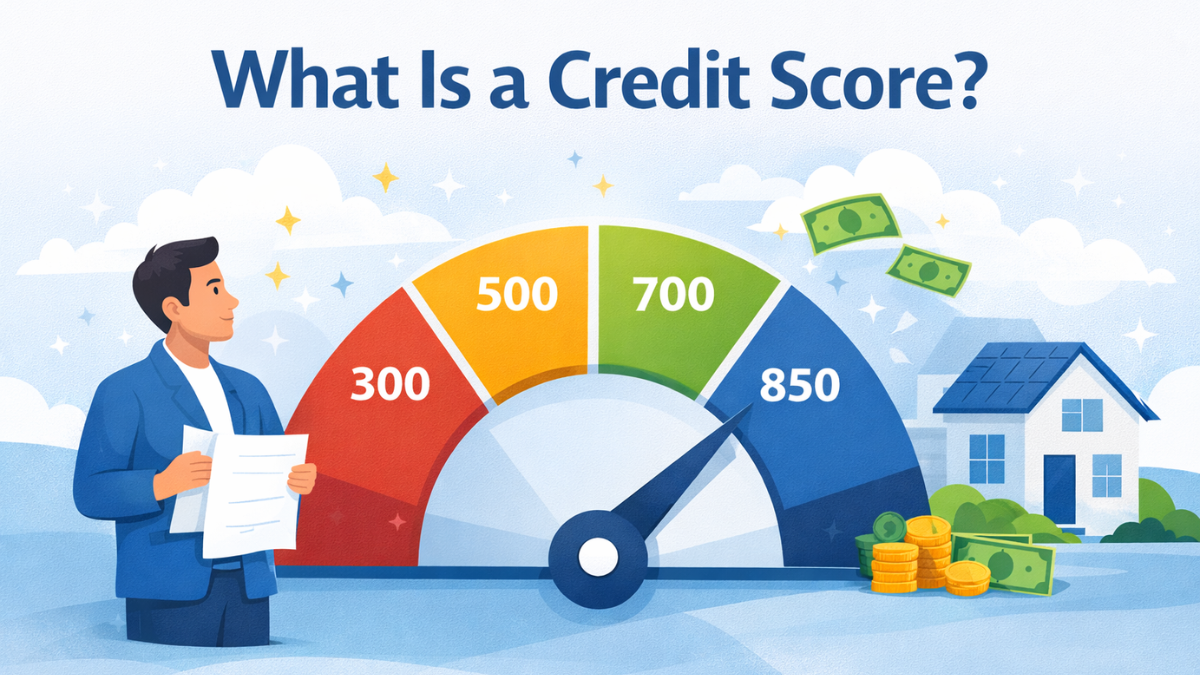
Money decisions in the United States often come down to one quiet number working behind the scenes. It can influence whether you’re approved for a credit card, how much interest you pay on a car loan, whether a landlord rents to you, or even how much you pay for insurance in some states. That number is your credit score.
Many people first learn about credit scores after something goes wrong — a loan denial, an unexpectedly high interest rate, or a rejected rental application. Others assume credit scores are mysterious, fixed, or easy to “hack.” None of that is true. Credit scores follow specific rules, and once you understand those rules, they become far less intimidating.
What is a credit score?

A credit score is a three-digit number designed to predict how likely you are to repay borrowed money on time.
In simple terms:
- A credit score is a risk score
- Lenders use it to estimate how risky it is to lend you money
- Higher scores generally mean lower risk
- Lower scores suggest higher risk
Most U.S. credit scores fall between 300 and 850. The closer your score is to 850, the more favorably lenders usually view you.
What a credit score is not
A credit score is often misunderstood. It is not:
- A measure of how wealthy you are
- A judgment of your character
- A record of your income or job title
- A permanent label you’re stuck with for life
Your credit score reflects patterns of behavior, not who you are as a person. And because it’s based on ongoing activity, it can change — for better or worse — over time.
Why credit scores matter in real American life
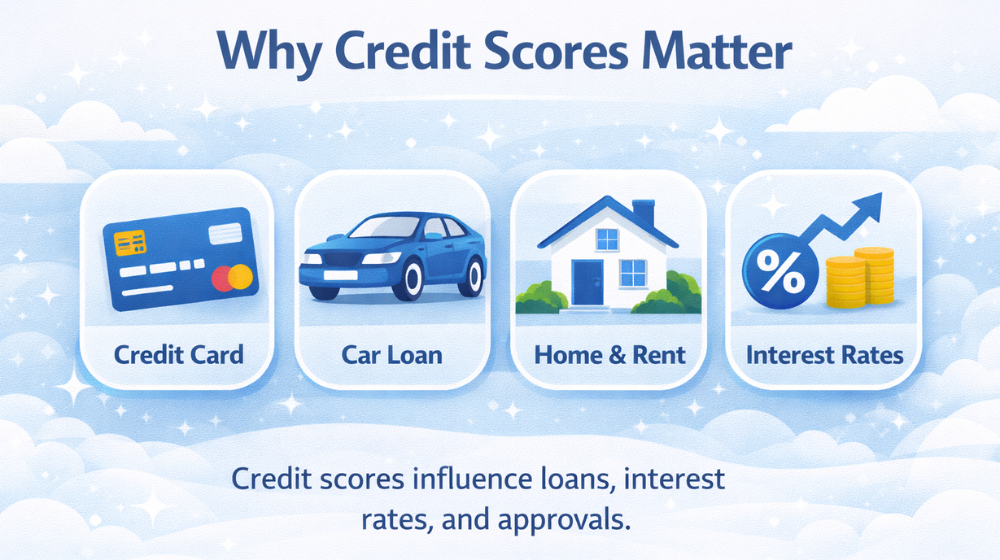
In the U.S., credit scores are woven into everyday systems. They can affect:
- Loan approvals (credit cards, auto loans, mortgages)
- Interest rates and borrowing costs
- Rental housing decisions
- Utility deposits (electricity, gas, internet)
- Insurance pricing in many states
- Employment checks for certain roles (credit report, not score)
Even small differences in a credit score can translate into thousands of dollars over time through higher or lower interest costs.
Key takeaway: A credit score doesn’t just affect whether you’re approved — it affects how expensive borrowing becomes once you are approved.
Who creates and tracks credit scores in the U.S.?
Your credit information is collected by three major consumer credit bureaus:
These bureaus gather data from lenders and creditors, such as:
- Credit card companies
- Banks and credit unions
- Auto lenders
- Mortgage servicers
Using this data, scoring models calculate your credit score. Different lenders may use different models, which is why your score can vary slightly depending on where you check it.
The basic credit score ranges (high-level)
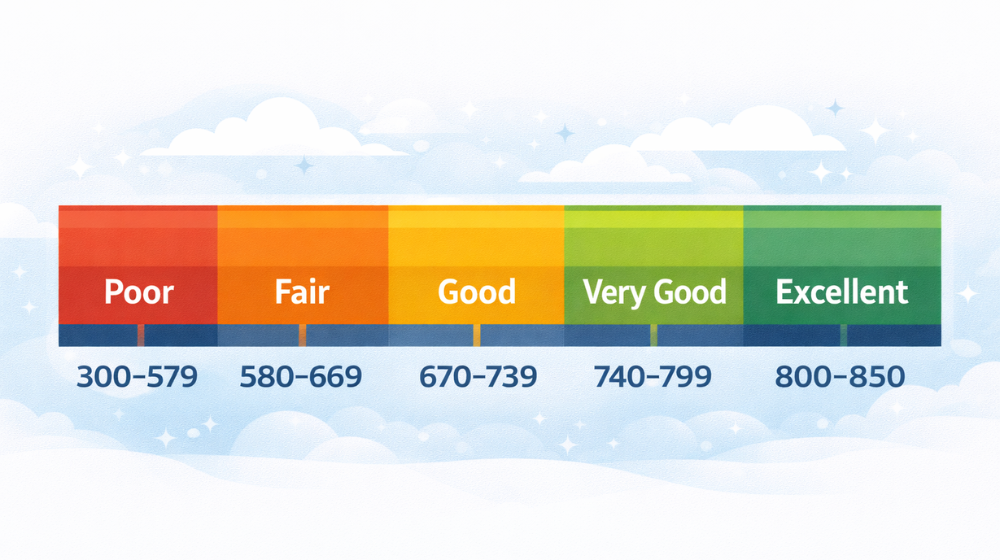
While exact cutoffs vary by scoring model and lender, scores are often grouped like this:
| Credit Score Range | General Meaning |
|---|---|
| 300–579 | Poor |
| 580–669 | Fair |
| 670–739 | Good |
| 740–799 | Very Good |
| 800–850 | Excellent |
Important: There is no single “magic number” that guarantees approval. Lenders look at your score along with your credit history, income, and overall financial picture.
A common beginner misunderstanding
Many people believe checking their credit score lowers it. This is a myth.
- Checking your own credit score is a soft inquiry
- Soft inquiries do not affect your credit score
- Monitoring your credit is generally a healthy habit
Score drops usually come from late payments, high balances, missed bills, or certain types of credit applications — not from simply looking at your score.
This foundation matters because everything else — how scores are calculated, how to build credit, and how to avoid damage — builds on these basics.
How Credit Scores Are Calculated in the United States
Understanding how a credit score is calculated removes most of the fear and confusion around it. Credit scores are not random. They are based on specific factors, weighted in predictable ways.
While multiple scoring models exist, the most widely used system in the U.S. is the FICO Score. Most major lenders rely on some version of it when making decisions.
The five main factors that shape your credit score
A FICO score is calculated using five core categories. Each reflects a different aspect of how you handle credit.
| Factor | Approximate Weight |
|---|---|
| Payment history | ~35% |
| Amounts owed (credit utilization) | ~30% |
| Length of credit history | ~15% |
| Credit mix | ~10% |
| New credit inquiries | ~10% |
These percentages are not exact formulas, but they accurately reflect what matters most.
1. Payment history (the single most important factor)
Payment history shows whether you pay your bills on time.
It includes:
- Credit card payments
- Loan payments (auto, student, mortgage)
- Any reported missed or late payments
What hurts the most:
- Late payments, especially 30+ days past due
- Collections
- Charge-offs
- Defaults
Important warning: Even one missed payment can damage a strong credit score, especially if the score was previously high.
On-time payments, over time, are the strongest foundation of a healthy credit profile.
2. Amounts owed (credit utilization)
This factor looks at how much of your available credit you are using, not how much you owe in total.
Example:
- Credit card limit: $5,000
- Balance: $1,500
- Utilization: 30%
Lower utilization generally helps your score. High utilization suggests financial strain, even if payments are on time.
General guidance (not a rule):
- Below 30% utilization is often viewed favorably
- Lower is usually better
Key misunderstanding: Paying interest does not help your score. Carrying balances does not build credit faster.
3. Length of credit history
This measures how long you’ve been using credit.
It considers:
- Age of your oldest account
- Average age of all accounts
Longer histories help because they provide more data about your habits. This is why closing old accounts can sometimes hurt a score, even if they’re paid off.
Reality check: Time matters here. There’s no shortcut for length — consistency over years is what builds this factor.
4. Credit mix
Credit mix looks at the types of credit you’ve used, such as:
- Credit cards (revolving credit)
- Auto loans
- Student loans
- Mortgages
A mix shows you can handle different kinds of obligations. However, this factor is less important than payment history or utilization.
Do not open loans just to improve credit mix.
That usually creates more risk than benefit.
5. New credit inquiries
When you apply for new credit, lenders may check your report. These are called hard inquiries.
- A few inquiries are normal
- Many inquiries in a short time can lower your score temporarily
Hard inquiries usually affect your score for a short period and fade over time.
Exception: Certain loan applications (like auto or mortgage shopping) are often grouped together if done within a short window, so rate-shopping doesn’t overly penalize you.
Why scores can differ between places
It’s normal to see different credit scores depending on where you check.
Reasons include:
- Different scoring models
- Different bureau data
- Timing of recent updates
A small difference does not mean something is wrong.
A critical takeaway
Credit scores reward patterns, not perfection.
They respond to habits over time — paying on time, keeping balances manageable, and avoiding unnecessary credit stress.
Once you understand the calculation, the system becomes predictable instead of intimidating.
Where Credit Scores Are Used — and Who Looks at Them
Credit scores don’t live only inside banks. In the United States, they influence many everyday decisions — sometimes in places people don’t expect.
Lenders and financial institutions
This is the most common use.
Credit scores help lenders decide:
- Whether to approve or deny an application
- What interest rate to offer
- What fees or terms apply
They’re used for:
- Credit cards
- Auto loans
- Mortgages
- Personal loans
A higher score doesn’t just improve approval odds — it often lowers the long-term cost of borrowing.
Landlords and rental housing
Many landlords review a credit report (and sometimes a score) when screening tenants.
They may look for:
- On-time payment patterns
- Past evictions or collections
- Overall financial reliability
Important: Some landlords focus more on negative marks than the exact number. Others use minimum score thresholds. Practices vary by location and property type.
Utilities and service providers
Utility companies may check credit to decide:
- Whether a security deposit is required
- How large that deposit must be
This can apply to:
- Electricity and gas
- Internet and cable
- Cell phone plans
Lower scores often result in higher upfront deposits.
Insurance pricing (in many states)
In many states, insurers use credit-based insurance scores to help set premiums.
These are not identical to standard credit scores, but they rely on similar data patterns.
Key limitations:
- Not allowed in every state
- Rules vary by state law
- Insurers cannot use income, race, or religion
Credit history can still influence insurance costs where legally permitted.
Employment background checks (limited use)
Some employers review credit reports (not scores) for certain positions, especially roles involving:
- Financial responsibility
- Access to sensitive information
They must follow federal rules and obtain written permission.
Important distinction: Employers do not see your credit score — only a modified credit report, and only if you consent.
Different scoring models in real life
While FICO is dominant, some lenders use alternative models like VantageScore.
This explains why:
- Scores can differ across platforms
- One lender approves while another declines
The underlying credit behavior matters more than the exact number.
Who credit scores are really for — and who they aren’t
Credit scores are designed for risk evaluation, not personal judgment.
They work best when:
- You borrow responsibly
- You understand how your actions affect the score
- You avoid emotional decisions tied to the number
They are not meant to:
- Define your financial worth
- Replace income verification
- Predict future success
A common mistake to avoid
Mistake: Trying to keep a credit score perfect at all costs.
Reality: A “good enough” score often qualifies for the same rates as a perfect one.
Chasing small increases by taking unnecessary risks can backfire.
Who Credit Scores Are For — and Who Should Be Careful
Credit scores are powerful tools, but they are not universally helpful in the same way for everyone. Understanding who benefits most — and who should be cautious — prevents many common financial mistakes.
Who credit scores are most useful for
Credit scores tend to work in your favor if you:
- Use credit cards primarily for convenience, not survival
- Pay bills on time and in full (or close to it)
- Borrow for long-term needs like education, transportation, or housing
- Plan to apply for loans, rent housing, or refinance in the future
For these individuals, credit scores help:
- Reduce borrowing costs
- Increase approval options
- Provide flexibility during emergencies
When managed carefully, credit becomes a tool, not a trap.
Who should be cautious with credit
Credit can create problems when it’s used to cover structural issues.
Extra caution is needed if you:
- Regularly rely on credit to cover basic living expenses
- Carry high balances month after month
- Miss payments due to unstable income
- Feel pressure or anxiety around credit usage
In these cases, focusing solely on improving a score without addressing cash flow can lead to long-term financial stress.
Critical warning: Improving a credit score does not fix spending problems or income gaps. It only reflects how debt is handled — not whether debt is necessary.
Young adults and first-time credit users
For people new to credit, scores often start low or nonexistent.
This is normal.
Early-stage credit profiles:
- Are sensitive to small mistakes
- Improve quickly with consistent on-time payments
- Don’t require complex strategies
Best practice: Start slow, use small amounts, and focus on habits — not numbers.
People living mostly cash-only
Some people avoid credit entirely by choice.
This can work if:
- Income is stable
- Savings are sufficient
- Housing and utilities don’t require credit checks
However, a complete lack of credit history can still create friction when:
- Renting an apartment
- Setting up services
- Applying for a mortgage later
A thin credit file isn’t bad — but it can limit options.
The emotional side of credit scores
One of the most overlooked risks is emotional decision-making.
Common emotional traps include:
- Obsessively checking scores
- Feeling shame about a low number
- Taking unnecessary actions for small score gains
Important reminder: A credit score is a measurement tool, not a scoreboard for self-worth.
A realistic perspective
Credit scores are most effective when treated as:
- A long-term indicator
- A reflection of patterns
- One part of a broader financial picture
They are least effective when treated as:
- A goal by themselves
- A substitute for budgeting or savings
- A source of validation
Pros and Cons of Credit Scores — The Benefits and the Trade-Offs
Credit scores can make financial life easier — but they also come with real downsides. Seeing both sides clearly helps you use credit intentionally instead of emotionally.
The benefits of having a good credit score
1. Lower borrowing costs
This is the most direct and measurable benefit.
A higher credit score often leads to:
- Lower interest rates
- Fewer required fees
- Better repayment terms
Over time, even small rate differences can save thousands of dollars, especially on auto loans and mortgages.
2. Easier approvals and fewer obstacles
Strong credit reduces friction when you:
- Apply for credit cards or loans
- Rent an apartment
- Set up utilities or phone plans
You spend less time explaining your situation or searching for alternatives.
3. Financial flexibility in emergencies
Good credit can act as a temporary safety net when:
- Income is interrupted
- Unexpected expenses arise
Important caution: This flexibility helps only when balances are managed carefully. Emergency credit should not become permanent debt.
4. More choice and negotiating power
With strong credit, you:
- Have more lenders to choose from
- Can compare offers instead of taking the first approval
- Are less likely to accept unfavorable terms out of necessity
Choice itself has value.
The downsides and risks of credit scores
1. Encourages debt dependence
Easy access to credit can:
- Delay addressing spending problems
- Mask income shortfalls
- Increase long-term financial pressure
Credit can smooth short-term issues while quietly worsening the underlying problem.
2. Scores can drop faster than they rise
Credit scores are asymmetrical:
- One missed payment can cause sharp damage
- Recovery often takes much longer
This can feel discouraging, especially for people rebuilding credit.
3. Not all scoring factors feel fair
Credit scores don’t account for:
- Job loss timing
- Medical emergencies
- Rising living costs
While the system is data-driven, it doesn’t always reflect real-life hardship.
4. Psychological stress and over-focus
For some people, credit scores:
- Create anxiety or shame
- Lead to constant checking
- Encourage unnecessary financial moves
Key reality: Beyond a certain point, higher scores don’t meaningfully improve outcomes.
A balanced takeaway
Credit scores are tools, not goals.
They work best when:
- Used to lower costs
- Managed calmly
- Integrated into a broader financial plan
They work poorly when:
- Treated as a personal judgment
- Chased at the expense of savings or stability
- Used to justify ongoing debt
When credit scores are used thoughtfully, their benefits can outweigh their limitations. The key is understanding what they can help with — and what they cannot fix.
Risks, Common Mistakes, and Myths vs. Facts About Credit Scores
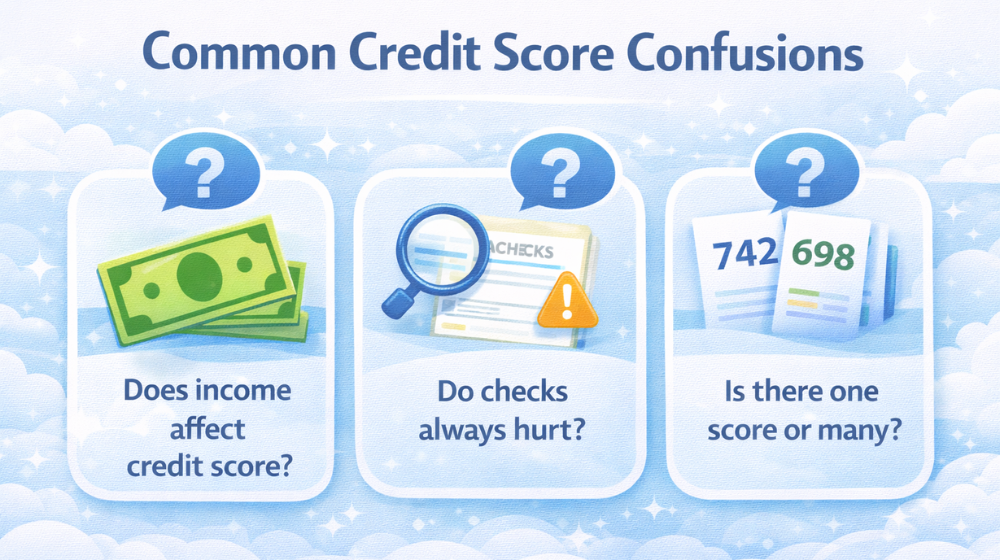
Many credit score problems don’t come from lack of effort — they come from misunderstandings. Clearing up common mistakes and myths can prevent long-lasting damage.
Common risks and mistakes to avoid
1. Missing a payment by “just a few days”
Reality: Most lenders report payments as late only after 30 days, but fees and interest can begin earlier.
Why this matters:
- A 30-day late mark can significantly lower a strong score
- The mark can stay on your credit report for up to seven years
Safer habit: Automate at least the minimum payment to reduce the risk of accidental damage.
2. Maxing out credit cards, even temporarily
Using a large portion of your credit limit — even if you plan to pay it off — can cause short-term score drops due to high utilization.
Key point: Credit scores often reflect the balance reported, not the balance after you pay later.
3. Closing old credit cards without thinking it through
Closing an old card can:
- Reduce your available credit
- Increase utilization
- Shorten average account age
This doesn’t always hurt, but it often surprises people.
Balanced approach:
If a card has no annual fee and isn’t causing spending problems, keeping it open can help.
4. Applying for too much credit at once
Multiple applications in a short period can:
- Add several hard inquiries
- Signal financial stress to lenders
This can temporarily reduce your score and approval odds.
5. Confusing income with creditworthiness
Income helps you afford payments, but credit scores reflect whether you actually make them.
Someone with modest income and consistent habits can have better credit than a high earner with irregular payments.
Myths vs. facts
| Myth | Fact |
|---|---|
| Checking your score lowers it | False — checking your own score is a soft inquiry |
| Carrying a balance builds credit | False — interest payments don’t improve scores |
| You need debt to have good credit | Partly false — you need credit history, not ongoing debt |
| A perfect score is necessary | False — “good” is often enough for top rates |
| Closing paid accounts always helps | False — it can sometimes hurt |
A practical mindset shift
Instead of asking:
“How do I raise my score fast?”
Ask:
“What habits will keep my score stable over time?”
Credit scores respond best to boring consistency, not clever tricks.
When to worry — and when not to
You should pay attention if:
- You’re missing payments
- Balances keep rising
- Collections or errors appear
You don’t need to worry about:
- Minor monthly fluctuations
- One-time small changes
- Comparing your score to others
Most credit score damage comes from small misunderstandings repeated over time. Once the myths are cleared, protecting your score becomes much simpler and less stressful.
Real-Life U.S. Examples — How Credit Scores Affect Outcomes
Seeing how credit scores work in real situations makes their impact clearer. Below are common, realistic scenarios many Americans face.
Example 1: Auto loan approval and cost
Two borrowers apply for the same used car loan:
- Borrower A: Good credit
- Borrower B: Fair credit
Both qualify, but the interest rates differ.
What changes in practice:
- Borrower A pays less interest each month
- Borrower B pays more over the life of the loan
Key point: Approval alone doesn’t tell the full story. The rate determines the real cost.
Example 2: Renting an apartment
A landlord reviews applications for the same unit.
- Applicant 1 has a clean report with on-time payments
- Applicant 2 has recent late payments and collections
Even with similar income:
- Applicant 1 may be approved faster
- Applicant 2 may be asked for a higher deposit or a co-signer
Important: Many landlords care more about recent negative marks than the exact score number.
Example 3: Credit cards and limits
Two people are approved for the same credit card.
- One receives a higher credit limit
- The other receives a lower limit
This affects:
- Spending flexibility
- Credit utilization ratios
- How quickly balances feel “maxed out”
Higher limits don’t mean permission to spend more — they often reflect lower perceived risk.
Example 4: Insurance pricing (where allowed)
In states that permit it, insurers may use credit-based insurance scores.
- Strong credit patterns may lead to lower premiums
- Riskier patterns may increase costs
Rules vary by state, and insurers cannot use personal characteristics like race or income.
Example 5: Rebuilding after a setback
Someone experiences:
- A medical emergency
- Temporary income loss
- Missed payments
Their score drops. Over time, as payments return to normal and balances fall:
- The score gradually improves
- Older negatives matter less
Reality: Credit recovery is usually slow but steady, not instant.
Why lenders care about patterns, not stories
Lenders generally don’t see:
- Why a payment was late
- What caused financial stress
They see patterns over time. This is why consistency matters more than explanations.
Consumer protections to know about
Federal law provides important rights, including:
- Access to free credit reports
- The ability to dispute errors
- Limits on how long negative items stay on reports
Agencies like the Consumer Financial Protection Bureau oversee many of these protections.
Practical takeaway
Credit scores don’t determine your future — but they shape the terms you’re offered along the way. Understanding how they play out in real decisions helps you use credit with intention, not fear.
How to Check, Monitor, and Protect Your Credit Score
Knowing your credit score is only useful if you also know where it comes from, how to monitor it, and how to protect it from errors or misuse.
How to check your credit score safely
You can check your credit score without harming it.
Safe ways include:
- Credit card statements or issuer dashboards
- Bank account portals
- Free credit monitoring tools
These checks use soft inquiries, which do not affect your score.
Important distinction: Only hard inquiries (usually tied to applications) can temporarily affect your score.
How to access your full credit reports
Your credit score is based on your credit reports — the detailed records behind the number.
Under federal law, you can get free credit reports from all three bureaus through AnnualCreditReport.com.
You can review:
- Open accounts
- Payment history
- Balances
- Public records
- Inquiries
Checking reports helps you spot errors early.
Why monitoring matters even with good credit
Credit report errors are more common than many people expect.
Monitoring helps you:
- Catch incorrect late payments
- Identify unfamiliar accounts
- Detect potential identity theft
Key point: Good credit today doesn’t protect you from errors tomorrow.
What to do if you find an error
If something on your credit report is incorrect:
- Gather supporting documents
- File a dispute with the credit bureau
- The bureau must investigate, usually within 30 days
- Errors must be corrected or removed if unverified
Disputes can be filed online, by mail, or by phone.
Protecting your credit from fraud and misuse
Basic protective steps include:
- Strong passwords on financial accounts
- Monitoring alerts for new accounts or inquiries
- Reviewing statements regularly
In higher-risk situations, you can consider:
- Credit freezes (free under U.S. law)
- Fraud alerts
These tools help prevent unauthorized accounts from being opened.
How often should you check?
There’s no single rule, but many people benefit from:
- Monthly score checks
- Full report reviews at least once per year
More frequent checks may be useful after:
- Data breaches
- Identity theft
- Major financial changes
A calm, responsible approach
Monitoring credit is about awareness, not anxiety.
Use it to:
- Stay informed
- Catch problems early
- Adjust habits when needed
Used correctly, credit monitoring is a quiet form of protection — not a daily obsession. It helps you stay informed without letting the number control your decisions.
Credit Scores and Long-Term Financial Impact
Credit scores don’t just affect single approvals. Over years, they quietly shape how expensive your financial life becomes and how much flexibility you have during major milestones.
How credit scores affect long-term costs
The biggest long-term impact comes from interest rates.
A small rate difference can mean:
- Thousands more paid on a car loan
- Tens of thousands more paid on a mortgage
- Higher monthly payments that reduce saving capacity
Critical insight: Credit scores don’t change how much you borrow — they change how much borrowing costs you over time.
The compounding effect most people miss
Higher interest costs create a chain reaction:
- More money goes to interest
- Less money is available for savings
- Emergencies rely more on credit
- Balances stay higher for longer
This cycle can quietly widen financial gaps, even among people with similar incomes.
Credit scores vs. real financial health
A strong credit score does not automatically mean:
- Adequate savings
- Low financial stress
- Long-term security
Likewise, a weaker score doesn’t mean:
- Poor money habits forever
- Lack of responsibility
- No path forward
Healthy finances balance:
- Income stability
- Emergency savings
- Controlled credit usage
- Long-term planning
Credit scores are only one piece of that system.
When credit scores matter less
As finances stabilize, the role of credit often shrinks.
Scores matter less when:
- Major loans are already secured
- Emergency savings are strong
- Debt levels are low or declining
At this stage, maintaining credit becomes about preservation, not optimization.
The realistic long-term goal
The goal isn’t the highest possible score. It’s:
- Access to fair rates
- Predictable approvals
- Minimal stress around borrowing
For most Americans, a consistently good score delivers nearly all practical benefits without added risk.
A grounded perspective
Credit scores influence outcomes — they don’t define them.
Used wisely, they reduce friction and cost. Overemphasized, they distract from building real financial stability.
Over the long run, credit scores matter most when they quietly lower costs and reduce friction — not when they become a constant focus. Understanding this balance is what turns credit from a source of stress into a useful financial tool.

Frequently Asked Questions About Credit Scores (U.S.)
Below are real questions Americans commonly search for when trying to understand credit scores. Each answer is practical, accurate, and grounded in how the U.S. system actually works.
-
What is considered a “good” credit score in the United States?
A good credit score is generally in the 670–739 range under most scoring models.
At this level, many borrowers:
– Qualify for competitive interest rates
– Face fewer approval barriers
– Have access to mainstream financial productsHigher scores can help, but most top-tier benefits begin once you reach the “good” range.
-
How long does it take to improve a credit score?
It depends on what caused the score to be low.
– High balances: improvement may appear within 1–2 billing cycles after balances drop
– Late payments: recovery often takes months or longer
– Serious negatives (collections, charge-offs): improvement is usually gradual over yearsThere is no instant or guaranteed timeline.
-
Does paying off debt always raise your credit score?
Not always immediately.
Paying off debt helps most when it:
– Reduces credit card utilization
– Eliminates missed payments
– Lowers financial risk over timeIn some cases, scores may briefly dip due to account changes, but long-term impact is usually positive.
-
Is it bad to have no credit score at all?
It’s not “bad,” but it can be limiting.
Without a credit history:
– Loan approvals may be harder
– Deposits may be higher
– Housing options may be restrictedHaving some credit history often creates flexibility, even if you don’t borrow often.
-
How often do credit scores change?
Credit scores can change whenever:
– A balance updates
– A payment posts
– A new account or inquiry appearsThis can happen multiple times per month. Small fluctuations are normal and usually not a concern.
-
Will checking my credit score hurt it?
No.
Checking your own credit score is a soft inquiry and does not lower your score.
Only certain credit applications trigger hard inquiries, which may cause small, temporary changes.
-
Do closed accounts disappear from credit reports immediately?
No.
Closed accounts in good standing often remain on your credit report for up to 10 years, contributing positively to credit history length during that time.
-
Can credit scores be fixed by paying a company?
There is no legal way to remove accurate, negative information early.
Be cautious of any service that promises:
– Instant score increases
– Guaranteed removals
– “Credit repair hacks”Legitimate improvement comes from time and consistent behavior.
-
Is there one credit score that all lenders use?
No.
Lenders may use:
– Different bureaus
– Different scoring models
– Industry-specific versionsThis is why scores can vary slightly depending on where you check.
-
A final FAQ takeaway
Most credit score questions come back to the same truth:
Consistency matters more than tactics.
Disclaimer
This content is provided for educational and informational purposes only.
Monvixo publishes educational financial content to help readers understand complex money topics in a clear and responsible way.
It is not financial, legal, or tax advice. Credit rules, scoring models, and lending practices can vary by lender, state, and individual financial situation.
Before making personal financial decisions, you should consult a qualified financial professional, credit counselor, or legal advisor who understands your specific circumstances.

10 thoughts on “What Is a Credit Score? How It Works and Why It Matters”