
Key Takeaways
- Whole life insurance is permanent life insurance that stays in force for your entire life as long as premiums are paid.
- It combines a death benefit with a cash value component that grows over time.
- Premiums are typically much higher than term life insurance and are usually fixed.
- The cash value grows tax-deferred, but accessing it has rules, costs, and risks.
- Whole life insurance fits a narrow set of financial situations and is not appropriate for many households.
Why Whole Life Insurance Confuses So Many Americans
Life insurance sounds simple until you start shopping. Many people expect it to be straightforward—pay a premium, protect your family—but quickly run into complicated terms, long contracts, and big price differences. Whole life insurance is often the most confusing option.
Some Americans hear it described as “insurance plus savings.” Others are told it’s a “guaranteed investment” or something everyone should own for life. At the same time, many people buy it without fully understanding the long-term costs or how the cash value actually works.
Because whole life insurance is expensive, permanent, and difficult to reverse, misunderstanding it can cause long-term financial damage.
What Is Whole Life Insurance?
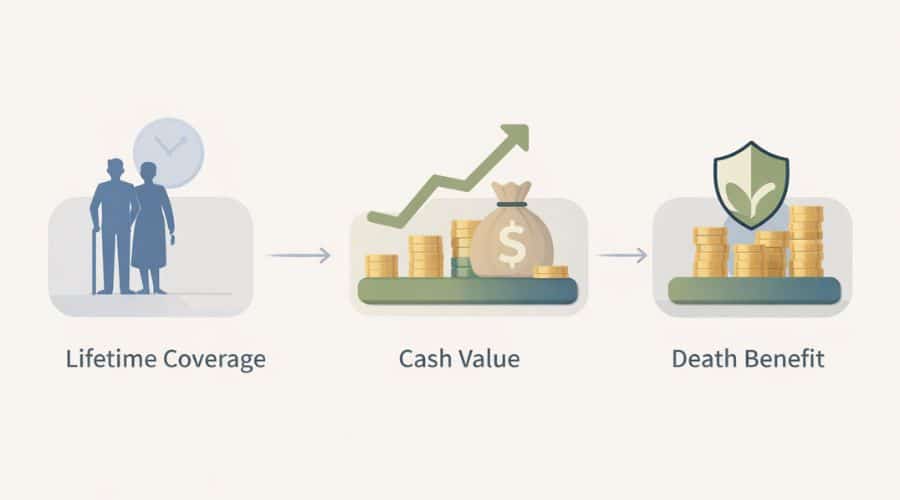
Whole life insurance is a type of permanent life insurance that provides coverage for your entire lifetime, not just a set number of years.
It has two core components:
Death benefit
A guaranteed amount paid to your beneficiaries when you die, as long as the policy is active.
Cash value
A savings-like account inside the policy that grows over time according to the policy’s rules.
As long as you keep paying the required premiums, the policy does not expire due to age. This structure is what makes whole life insurance fundamentally different from term life insurance.
How Whole Life Insurance Works in the U.S.
Premiums
- Premiums are usually fixed and do not increase as you age.
- You typically pay premiums monthly or annually for decades.
- Missing payments can cause the policy to lapse or consume cash value.
Death Benefit
- The death benefit is guaranteed by the insurance contract.
- Beneficiaries generally receive the payout income-tax-free under current U.S. tax law.
- The payout amount does not automatically include unused cash value unless structured that way.
Cash Value Growth
- A portion of each premium goes into the cash value account.
- Growth is typically slow in the early years due to fees and commissions.
- Cash value grows tax-deferred, not tax-free.
Guarantees and Dividends
- Some policies offer guaranteed minimum growth on cash value.
- Participating policies may pay dividends, but dividends are not guaranteed and depend on the insurer’s performance.
Whole Life vs. Term Life (High-Level Comparison)
| Feature | Whole Life Insurance | Term Life Insurance |
|---|---|---|
| Coverage length | Lifetime | Fixed term (e.g., 20–30 years) |
| Premium cost | High | Much lower |
| Cash value | Yes | No |
| Premium stability | Usually fixed | Fixed during term |
| Complexity | High | Simple |
This difference in cost and structure is why whole life decisions should never be rushed.
What the Cash Value Really Is (and Is Not)
The cash value is often misunderstood.
What it is:
- A policy-controlled account that grows at a contract-defined rate
- Accessible through policy loans or withdrawals
- Grows tax-deferred under U.S. tax rules
What it is not:
- A high-return investment
- A free savings account
- Automatically paid out on top of the death benefit

Accessing cash value incorrectly can reduce the death benefit or even collapse the policy.
How Policy Loans Work
Instead of withdrawing money, many policies allow you to borrow against the cash value.
Key points:
- Loans usually do not require credit checks
- Interest accrues on outstanding loans
- Unpaid loans reduce the death benefit
- Large or unmanaged loans can cause policy lapse
Policy loans are often presented as flexible, but they come with long-term consequences if misused.
Who Whole Life Insurance Is Typically For
Whole life insurance may make sense for some people, such as:
- Individuals with long-term dependents who will always need financial support
- Families planning for estate liquidity or legacy goals
- High-income households that have already maximized retirement savings
- People with permanent insurance needs and stable cash flow
Even in these cases, it requires careful evaluation.
Who Should Be Very Cautious or Avoid It
Whole life insurance is often a poor fit for:
- Young families on tight budgets
- People who primarily need income replacement for a limited time
- Anyone who may struggle to maintain high premiums long-term
- Buyers who expect quick cash value growth
Canceling a whole life policy early often results in significant financial loss.
How Much Does Whole Life Insurance Cost?

Whole life insurance is one of the most expensive forms of life insurance available in the U.S.
The cost depends on:
- Age at purchase
- Health and medical history
- Gender (based on actuarial life expectancy)
- Death benefit amount
- Policy design and guarantees
Typical Cost Difference (Illustrative)
While exact prices vary by insurer and individual underwriting, the gap between term and whole life is large.
| Policy Type | Example Coverage | Approximate Cost Trend |
|---|---|---|
| Term life | $500,000 for 20–30 years | Low monthly premium |
| Whole life | $500,000 lifetime coverage | 5–15× higher premium |
These figures are illustrative and vary widely based on age, health, and insurer.
Because premiums are contractual and long-term, affordability must be evaluated over decades, not just the first few years.
Where Your Premium Dollars Actually Go
Many buyers assume most of their early payments go toward savings. In reality:
- Early premiums largely cover:
- Insurance costs
- Administrative expenses
- Sales commissions
- Cash value growth is minimal in the first several years
- Meaningful accumulation usually happens much later
This structure is why surrendering a policy early often results in getting less money back than paid in.
Pros and Cons of Whole Life Insurance
Advantages
| Pros | Why It Matters |
|---|---|
| Lifetime coverage | No expiration if premiums are paid |
| Fixed premiums | Predictable long-term costs |
| Cash value growth | Tax-deferred accumulation |
| Forced savings element | Can help disciplined long-term savers |
| Income-tax-free death benefit | Helps beneficiaries financially |
Disadvantages
| Cons | Why It Matters |
|---|---|
| Very high cost | Limits flexibility and cash flow |
| Slow early cash value growth | Poor short-term liquidity |
| Complex structure | Easy to misunderstand or misuse |
| Opportunity cost | Money could be invested elsewhere |
| Hard to exit | Early surrender can cause losses |
Risks and Downsides Many People Miss

Policy Lapse Risk
If premiums are missed and cash value is insufficient, the policy can lapse—ending coverage and potentially triggering taxes.
Tax Risk on Cash Value
- Withdrawals beyond your cost basis may be taxable
- Policy lapse with outstanding loans can create a tax bill on phantom income
Inflation Risk
The guaranteed growth rate may not keep up with long-term inflation, reducing real purchasing power.
Overinsurance Risk
Buying more permanent coverage than needed can strain household finances for decades.
Common Mistakes Americans Make With Whole Life Insurance
- Buying it without fully understanding long-term obligations
- Replacing term insurance prematurely
- Assuming cash value equals an investment account
- Using policy loans without a repayment plan
- Cancelling after a few years due to affordability issues
Most problems arise not from the product itself, but from sales-driven explanations and misaligned expectations.
Myths vs. Facts About Whole Life Insurance
| Myth | Reality |
|---|---|
| “It’s an investment” | It is insurance with a savings component |
| “Cash value is free money” | Loans accrue interest and reduce benefits |
| “Everyone should have it” | It fits specific situations only |
| “You can’t lose money” | Early surrender often results in loss |
| “Dividends are guaranteed” | Dividends depend on insurer performance |
Impact on Long-Term Financial Planning
Whole life insurance can affect:
- Monthly cash flow
- Ability to save for retirement
- Emergency fund flexibility
- Estate planning strategies
- Overall risk tolerance
For most households, insurance should solve a clear financial problem, not create a new one.
Tax Treatment of Whole Life Insurance in the United States

Understanding the tax rules is critical because many decisions around whole life insurance involve long time horizons and large dollar amounts. Misunderstanding these rules can turn tax advantages into unexpected tax liabilities.
Death Benefit Taxes
- In most cases, the death benefit is not subject to federal income tax for beneficiaries.
- Estate taxes may apply if the policy is owned by the insured and the estate exceeds federal or state estate tax thresholds.
- Estate tax rules can change, and state-level rules vary.
Cash Value Growth
- Cash value grows tax-deferred, not tax-free.
- You do not owe income tax each year on growth inside the policy.
Proper ownership and beneficiary structuring can significantly affect estate tax outcomes.
Withdrawals and Loans
- Withdrawals up to the amount you paid in premiums (your cost basis) are generally not taxed.
- Withdrawals beyond that amount may be taxable.
- Policy loans are generally not taxable when taken, but they come with important conditions:
- Interest accrues
- Unpaid loans reduce the death benefit
- A lapsed policy with outstanding loans can trigger taxable income
In simple terms, loans delay taxes—but they do not eliminate them.
Modified Endowment Contract (MEC) Risk
If a policy is overfunded beyond IRS limits, it can become a Modified Endowment Contract (MEC):
- Loans and withdrawals may be taxed as income
- Penalties may apply if taken before age 59½
- MEC status is usually permanent
Many policyholders do not realize their policy has become a MEC until tax consequences appear.
Once a policy becomes a MEC, the tax advantages are significantly reduced.
Regulatory Oversight and Consumer Protections
Whole life insurance in the U.S. is regulated primarily at the state level.
- Insurance companies must be licensed in each state
- Policy forms and disclosures are regulated by state insurance departments
- Guarantees depend on the insurer’s financial strength, not the federal government
There is no FDIC insurance on life insurance cash value.
Step-by-Step: How Americans Typically Buy Whole Life Insurance
Step 1: Determine the Need for Permanent Coverage
Whole life insurance only makes sense if the need for coverage is permanent, not temporary.
Step 2: Evaluate Long-Term Affordability
Ask whether the premium is affordable:
- During job changes
- During retirement
- During economic downturns
Step 3: Underwriting and Medical Review
Most policies require:
- Health questionnaires
- Medical exams
- Review of prescription and medical history
Step 4: Policy Design Choices
Key choices affect cost and outcomes:
- Face amount
- Dividend options
- Riders (if any)
These decisions have long-term consequences.
Step 5: Ongoing Monitoring
Whole life insurance is not “set and forget”:
- Loan balances should be tracked
- Policy performance should be reviewed periodically
- Life changes may require reassessment
Whole Life Insurance vs. Other Permanent Options
| Feature | Whole Life | Universal Life |
|---|---|---|
| Premiums | Fixed | Flexible |
| Guarantees | Strong | Varies by policy |
| Cash value predictability | High | Depends on interest/market |
| Complexity | Moderate | High |
| Risk of lapse | Lower | Higher if mismanaged |
This comparison matters for households considering permanent insurance broadly, not just whole life.
When Whole Life Insurance May Play a Role
Whole life insurance is sometimes used for:
- Estate planning liquidity
- Providing for lifelong dependents
- Long-term legacy planning
- Conservative cash-value accumulation for disciplined savers
Even in these situations, it should complement—not replace—core financial planning basics.
Real-Life U.S.-Based Examples

Example 1: Permanent Dependent Support
A parent has an adult child with a lifelong disability who will always need financial support. Term insurance would eventually expire, creating uncertainty. A properly structured whole life policy can ensure funds are available whenever the parent dies, regardless of age.
Example 2: Estate Liquidity Planning
A family owns an illiquid asset, such as a closely held business or real estate. When the owner dies, heirs may need cash to cover estate taxes or expenses without selling the asset quickly. Whole life insurance can provide predictable liquidity at death.
Example 3: Stable High-Income Household
A high-income couple has already maxed out workplace retirement plans and IRAs and has strong cash reserves. They value guarantees over growth and want a conservative, long-term insurance-backed asset. Whole life may be considered as a supplement, not a core strategy.
These scenarios are specific and do not apply to most households.
Common Beginner Misunderstandings
- Confusing permanence with necessity
Lifetime coverage is only useful if the financial need is also lifetime. - Overestimating cash value access
Cash value is not instantly liquid and comes with restrictions. - Ignoring opportunity cost
High premiums reduce flexibility to save or invest elsewhere. - Assuming future income stability
Whole life premiums do not adjust downward if income drops.
Understanding these issues early prevents regret later.
How Whole Life Insurance Affects Credit and Cash Flow
Credit Impact
- Buying or owning whole life insurance does not improve your credit score
- Policy loans do not appear on credit reports
- Missed premiums do not affect credit directly, but policy lapse has financial consequences
Cash Flow Impact
- Premiums are contractual obligations
- Reduced disposable income may limit:
- Emergency savings
- Retirement contributions
- Debt repayment
Insurance should support financial stability, not strain it.
Key Questions to Ask Before Buying
Before committing, Americans should be able to answer yes to all of the following:
- Do I need coverage for my entire lifetime?
- Can I afford this premium for decades without stress?
- Do I understand how cash value grows and how it can be accessed?
- Have I already addressed emergency savings and retirement basics?
- Am I comfortable with limited flexibility?
If the answer to any is no, caution is warranted.
Frequently Asked Questions (FAQ)
-
Is whole life insurance worth it for most people?
For most Americans, no. Term life insurance meets the primary goal—income protection—at far lower cost. Whole life fits narrower, long-term needs.
-
Can you cash out a whole life insurance policy?
Yes, but surrendering early often results in receiving less than you paid in premiums. Surrender charges may apply.
-
Does whole life insurance replace retirement savings?
No. It should never replace employer retirement plans or IRAs. Its structure, liquidity, and returns are very different.
-
What happens if I stop paying premiums?
The policy may use cash value to cover premiums temporarily. If insufficient, the policy lapses and coverage ends, possibly triggering taxes.
-
Are dividends guaranteed?
No. Dividends depend on the insurer’s financial performance and are not guaranteed.
-
Is whole life insurance safer than investing?
It is generally less volatile, but safety comes at the cost of lower potential growth and reduced flexibility.

Key Takeaways Revisited
- Whole life insurance is permanent and expensive
- Cash value growth is slow early and tightly controlled
- Tax advantages exist but come with rules and risks
- It fits specific long-term needs, not general use
- Understanding the contract matters more than the illustration
Disclaimer
This content is provided for educational and informational purposes only. It does not constitute legal, tax, or financial advice. Insurance needs and outcomes vary based on individual circumstances, state regulations, and policy terms. Readers should consult a qualified financial, tax, or legal professional before making personal financial decisions.
