In the U.S., there are several different types of savings accounts, and each one works differently depending on interest rates, access rules, and the purpose of the money. Understanding these differences helps you choose the right place to keep your savings safe, accessible, and growing at the right pace.
Key Takeaways
- Not all savings accounts grow your money the same way — interest rates, access rules, and features vary by account type.
- High-yield savings accounts and money market accounts usually pay more interest than basic savings, but they work differently.
- Some options, like CDs and specialty savings accounts, trade flexibility for higher or more structured returns.
- Choosing the right type depends on how soon you need the money, how stable your income is, and how disciplined you are about saving.
- All standard bank and credit union savings accounts are typically protected by federal deposit insurance up to legal limits, but investment-based options are not.
Why the Type of Savings Account You Choose Actually Matters
Most people hear the word “savings account” and assume it means one simple place to store money. In reality, U.S. banks and credit unions offer several different savings account structures, each built for a specific purpose.
Some accounts are designed for emergency funds.
Others work better for short-term goals like a car down payment.
And some are meant for money you can lock away for months or years.
Choosing the wrong type can quietly cost you in three ways:
- Lower interest than you could be earning
- Unnecessary fees or balance requirements
- Restrictions that make your money harder to access when you need it
Understanding the differences helps you match your savings to real-life needs instead of treating all savings the same.
How Savings Account Types Are Classified in the U.S.
In the U.S. banking system, savings accounts are usually grouped by:
| Factor | What It Affects |
|---|---|
| Interest structure | How fast your balance grows |
| Access rules | How easily you can move or withdraw money |
| Account purpose | Everyday savings vs long-term goals |
| Institution type | Bank vs credit union differences |
Most people will encounter these main categories:
- Traditional (Basic) Savings Accounts
- High-Yield Savings Accounts (HYSA)
- Money Market Accounts (MMAs)
- Certificates of Deposit (CDs)
- Specialty and Goal-Based Savings Accounts
Each serves a different role in a healthy personal finance setup.
Traditional (Basic) Savings Accounts
What It Is
A traditional savings account is the most basic form of savings offered by banks and credit unions. It allows you to:
- Deposit money
- Earn a small amount of interest
- Withdraw or transfer funds when needed (with some limits)
Deposits in these accounts are typically protected by federal deposit insurance when held at insured banks or credit unions.
These accounts are usually opened alongside checking accounts and are commonly used by people who are just starting to save.
How It Works
- Interest is paid based on an annual percentage yield (APY) that can change at any time.
- Many banks set monthly withdrawal limits for certain types of transfers.
- Some accounts require:
- A minimum balance
- Or charge a monthly maintenance fee if you fall below it
Typical Use Cases
- First-time savers
- Small emergency funds
- Parking money temporarily before spending
Pros & Cons
| Pros | Cons |
|---|---|
| Easy to open and manage | Very low interest at many banks |
| Widely available everywhere | Fees may apply if balance drops |
| Usually federally insured | Poor long-term growth |
Important Reality Check
At many large U.S. banks, traditional savings accounts pay well below the national inflation rate, meaning your money may lose purchasing power over time even though the balance grows slightly.
That’s why many people move beyond this option once they build a stable cash buffer.
High-Yield Savings Accounts (HYSA)
What Makes It Different
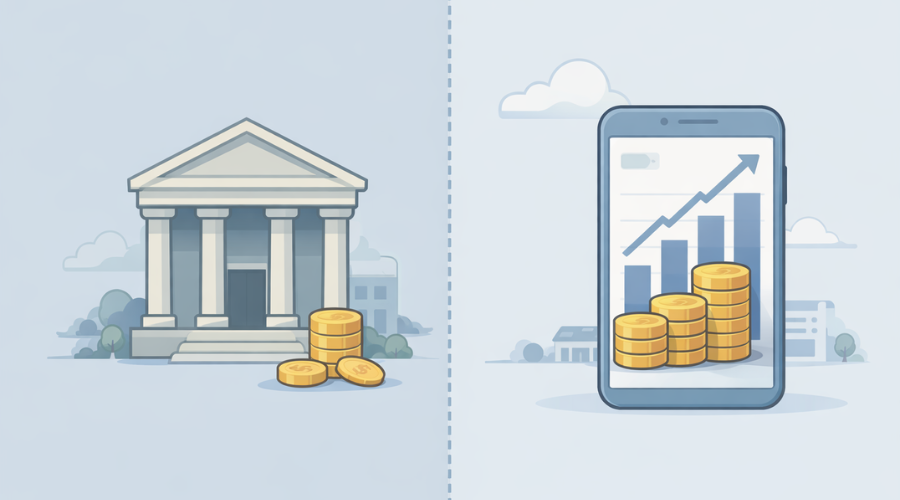
A high-yield savings account works like a regular savings account but pays significantly higher interest. These accounts are commonly offered by:
- Online-only banks
- Digital divisions of traditional banks
- Some credit unions
Because online banks have lower operating costs, they often pass those savings to customers through higher APYs.
How It Works
- Interest rates are variable and move with market conditions.
- You usually manage the account through:
- Mobile apps
- Online dashboards
- Transfers to and from checking typically take 1–3 business days.
Same-day cash access is usually not available unless the online bank partners with ATM networks.
Typical Use Cases
- Emergency funds
- Short-term savings goals
- Money you don’t need instantly but want accessible
Pros & Cons
| Pros | Cons |
|---|---|
| Much higher interest than basic savings | Not ideal for cash you need same day |
| Usually no monthly fees | Rates can drop when markets change |
| Fully insured at covered institutions | Limited in-person service |
Who It Works Best For
People who want:
- Better growth than basic savings
- Simple, low-risk storage
- No investment risk
For many Americans, this becomes the primary savings account once basic budgeting is under control.
Why High-Yield Doesn’t Mean “High Risk”
A common misunderstanding is that higher interest means higher risk. With HYSAs, that’s not true as long as the account is held at an institution insured by:
Insurance protects deposits up to the legal limits per person, per institution, per ownership category, even if the bank fails.
The higher yield comes from business models, not from taking investment risk with your deposits.
Money Market Accounts (MMAs)
What a Money Market Account Is
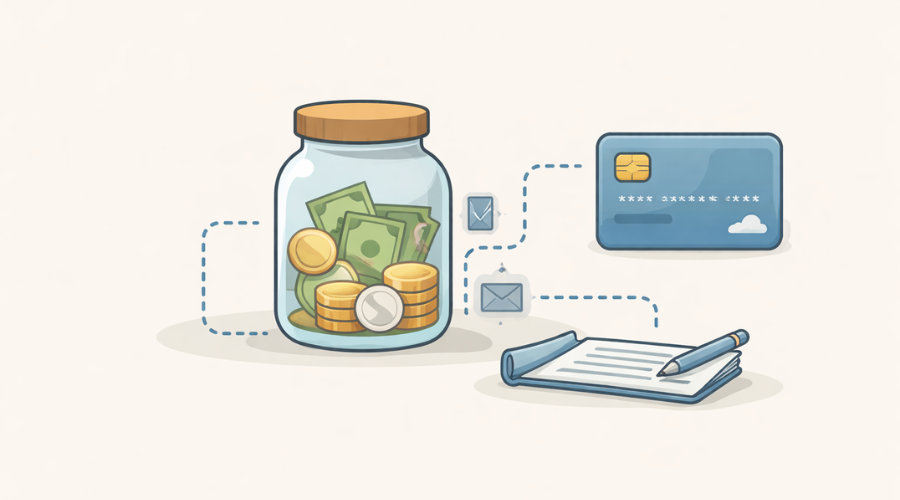
A money market account (MMA) is a type of savings account that combines features of both savings and checking. It usually offers:
- Higher interest than basic savings
- Limited check-writing or debit card access
- Federal deposit insurance when held at insured banks or credit unions
This means your deposited money is protected up to legal insurance limits, just like in regular savings accounts, as long as the institution is insured.
Despite the similar name, money market accounts are not the same as money market mutual funds (those are investment products and are not bank deposits).
How It Works in Practice
- Interest is variable and can change with market rates.
- Banks often require higher minimum balances to earn the best APY.
- Many MMAs allow:
- A limited number of checks per month
- Or debit card transactions
- If you exceed the bank’s allowed number of withdrawals or transfers, it may trigger:
- Fees
- Account conversion
- Or restrictions, depending on the institution
Typical Use Cases
- Emergency funds where some direct access is helpful
- Savings you may need soon but want earning more interest
- People who prefer limited check access without opening another checking account
Pros & Cons
| Pros | Cons |
|---|---|
| Higher interest than basic savings | Often higher minimum balance |
| Some direct spending access | Lower rates if balance drops |
| Federally insured when held at insured institutions | More rules than HYSAs |
MMA vs High-Yield Savings: Practical Differences
| Feature | High-Yield Savings | Money Market Account |
|---|---|---|
| Interest rates | Usually very competitive | Sometimes similar, sometimes slightly higher |
| Debit/check access | No | Often yes |
| Minimum balance | Often low or none | Frequently higher |
| Best for | Pure savings | Savings with occasional spending needs |
Important Clarification
Many people confuse money market accounts with money market funds:
- Money Market Account (MMA) → bank or credit union deposit, insured
- Money Market Mutual Fund → investment product, not insured, value can fluctuate
Only MMAs at insured institutions qualify for federal deposit protection.
Certificates of Deposit (CDs)
What a CD Is
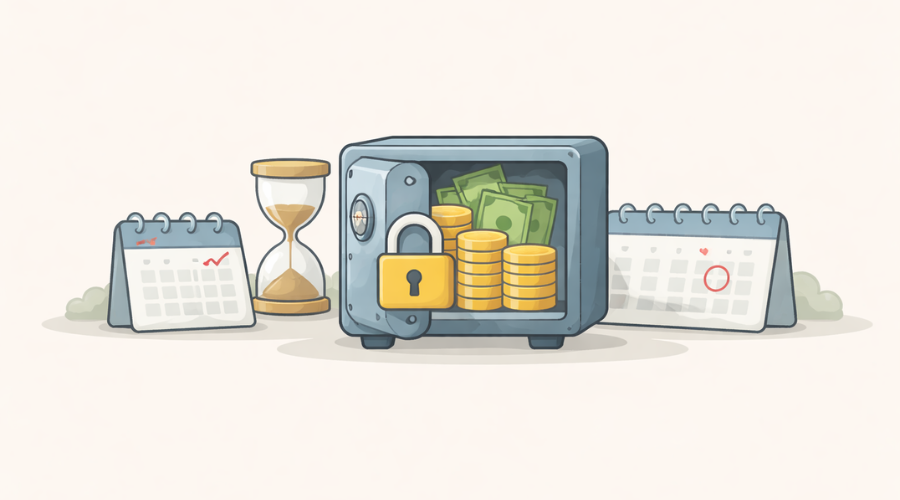
A certificate of deposit (CD) is a savings product where you agree to leave your money untouched for a fixed period in exchange for a fixed interest rate.
This is called the term of the CD, and it can range from:
- A few months
- To several years
How CDs Work
When you open a CD:
- You deposit a fixed amount of money.
- The bank locks in a fixed interest rate.
- You agree not to withdraw funds until maturity.
- At the end of the term, you receive your original deposit plus interest.
CDs held at insured banks and credit unions are typically protected by federal deposit insurance, just like savings accounts.
If you withdraw early, you usually pay an early withdrawal penalty, often equal to several months of interest.
Typical CD Terms
| Term Length | Common Uses |
|---|---|
| 3–12 months | Parking short-term savings safely |
| 1–3 years | Medium-term goals |
| 5 years | Long-term conservative saving |
Pros & Cons
| Pros | Cons |
|---|---|
| Guaranteed fixed return | No access to funds without penalty |
| Often higher than basic savings | Miss out if rates rise later |
| Insured at covered institutions | Not flexible for emergencies |
Who CDs Are Best For
CDs work well when:
- You know you won’t need the money for a specific period
- You want predictable returns without market risk
- You’re saving toward a date-based goal (tuition, planned purchase, etc.)
They are not ideal for:
- Emergency funds
- Income that might be needed unexpectedly
CD Strategies Some Savers Use
CD Laddering (Briefly Explained)
This strategy is often used to balance better interest rates with more regular access to saving
Instead of putting all money into one long CD, some people spread funds across multiple CDs with different maturity dates. This can:
- Provide regular access to portions of the money
- Reduce the risk of locking everything into a single interest rate
This approach adds flexibility but also requires more management and tracking.
Related Goal-Based Accounts People Often Confuse With Savings

Some savings accounts are designed around specific life situations or financial goals rather than general-purpose saving. These accounts can be helpful in the right context, but they also come with rules that limit flexibility.
Health Savings Accounts (HSAs)
Included here because many people treat HSAs as long-term savings, even though they are technically medical accounts.
What an HSA Is
A Health Savings Account (HSA) is available only if you are enrolled in a qualified high-deductible health plan (HDHP). It allows you to save money specifically for medical expenses with unique tax benefits.
How It Works
- Contributions are tax-deductible or pre-tax
- Money grows tax-free
- Withdrawals for qualified medical expenses are tax-free
- Funds roll over every year — there is no “use it or lose it” rule
After age 65, withdrawals for non-medical purposes are allowed (but taxed like regular income).
Why Some People Use It Like a Savings Account
Because of its tax treatment, many people treat HSAs as:
- A backup emergency medical fund
- A long-term healthcare savings vehicle
However, it is not meant for everyday non-medical savings and has strict eligibility rules.
Pros & Cons
| Pros | Cons |
|---|---|
| Triple tax advantage | Only available with specific health plans |
| Funds never expire | Penalties if used incorrectly |
| Can grow if invested | Medical-purpose restrictions |
Education Savings Accounts (Coverdell ESAs and 529 Plans)
Although these are not standard bank savings accounts, many families consider them part of long-term saving. These accounts are investment-based and follow different rules than bank savings accounts, including market risk.
What They Are Used For
These accounts are meant for:
- K–12 expenses (in some cases)
- College and higher education costs
Key Differences
| Feature | Coverdell ESA | 529 Plan |
|---|---|---|
| Contribution limits | Lower annual limits | Much higher limits |
| Investment options | Broad | State-plan dependent |
| Tax treatment | Tax-free for qualified education | Same |
These accounts are not suitable for general savings, and non-qualified withdrawals can trigger taxes and penalties.
Custodial Savings Accounts for Minors
What These Are
Custodial accounts allow adults to save money in a child’s name until the child reaches legal adulthood (age varies by state).
They are often used for:
- Teaching kids about saving
- Holding gift money
- Long-term family contributions
Important Legal Reality
Once the child reaches adulthood, the money legally belongs to them, and parents no longer control how it is used.
Pros & Cons
| Pros | Cons |
|---|---|
| Teaches financial responsibility | Child gains full control later |
| Easy to open | Can affect future financial aid |
| Flexible deposits | Funds cannot be reclaimed by parents |
Holiday, Vacation, and “Sinking Fund” Accounts
Some banks and credit unions offer labeled savings accounts designed for:
- Holidays
- Travel
- Large annual expenses
Functionally, these are usually regular savings accounts with goal-tracking features, not separate legal account types.
They help with:
- Budgeting discipline
- Avoiding credit card debt for planned expenses
But financially, they work the same as standard or high-yield savings accounts.
Choosing the Right Type Based on Real-Life Needs
Rather than choosing one account for everything, many people use multiple savings types for different purposes.
Example Setup
| Goal | Account Type |
|---|---|
| Emergency fund | High-yield savings or MMA |
| Short-term goal | HYSA or MMA |
| Fixed future expense | CD |
| Medical expenses | HSA (if eligible) |
| Child’s savings | Custodial savings |
This approach separates money mentally and practically, reducing the chance that long-term savings get spent on short-term wants.
Common Mistakes People Make With Savings Account Types
1. Chasing Interest and Ignoring Access
Locking emergency money in CDs or restricted accounts can backfire when:
- Medical bills
- Job loss
- Urgent repairs
Liquidity matters as much as interest.
2. Leaving Large Balances in Low-Interest Accounts
Many people keep five-figure balances in basic savings accounts that pay extremely low APYs, often out of habit or convenience.
Over time, this can mean hundreds or thousands of dollars in lost interest, even without investing risk.
3. Confusing Bank Products With Investments
Savings accounts, MMAs, and CDs are deposit products, not investments. They protect capital but usually do not build long-term wealth.
Long-term growth usually requires separate investment accounts, which follow different rules and risks (covered in other topics).
4. Ignoring Fees and Balance Rules
Some accounts advertise attractive rates but require:
- High minimum balances
- Monthly activity
- Multiple linked accounts
Failing to meet conditions can quietly erase interest through fees.
How Savings Account Choices Affect Credit, Taxes, and Long-Term Finances
Savings accounts feel simple, but the type you choose can still affect other parts of your financial life — especially taxes, access to future credit, and how well your money keeps up with inflation.
Do Savings Accounts Affect Your Credit Score?
No — savings accounts do not directly affect your credit score.
Here’s why:
- Credit scores are based on borrowing behavior, not saving behavior.
- Banks do not report savings balances or activity to credit bureaus.
- Opening or closing a savings account does not create a credit inquiry.
However, savings can still affect your financial health indirectly:
- Having emergency savings can help you avoid using credit cards or loans in emergencies.
- Strong savings reduce missed payments, which does protect your credit score indirectly.
So while savings accounts are not part of your credit file, they strongly influence your ability to manage debt responsibly.
Are Savings Account Interest Earnings Taxable?
In most cases, yes — interest earned in savings accounts is taxable under U.S. federal law.
What Is Taxed
- Interest from:
- Traditional savings
- High-yield savings
- Money market accounts
- CDs
is considered taxable income in the year it is paid or credited.
Banks typically report interest to the IRS using Form 1099-INT if your interest reaches reporting thresholds, but you are still legally responsible for reporting all taxable interest even if you do not receive a form.
Exceptions and Special Cases
| Account Type | Tax Treatment |
|---|---|
| HSA (qualified expenses) | Not taxed |
| 529 education savings | Not taxed for qualified education |
| Regular savings & CDs | Taxed as ordinary income |
State tax treatment can vary depending on where you live and the type of interest, which is why local tax guidance may matter for larger balances.
Why Inflation Matters More Than Most People Realize
Even when your savings account pays interest, inflation can still reduce the real value of your money over time.
Example:
- If your account earns 4%
- But inflation is running at 3%
- Your real growth is only about 1%
Savings accounts protect stability, not purchasing power. Their main job is to keep money safe and available, not to grow wealth over decades. This is why savings should be used for:
- Emergency funds
- Short-term goals
- Known future expenses
Long-term wealth building usually requires different tools beyond savings products.
Federal Deposit Insurance: What Is Actually Protected
One of the biggest advantages of savings accounts is deposit protection.
How Insurance Works
Deposits are insured by:
- FDIC for banks
- NCUA for credit unions
Coverage is typically:
- Up to the legal limit per person, per institution, per ownership category
This includes:
- Savings accounts
- Checking accounts
- CDs
- Money market accounts at insured institutions
If a bank fails, insured depositors are protected even if the institution collapses.
What Is NOT Covered
Deposit insurance does not protect:
- Investment losses
- Money market mutual funds
- Stocks, bonds, or crypto
- Accounts at non-insured institutions
Insurance protects your balance — not your interest rate or purchasing power.
Myths vs Facts About Savings Account Types
| Myth | Reality |
|---|---|
| High-yield savings is risky | Not when held at insured institutions |
| All savings accounts grow money safely | Inflation can still reduce real value |
| CDs are always better than savings | Only if you can lock money away safely |
| Money market accounts are investments | MMAs are deposit accounts, not investments |
| More accounts always means more complexity | Multiple accounts can simplify goal tracking |
Understanding these differences helps avoid choices that look good on paper but cause stress or losses later.
How to Decide Which Type You Actually Need (Step-by-Step)
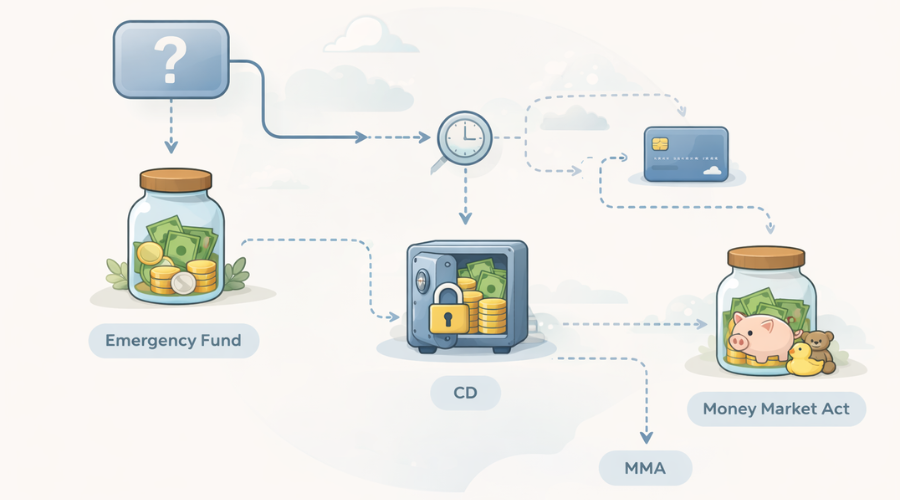
Rather than picking based on interest rate alone, start with how you will use the money.
Step 1: Decide How Soon You Might Need the Money
| Time Frame | Better Options |
|---|---|
| Anytime / emergencies | HYSA or MMA |
| Within 1 year | HYSA or short-term CD |
| 1–5 years | CD or HYSA depending on flexibility needs |
| Medical expenses | HSA (if eligible) |
Step 2: Decide How Important Access Is
Ask yourself:
- Could I wait several days to transfer this money?
- Would I need to spend directly from this account?
If yes → MMA may help
If no → HYSA or CD may be fine
Step 3: Check Your Discipline Level
Some people benefit from restrictions.
- If you tend to spend savings impulsively → CDs can protect you from yourself
- If you manage money carefully → flexible accounts usually work better
Your behavior matters just as much as interest rates.
Frequently Asked Questions About Types of Savings Accounts (U.S.)
-
Is a high-yield savings account better than a regular savings account?
For most people, a high-yield savings account is better than a regular savings account because it usually pays much higher interest while offering the same federal deposit insurance at covered institutions. Both account types allow deposits and withdrawals, but basic savings accounts at large banks often pay very low interest. The trade-off is that high-yield accounts are usually managed online and may not offer in-person service.
-
Can I lose money in a savings account?
You generally will not lose your deposited money in insured savings accounts due to bank failure because of federal deposit insurance limits. However, you can still lose purchasing power over time if inflation is higher than your interest rate. Also, fees and penalties can reduce your balance if account rules are not followed.
-
Are money market accounts safe during financial crises?
Money market accounts held at FDIC-insured banks or NCUA-insured credit unions are protected up to legal insurance limits, even during financial stress or bank failures. This protection does not apply to money market mutual funds, which are investment products and can experience losses.
-
Should emergency funds be kept in CDs?
Usually, no. Emergency funds need fast access. CDs impose penalties for early withdrawals, which can delay access and reduce your balance. Most people are better served using high-yield savings or money market accounts for emergency funds.
-
Can I have multiple savings accounts at the same time?
Yes. Many people use multiple savings accounts for different goals, such as:
– Emergency fund
– Vacation savings
– Home down paymentHaving separate accounts can make budgeting and progress tracking easier, as long as fees and minimum balances are manageable.
Many online banks also allow you to create multiple labeled savings “buckets” under one login, which can simplify organization.
-
Do savings accounts have withdrawal limits?
Many banks still apply limits on certain types of withdrawals or transfers, especially from savings and money market accounts. While federal rules changed in recent years, banks are still allowed to set their own limits, and exceeding them may trigger fees or account restrictions. These limits vary by bank and by account type, so always review the account agreement before relying on frequent transfers. Always check your bank’s specific policy.
-
Is interest from savings accounts reported to the IRS?
Yes. Interest earned in savings accounts, money market accounts, and CDs is generally considered taxable income and must be reported on your federal tax return. Banks often issue Form 1099-INT when interest reaches reporting thresholds, but you are still responsible for reporting all taxable interest even if you do not receive a form.
-
Are online savings accounts trustworthy?
Online banks that are properly insured by the FDIC (or NCUA for credit unions) provide the same federal protection as brick-and-mortar banks. The main differences are service delivery and access methods, not safety of deposits.
-
Do higher interest rates mean higher risk in savings accounts?
Not when comparing insured deposit accounts. Higher rates in high-yield savings accounts usually come from lower operating costs or business strategy, not from investing your deposits in risky assets. The risk profile remains low as long as the institution is insured.
-
What happens when a CD matures?
When a CD reaches its maturity date, banks typically:
– Return the funds to your savings account, or
– Automatically renew the CD into a new term unless you take action during a grace periodIf you do nothing, your money may roll into a new CD with a different rate, so it’s important to review options when maturity approaches.
-
Are savings accounts good for long-term retirement saving?
Savings accounts are not designed for long-term retirement growth. They protect money but usually do not provide returns that keep up with long-term inflation. Retirement savings typically use separate investment-based accounts that follow different rules, risks, and tax treatments.
Common Beginner Misunderstandings (Quick Clarifications)
- “More interest always means better choice.”
Not if it restricts access you may need. - “Savings accounts help build credit.”
They don’t affect credit scores directly, but they support better debt management. - “All savings products are basically the same.”
Rules, access, and returns can differ significantly by account type. - “Deposit insurance covers everything.”
It protects deposits at insured institutions, not investment products or market losses.
Disclaimer
This content is provided for educational and informational purposes only and is not intended as legal, tax, or financial advice. It does not replace personalized advice from a licensed professional who understands your full financial situation. Financial rules, tax treatment, and banking policies can vary by institution, state, and individual circumstances. Readers should consult a qualified financial, tax, or legal professional before making personal financial decisions.
