Opening a bank account in the United States is not just about choosing a bank or filling out an application. U.S. banks are legally required to verify your identity before allowing you to access financial services, and this process depends heavily on the documents you provide.
Whether you are a U.S. citizen, a new immigrant, an international student, or someone without a permanent address, document requirements can differ based on your personal situation and the type of account you are opening.
This guide explains exactly what documents are needed to open a bank account in the U.S. in 2026, why banks ask for them, and how the verification process works. It also covers common mistakes, denial reasons, and practical steps to prepare so you can avoid delays and open your account smoothly.
Key Takeaways
- U.S. banks must verify your identity under federal law before opening an account.
- Most people need photo ID, a Social Security number (or ITIN), and proof of address.
- Requirements can vary by bank, account type, and personal situation (student, immigrant, minor, etc.).
- You usually do not need perfect credit to open a basic checking or savings account.
- Being prepared with the right documents can prevent delays or rejection. Online and in-branch applications follow the same legal rules, but verification may work differently.
Why banks ask for documents in the first place
Opening a bank account in the U.S. is not just a customer service process. It is also a legal compliance process.
Banks and credit unions are required by federal law to verify who you are before they allow you to:
- Deposit money
- Send or receive payments
- Access financial services
This is part of the government’s effort to prevent:
- Identity theft
- Fraud
- Money laundering
- Terrorist financing
Because of this, every U.S. financial institution must follow strict identity-verification rules. Even if you are opening a simple checking account with a small balance, the bank still has to collect certain information and documents.
The federal rules that control account opening
Two major regulations shape what banks must collect from new customers:
Customer Identification Program (CIP)
Under the USA PATRIOT Act, banks must run a Customer Identification Program (CIP). This requires them to collect and verify basic personal information before opening an account.
At minimum, banks must obtain:
- Full legal name
- Date of birth
- Physical address
- Identification number (SSN or ITIN for most individuals)
They must also verify this information using documents or reliable databases.
Know Your Customer (KYC) policies
In addition to federal law, banks follow internal Know Your Customer (KYC) policies. These help institutions assess risk and confirm that customers are who they claim to be.
This is why one bank may ask for extra documents while another may not, even though both follow the same federal rules.
These rules are monitored by regulators, so banks cannot skip identity checks even if the customer seems trustworthy.
The three main document categories most banks require
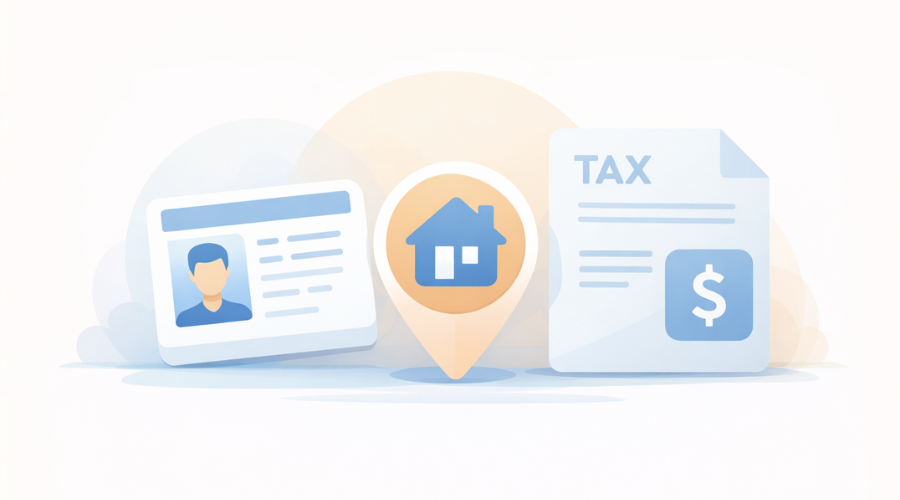
While exact requirements vary, most U.S. banks ask for documents in three core categories:
| Category | Purpose |
|---|---|
| Identity proof | Confirms who you are |
| Tax identification | Links you to the U.S. tax system |
| Address verification | Confirms where you live |
Let’s go through each one clearly.
1. Proof of identity (who you are)
Banks must verify your identity using government-issued photo identification in most cases.
Commonly accepted identity documents
Most banks accept one of the following:
- U.S. driver’s license
- State-issued ID card
- U.S. passport
- Foreign passport (often accepted with additional documents)
These documents must be:
- Valid (not expired)
- Original (not photocopies)
- Clearly readable
Temporary or paper IDs are usually not accepted for opening a bank account.
Why photo ID is usually required
Photo ID allows banks to:
- Match your face to the document
- Confirm your legal name and date of birth
- Reduce identity fraud
Some online banks may verify identity digitally using databases, but they still require the same underlying information.
Tax identification number (SSN or ITIN)
Most adults opening a U.S. bank account must provide one of the following:
- Social Security Number (SSN)
- Individual Taxpayer Identification Number (ITIN)
What this is used for
Banks use this number to:
- Report interest income to the IRS
- Comply with tax and anti-fraud regulations
- Verify identity through government databases
Who uses which number
| Situation | Typically used |
|---|---|
| U.S. citizens | SSN |
| Permanent residents | SSN |
| Many non-citizens | ITIN |
Not all banks accept ITINs, but many large banks and credit unions do, especially in areas with immigrant populations.
Important: A bank cannot legally open an interest-earning account without collecting a valid tax identification number.
Proof of address (where you live)
Banks must collect a physical U.S. address (not just a P.O. Box) to comply with federal regulations.
Common proof of address documents
Banks may accept:
- Utility bill (electric, water, gas, internet)
- Lease or rental agreement
- Mortgage statement
- Bank or credit card statement
- Government mail (DMV, IRS, Social Security)
Documents usually must show:
- Your full name
- Your current address
- A recent date (often within 30–90 days)
Why address matters legally
Federal rules require banks to record a residential or physical address to:
- Support law enforcement investigations if needed
- Prevent anonymous financial activity
Even online banks that do not require branch visits still collect this information digitally.
What information banks collect even if they don’t ask for documents
In addition to physical documents, banks must record:
- Legal name
- Date of birth
- Citizenship or residency status (in some cases)
- Contact information
They may verify this using:
- Credit bureau databases
- Public records
- Identity verification services
This is why sometimes you can open an account online without uploading documents — but only if the system can verify your identity electronically.
Why some people get denied even with documents
Having documents does not guarantee approval. Banks may still refuse to open an account if:
- Identity cannot be verified
- Information does not match public records
- There is a negative banking history (such as unpaid overdrafts reported to ChexSystems or Early Warning Services)
This is separate from credit scores. Many people confuse the two, but basic bank accounts do not usually require good credit.
Real-life example: two people, different requirements
Example 1: U.S.-born worker
- Driver’s license
- Social Security number
- Utility bill
Account usually opens the same day.
Example 2: International student
- Passport
- Student visa
- School enrollment letter
- ITIN or campus-issued ID (varies by bank)
Account may require additional verification and take longer to process.
This difference is normal and based on legal identity verification standards, not discrimination.
Document requirements can change based on personal situations such as citizenship status, student status, age, and housing stability. The next section explains what banks typically ask for in these common situations.
Document requirements by personal situation

Banks apply the same federal rules to everyone, but the documents used to meet those rules differ based on your legal and residency status. Below are the most common situations and what banks typically ask for in each case. Policies still vary by bank, so exact requirements may differ even for people in the same situation.
U.S. citizens and permanent residents
This is the most straightforward category.
Typical documents:
- Government-issued photo ID (driver’s license, state ID, or U.S. passport)
- Social Security number (SSN)
- Proof of address (if not already shown on ID)
Many banks can verify identity electronically if your ID and SSN match public databases. In those cases, you may not be asked to upload or show address documents, especially for online account openings.
Common issues that cause delays:
- Address on ID does not match current residence
- Name mismatch (for example, after marriage but not updated on ID)
- Recently issued SSN not yet visible in databases
Non-U.S. citizens and immigrants
Many non-citizens can legally open bank accounts in the U.S., but extra documentation is often required.
Commonly accepted documents:
- Valid passport (foreign passport is usually acceptable)
- U.S. visa or immigration document, such as:
- I-94 arrival record
- Employment Authorization Document (EAD)
- Green card (for permanent residents)
- ITIN or SSN
- Proof of U.S. address
Some banks accept foreign passports as primary ID, while others require an additional U.S.-issued ID.
Important limitations:
- Not all banks accept ITINs.
- Online-only banks often have stricter automated verification systems that may not support non-citizen documentation.
- Branch visits are more successful when documentation is complex.
International students
Students often fall into a special category at many banks, especially near college campuses.
Typical student account documents:
- Passport
- Student visa (F-1 or J-1)
- I-20 or DS-2019 form
- School enrollment verification
- Campus housing address or local lease
- ITIN or SSN (if available)
Some banks allow students to open accounts without an SSN if they provide immigration and school documents, but policies vary widely.
Common problems:
- No U.S. address yet
- No tax identification number
- Online applications failing automated checks
In these cases, visiting a branch that works regularly with international students is usually more effective.
Minors (children and teens)
Minors usually cannot open bank accounts alone. Most banks require a joint account with a parent or legal guardian.
Documents typically required:
For the child:
- Birth certificate or passport
- Social Security number (if available)
For the parent/guardian:
- Government-issued photo ID
- SSN
- Proof of address
The adult becomes legally responsible for the account until the child reaches the bank’s age threshold (often 18, sometimes 21).
Why banks require this:
Minors cannot legally enter binding financial contracts on their own in most states, so a responsible adult must be listed on the account.
People without a permanent address
This situation affects:
- Recently relocated individuals
- People living in temporary housing
- Some unhoused individuals
Federal rules still require banks to collect a physical address, but alternatives may be accepted.
Possible address options:
- Shelter address with documentation
- Employer address (in limited cases)
- Letter from a government agency
- Transitional housing program address
Acceptance depends heavily on bank policy and local regulations.
Important note: A P.O. Box alone is usually not sufficient for account opening under federal rules, though it may be added later as a mailing address.
Approval in these cases is rare online and usually requires visiting a local branch.
Account type can change document requirements
While the document types usually stay the same, some accounts involve extra verification steps after documents are submitted.
Document needs can also vary based on what type of account you are opening.
Basic checking or savings accounts
Usually require only:
- ID
- SSN or ITIN
- Address
No income proof and no credit check are typically required.
Interest-bearing or premium accounts
May require additional steps such as:
- Enhanced identity verification
- Initial deposit confirmation
- Extra compliance screening
The document types are usually the same, but verification may take longer.
Business accounts (brief mention)
Business accounts follow a separate legal process and require:
- Business registration documents
- Employer Identification Number (EIN)
- Ownership verification
Personal documents alone are not enough for business banking.
What banks are legally allowed to reject
Rejections are usually related to verification results, not the physical documents themselves.
Even if you provide all documents, a bank can still refuse to open an account if:
- Identity cannot be verified
- Fraud risk systems flag the application
- Prior banking abuse is reported in consumer databases
- Information appears inconsistent or incomplete
Banks are not required to give detailed explanations, but they must follow non-discrimination laws and federal compliance rules. Even when documents are correct, identity systems must also confirm the information electronically.
Common myths about documents and bank accounts
Many people misunderstand what banks actually evaluate during account opening. These are some of the most common misconceptions:
| Myth | Reality |
|---|---|
| You need good credit to open a bank account | Most basic accounts do not use credit scores |
| Only U.S. citizens can open accounts | Many non-citizens legally can |
| You must show proof of income | Income proof is rarely required for personal accounts |
| Online banks need fewer documents | They still require the same legal identity verification |
While documents are essential, banks also run verification checks after you apply. Delays or denials are usually related to this process rather than missing paperwork.
What happens after you submit your documents
Once you provide your information and documents, the bank does not immediately treat the account as fully approved in every case. There is a verification process that must happen first.
Understanding this process helps explain why some accounts open instantly while others take days or get declined. Even when all documents are correct, banks must still confirm the information through their internal and government-linked systems.
Step 1: Identity and data matching
The bank checks your details against trusted databases, which may include:
- Social Security Administration records
- IRS name–number matching systems
- Credit bureau identity files (not credit scores)
- Public records
The goal is to confirm that:
- Your name, date of birth, and ID number match
- Your address appears valid
- Your identity does not raise fraud concerns
These checks focus on identity confirmation, not on your income or employment.
If everything matches, approval can be instant, especially with online applications.
Step 2: Document review (if required)
If automatic checks fail or if you applied in person, the bank may manually review:
- Your photo ID
- Immigration documents (if applicable)
- Proof of address
This is more common for:
- New immigrants
- Students
- People without credit or banking history
- Recently issued SSNs or ITINs
Manual review can take anywhere from a few hours to several business days, depending on the institution. This review exists mainly to confirm documents that could not be verified automatically.
Step 3: Banking history screening
Most banks also check consumer reporting systems that track bank account behavior, not credit debt.
Common systems include:
- ChexSystems
- Early Warning Services
These reports may show:
- Unpaid overdrafts
- Account closures due to misuse
- Suspected fraud activity
Important: This is separate from credit reports and does not affect your credit score, but it can still block account approval. So even with valid documents, past bank account problems can still prevent approval.
Step 4: Final approval and account activation
After verification, the bank will:
- Open the account
- Issue debit cards or checks (if applicable)
- Enable online banking
Some banks restrict features until:
- Initial deposit clears
- Debit card is activated
- Address is verified by mailed letter
This is normal and part of fraud prevention.
How long account opening usually takes
| Application type | Typical time |
|---|---|
| Online, U.S. citizen, SSN verified | Minutes to same day |
| In-branch with standard documents | Same day |
| With immigration or student documents | 1–5 business days |
| With manual address verification | Several days |
Longer timelines usually happen when documents or identity details need manual checking.
Delays are usually caused by verification, not missing paperwork.
What to do if your application is delayed
If your account is “under review,” the bank may ask for:
- Clearer ID images
- Additional address proof
- Immigration status confirmation
Practical steps that help:
- Respond quickly to document requests
- Visit a branch if possible
- Bring original documents, not copies
- Ask what specific verification is missing
Also make sure your ID is not expired and your name and address match across all documents.
Banks are limited in what they can disclose, but staff can often tell you which category caused the delay.
What to do if your account is denied
If a bank refuses to open your account, you still have options.
Step 1: Ask for the reason (when possible)
Banks may say:
- Identity could not be verified
- Prior account history flagged
- Information mismatch
If the decision involved ChexSystems or similar agencies, the bank must tell you which report was used.
Step 2: Request your banking history report
You have the legal right to request a free copy of your consumer banking report if it was used to deny your application.
Review it for:
- Errors
- Old unpaid fees that may be resolved
- Fraud entries you did not cause
Incorrect records can be disputed directly with the reporting agency.
Step 3: Try alternative institutions
Different banks have different risk policies.
Options that may work when large banks deny applications:
- Community banks
- Local credit unions
- Banks offering “second chance” checking accounts
These accounts may have limits and fees, but they allow you to rebuild banking history.
How long banks keep your documents
Banks must store customer identification records for several years under federal law.
This includes:
- Copies or data from ID documents
- Verification results
- Account application details
They are required to protect this data under privacy laws, but customers should still be cautious about:
- Uploading documents on unsecured networks
- Sharing information with unofficial websites
Only submit documents through official bank systems or in person at branches.
How document rules affect your long-term finances
Being able to open and maintain a bank account affects much more than just daily spending.
Without a bank account, people often face:
- Higher fees from check-cashing services
- Difficulty receiving wages or benefits
- Limited access to credit-building tools
That is why document access — especially ID and tax numbers — plays a major role in financial inclusion in the U.S.
Being prepared with correct and consistent documents greatly improves your chances of smooth approval.
Common mistakes that cause problems at account opening
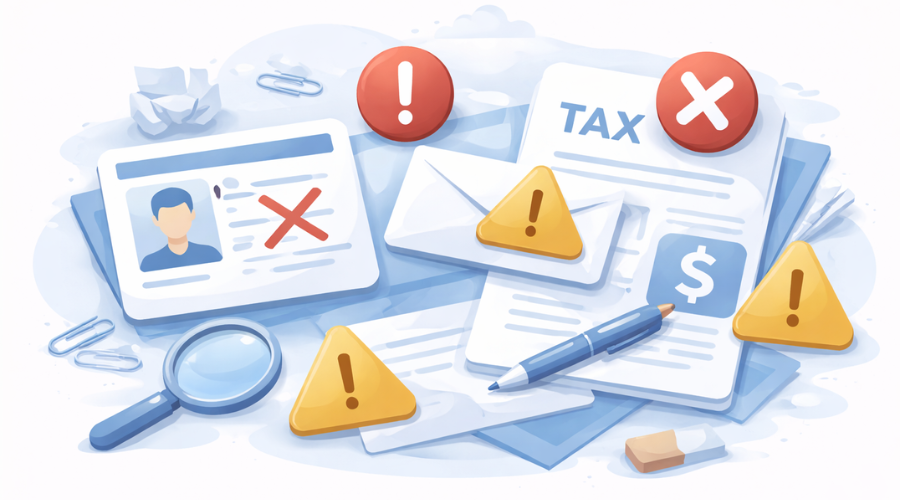
Many account applications fail or get delayed not because people are ineligible, but because small, fixable issues prevent verification. Knowing these ahead of time can save multiple trips to the bank. Most of these problems are related to documents or mismatched personal information, not eligibility.
Bringing expired or damaged ID
Banks generally cannot accept:
- Expired driver’s licenses
- Passports past their validity date
- IDs with unreadable photos or text
Even if the expiration is recent, most banks must follow strict ID validity rules under their compliance programs.
Fix: Renew the ID first, then apply. Temporary paper IDs usually do not work for bank verification.
Name mismatches across documents
If your name appears differently on:
- ID
- Social Security records
- Utility bills or lease
the bank’s systems may not match your identity automatically.
Common causes:
- Marriage or divorce name changes
- Hyphenated last names
- Middle names used inconsistently
Fix: Bring documents that show the legal name change, such as a marriage certificate or court order, and update government records when possible. Updating your name with Social Security and DMV records helps prevent future verification problems.
Using outdated or unacceptable address proof
Banks usually require recent documents showing your current residence.
Problems occur when:
- Bills are more than 90 days old
- Address is different from ID
- Only P.O. Box is provided
Fix: Bring recent utility bills, lease agreements, or official government mail showing your name and address.
Applying online when in-person is better
Online systems rely heavily on automated verification. If documents cannot be verified automatically, only in-person review can move the application forward. This works well for many U.S.-born applicants but often fails for:
- New immigrants
- Students
- People without prior U.S. financial records
Fix: If an online application fails, visit a branch where staff can manually review documents.
Not disclosing prior banking problems
Some applicants repeatedly apply at different banks without realizing that:
- Past unpaid overdrafts
- Closed accounts for misuse
may appear on consumer banking reports.
Fix: Request your ChexSystems or Early Warning Services report if you have repeated denials and resolve errors or unpaid balances when possible.
Special cases that confuse many applicants
Certain situations are legal but still trigger extra scrutiny.
Recently issued SSN or ITIN
If your tax ID number was issued recently, bank databases may not yet show it.
This can lead to:
- Identity mismatch
- Manual review requirements
Fix: Bring your official SSN or ITIN issuance letter when opening the account.
Foreign address on passport or documents
Some banks want both:
- Proof of identity
- Proof of U.S. residence
Foreign passports alone do not establish U.S. address.
Fix: Bring U.S. lease agreements, dorm letters, or employer letters if you recently moved.
Joint accounts
When opening joint accounts:
- Both people must usually be present
- Both must provide full documentation
If one person fails verification, the entire application may be denied.
This applies even if one person is only being added for supervision or convenience.
How to prepare before going to the bank
A simple checklist helps avoid delays:
Bring:
- Valid photo ID
- SSN or ITIN number (and letter if recently issued)
- Recent proof of address
- Immigration documents (if applicable)
Optional but helpful:
- Secondary ID
- Prior bank statements (if switching banks)
- School or employment letters if address is temporary
Preparation matters because compliance staff cannot make exceptions once documents fail verification.
Documents vs. financial eligibility: an important distinction
Many people assume they were denied because of money or credit, when the real issue was documentation or verification.
Documents verify identity.
Banking history evaluates account behavior.
These are two separate systems, and both must pass before an account can open.
Myths vs. facts about documents and bank accounts
| Claim | What actually matters |
|---|---|
| You must have a job | Employment is not required for basic accounts |
| You must be a citizen | Many non-citizens qualify |
| You need a minimum balance to open | Some accounts require deposits, many do not |
| You need perfect documents | You need verifiable, consistent documents |
The focus is always on identity verification and legal compliance, not personal wealth.
While federal document rules are the same, banks and credit unions may differ in how strictly they review documents and verification results, which can affect how easy account opening feels.
Bank vs. credit union: do document requirements differ?
Both banks and credit unions must follow the same federal identity verification laws, but their internal policies can differ in ways that affect how easy account opening feels.
Understanding these differences can help if you are struggling to open an account at one type of institution.
The difference is usually in how documents are reviewed, not in what the law requires.
What is legally the same
Under federal law, both banks and credit unions must:
- Collect name, date of birth, address, and tax ID
- Verify identity before opening an account
- Screen customers for fraud risk
So no institution can legally skip:
- Identity verification
- Tax identification collection
- Address requirements
There is no such thing as a “no-ID” legal bank account in the U.S.
Where credit unions may be more flexible
Credit unions are member-owned and often community-based. Because of this, they may:
- Accept a wider range of address documents
- Be more willing to review documents manually
- Offer guidance on what works in their system
They may also be more familiar with:
- Local immigrant populations
- Students from nearby schools
- Workers with nontraditional housing
However, flexibility depends on the specific credit union and its regulator.
Staff still must follow verification rules, so they cannot approve accounts without valid documents.
Membership requirements at credit unions
Before opening an account at a credit union, you must qualify for membership, which may be based on:
- Where you live
- Where you work
- School enrollment
- Family relationships
Membership itself may require proof, such as:
- Utility bills
- Employer letters
- School documents
This is in addition to normal identity verification documents.
When large national banks may be easier
Large banks often have:
- More advanced automated verification systems
- Broader acceptance of ITIN-based accounts
- Multilingual support in some regions
For applicants with strong database matches (SSN, stable address, prior banking history), national banks can offer very fast approvals, especially online.
But when automated checks fail, resolving issues may be harder without visiting a branch. This is why some applicants succeed faster in person than online, even at large banks.
Online banks vs. in-branch account opening
Online-only banks operate under the same legal rules but rely heavily on technology for verification.
Advantages of online applications
- Fast approvals for eligible applicants
- No need to visit a branch
- Digital document uploads
Limitations of online systems
They may struggle to verify:
- New immigrants
- Students
- People with no prior U.S. financial records
- Recently issued SSNs or ITINs
When automated checks fail, there is often no way to override them without human review, which can mean denial rather than delay.
When branch visits are better
In-person account opening is often better if you:
- Have immigration documents
- Have name or address mismatches
- Are opening a joint or custodial account
Branch staff can:
- Review original documents
- Explain exactly what is missing
- Escalate verification when needed
This does not guarantee approval, but it reduces confusion and repeated online failures.
Pros and cons: banks vs. credit unions for account opening
| Factor | Banks | Credit Unions |
|---|---|---|
| Federal rules | Same for both | Same for both |
| Online verification | Strong systems | Often limited |
| In-person flexibility | Varies by branch | Often more personal |
| Membership requirement | None | Usually required |
| Acceptance of ITIN | Common at large banks | Varies by credit union |
This comparison affects how documents are processed, not whether documents are required.
Choosing the right type of institution can make documentation easier, but neither can bypass federal verification rules.
How documentation affects account features after opening
Even after approval, document status can affect:
- Daily withdrawal limits
- International transfers
- Mobile deposit eligibility
Accounts opened with limited verification may start with restrictions until:
- Address is confirmed by mail
- Additional identity checks are completed
This is normal and not a sign of wrongdoing.
When updating documents becomes necessary
Banks may request updated documents later if:
- Your ID expires
- You change your legal name
- Your address changes significantly
- Regulatory audits require refreshed verification
Failure to update information can lead to:
- Temporary account restrictions
- Frozen transactions
- In rare cases, account closure
Keeping your bank records current protects access to your money.
Many common questions about bank account documents come from confusion about ID, SSN or ITIN, online applications, and lost documents. The following section answers the most frequent concerns clearly.
Frequently asked questions (FAQs) For Documents Needed to Open a Bank Account
These are common, real-world questions people in the U.S. ask when trying to open a bank account. Policies can vary by institution, but the answers below reflect how account opening usually works under U.S. banking regulations.
Most of these questions are related to documents, identity verification, or online application limits.
-
Can I open a bank account without a Social Security number?
Sometimes, yes — if the bank accepts ITINs (Individual Taxpayer Identification Numbers).
Many banks allow non-citizens to open accounts using:
– ITIN instead of SSN
– Passport as primary ID
– Proof of U.S. addressHowever:
-Not all banks accept ITINs
– Online banks are less likely to support ITIN verification
-In-branch applications work better for ITIN holdersIf you do not have either SSN or ITIN, most banks cannot legally open an interest-bearing account.
-
Can I open a bank account with only a passport?
A passport can verify identity, but it usually does not meet all requirements by itself.
Banks typically still need:
– U.S. address verification
– SSN or ITINSome banks accept foreign passports as primary ID, but additional documents are almost always required.
-
Do banks accept digital or photocopied documents?
In most cases:
– Original physical IDs are required for in-branch applications
– Clear digital images may be accepted for online applicationsPhotocopies are usually not accepted in branches because staff must verify physical security features on IDs.
-
Can I open a bank account online as a first-time customer?
Yes, but approval depends on whether the bank can verify your identity automatically.
Online account opening works best if:
– You have an SSN
-Your address matches public records
– You have prior U.S. financial historyIf verification fails, the system may deny the application rather than offer manual review.
-
What if my name is different on my ID and bills?
Banks must verify legal identity, so name mismatches can block approval.
Common causes:
– Marriage or divorce
– Misspellings
– Use of middle namesYou may need to provide:
– Legal name-change documents
– Updated government IDBanks cannot ignore discrepancies, even if they seem minor.
-
Can undocumented immigrants open bank accounts?
Some banks and credit unions allow account opening using:
– Foreign passport
– ITIN
– Proof of local addressHowever:
– Policies vary widely
– Online approval is unlikely
-Branch-level discretion is limited by compliance rulesHaving an ITIN significantly improves approval chances, but does not guarantee acceptance.
-
Can I open an account if I had problems with banks before?
Possibly, but prior issues may appear on consumer banking reports.
If your history includes:
– Unpaid overdrafts
– Accounts closed for misuse
– some banks may deny applications.Options include:
– Requesting your banking report and fixing errors
– Paying old balances
– Applying for second-chance checking accountsThese accounts may have limits but allow you to rebuild banking history.
-
Can I use a P.O. Box as my address?
Not by itself.
Federal rules require banks to collect a physical residential address. A P.O. Box may be added later for mailing, but it cannot replace your physical address for identity verification.
-
Do I need proof of income to open a bank account?
For basic personal checking and savings accounts:
– Income proof is not usually required
You may need income verification for:
– Certain premium accounts
– Overdraft credit products
-Business accountsBut not for standard consumer banking.
-
How long do banks keep my documents?
Banks must keep customer identification records for several years under federal regulations.
They are required to:
– Store data securely
– Limit employee access
– Follow privacy lawsStill, customers should avoid sending documents through unofficial or unsecured channels.
-
What if I lose my ID after opening an account?
f your identity is already verified, you usually can:
– Continue using your account
– Replace your ID laterHowever, some services may be restricted until ID is updated, especially if:
– Your old ID expires
– You request major account changesIt’s best to update documents as soon as replacements are available.
Final reminders before opening an account
Before applying, remember:
- Requirements vary by bank, not just by law
- Online systems are stricter than in-branch staff
- Consistent, current documents prevent most problems
When documents and personal details are consistent, most applications are approved without major issues.
Disclaimer
This content is provided for educational and informational purposes only and does not constitute legal, tax, or financial advice. Banking policies, documentation requirements, and eligibility rules can vary by institution, state, and individual circumstances. Readers should consult directly with a qualified financial professional or the specific financial institution for guidance related to their personal situation.
