Debt consolidation can sound like a simple fix: combine multiple debts into one and make a single monthly payment. For many Americans juggling credit cards, medical bills, and personal loans, that idea feels like relief.
But consolidation does not reduce what you owe. It changes how you owe it — and that difference matters. In some situations, consolidation can lower interest costs and simplify repayment. In others, it can quietly increase total debt and delay real financial recovery.
Many people choose consolidation without fully understanding the trade-offs, the fees, or how it affects their long-term finances. That’s where problems usually start.
Key Takeaways
- Debt consolidation does not erase debt — it reorganizes it into a new loan or payment structure.
- It can lower interest and simplify payments, but only if the new terms are truly better.
- Consolidation works best when combined with stable income and controlled spending.
- It is not a solution for chronic overspending or unresolved financial stress.
- Some consolidation options can increase total cost and extend debt for years.
What Is Debt Consolidation?
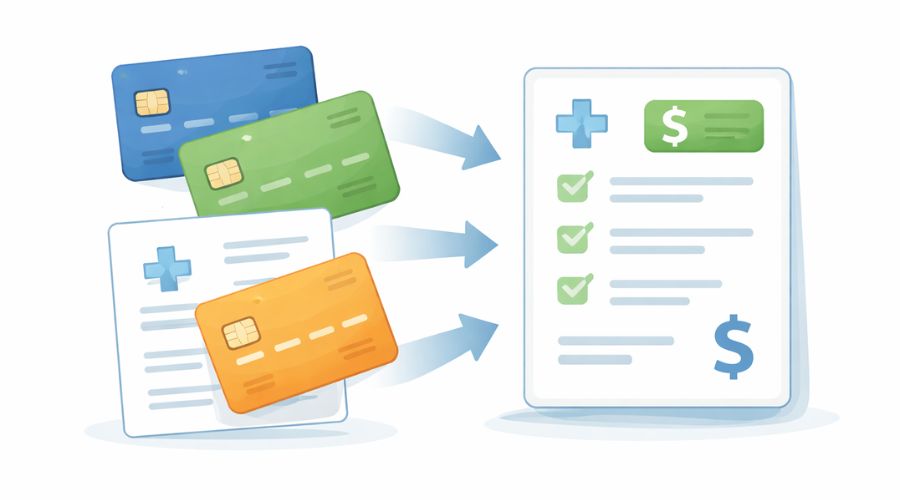
Debt consolidation means taking multiple existing debts and combining them into one new debt with a single monthly payment.
Instead of paying, for example:
- 3 credit cards
- 1 store card
- 1 medical bill
you replace them with one loan or one payment program that pays off those balances and leaves you with just one account to repay.
The goal is usually to:
- Reduce the number of bills
- Lower the interest rate
- Create predictable monthly payments
But consolidation only works financially if the new terms are better than the old ones.
How Debt Consolidation Works in the U.S.
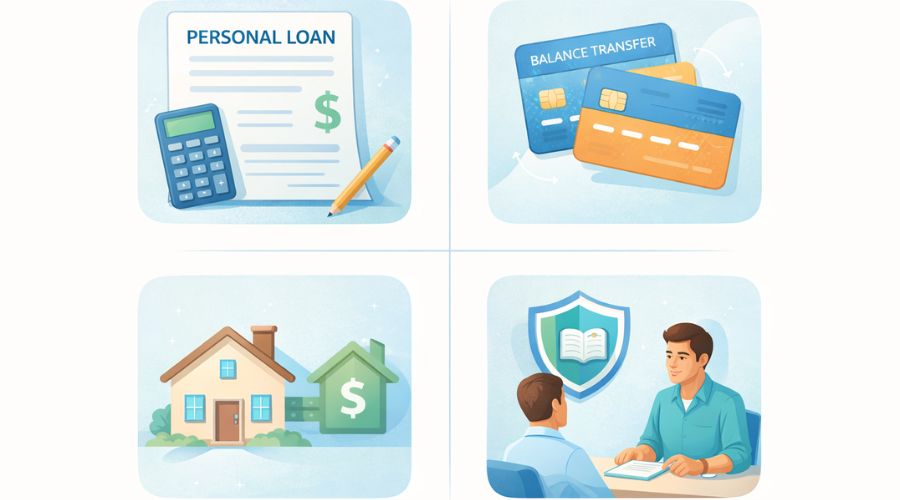
In the United States, consolidation usually happens in one of four ways:
Personal Debt Consolidation Loan
You take out a new personal loan and use it to pay off existing debts.
- Fixed interest rate (usually)
- Fixed monthly payment
- Set payoff timeline (often 2–5 years)
Common sources include banks, credit unions, and online lenders.
Balance Transfer Credit Card
You move high-interest credit card balances onto a new card offering 0% or low introductory interest.
- Promotional period often lasts 12–21 months (varies by issuer)
- After the promo period, standard interest applies
This only works if you can pay off most or all of the balance before the promo ends.
Home Equity Loan or HELOC
Homeowners may borrow against home equity and use that money to pay off other debts.
- Lower interest than credit cards
- Long repayment terms
But this converts unsecured debt into debt secured by your home, which increases risk.
Debt Management Plan (DMP) Through Credit Counseling
A nonprofit credit counseling agency negotiates lower interest rates with creditors and collects one monthly payment from you, distributing it to creditors.
- You still repay 100% of the principal
- Accounts are usually closed during the program
- Program typically lasts 3–5 years
This is not a loan, but it functions like consolidation from a payment perspective.
Who Debt Consolidation Is Best For
Debt consolidation tends to work best for people who:
- Have steady, predictable income
- Are not continuing to add new debt
- Have credit scores strong enough to qualify for lower interest rates
- Want a structured payoff plan rather than flexible minimum payments
Typical examples:
- Someone with several high-interest credit cards but strong employment stability
- A borrower who experienced temporary financial stress but has now recovered
- A household that wants simpler budgeting with one fixed monthly payment
In these cases, consolidation can improve cash flow and reduce long-term interest.
Who Should Be Careful or Avoid It

Debt consolidation can backfire for people who:
- Are still relying on credit to cover basic living expenses
- Have unstable or uncertain income
- Expect to face large future expenses they can’t currently afford
- Use consolidation but then run balances back up again
This pattern is very common:
- Consolidate credit cards into one loan
- Cards now show $0 balances
- Spending resumes on cards
- Result: new card debt + old consolidation loan
That doubles financial pressure and often leads to worse outcomes than before.
What Debt Consolidation Does — and Does Not — Fix
What It Can Fix
- Multiple due dates and payment confusion
- Very high interest rates
- Inconsistent minimum payments
- Short-term budgeting stress
What It Does NOT Fix
- Overspending habits
- Income shortfalls
- Emergency expense vulnerability
- Structural budget problems
If the underlying cash-flow problem remains, consolidation only delays the impact.
Pros and Cons of Debt Consolidation
| Pros | Cons |
|---|---|
| Simplifies multiple payments into one | Does not reduce principal owed |
| May lower interest rates | Some options increase total interest paid |
| Fixed monthly payment helps budgeting | Fees and loan costs may apply |
| Can shorten payoff timeline if structured well | Easy to fall back into debt after consolidating |
| May reduce financial stress from juggling bills | Some options risk assets (like home equity loans) |
How Debt Consolidation Affects Your Credit
The impact depends on how it’s done and how you manage it afterward.
Short-Term Effects
- Hard credit inquiry may slightly lower your score
- Closing paid-off accounts can affect credit history length
- Credit utilization may improve if card balances drop
Long-Term Effects
If you:
- Make all payments on time
- Avoid taking on new debt
your credit score often improves over time.
But if you:
- Miss payments on the new loan
- Run up new balances
your credit profile can decline more than before consolidation.
Payment history still matters more than the type of debt.
Common Beginner Mistakes With Debt Consolidation
Focusing Only on Monthly Payment
Lower monthly payments can look attractive, but longer loan terms may increase total interest paid.
Always compare:
- Total repayment amount
- Not just the monthly bill
Ignoring Fees
Some loans and programs include:
- Origination fees
- Monthly service fees
- Balance transfer fees
These costs reduce or eliminate interest savings.
Consolidating Without Budget Changes
If spending behavior doesn’t change, consolidation often fails.
Debt comes back — sometimes faster than before.
Using Home Equity Without Backup Plans
When home equity is used, missed payments can eventually put the home at risk.
That raises the stakes far higher than credit card default.
Debt Consolidation Myths vs Facts
Myth: Debt consolidation lowers your debt.
Fact: It reorganizes debt but does not reduce the amount owed unless paired with separate forgiveness programs (which consolidation is not).
Myth: Consolidation always helps credit scores.
Fact: It only helps if payments remain on time and new debt is avoided.
Myth: One payment means the debt problem is solved.
Fact: Payment simplicity does not equal financial stability.
When Debt Consolidation Actually Makes Sense
Debt consolidation is not about convenience alone. It only makes financial sense when the math, your income stability, and your behavior all line up. If even one of those pieces is missing, consolidation can turn into a longer and more expensive version of the same problem.
Here are the situations where consolidation is usually reasonable.
Your New Interest Rate Is Meaningfully Lower
This is the most important factor.
If your current debts carry interest rates like:
- Credit cards at 18%–30% APR
- Store cards with even higher rates
and your consolidation option offers:
- A personal loan at 8%–12%
- A balance transfer at 0% for a limited time
then consolidation may reduce how much interest you pay overall.
But if the new rate is only slightly lower — or higher — consolidation rarely provides real financial benefit.
Always compare total interest over time, not just monthly payments.
You Have Stable Income for the Full Repayment Period
Consolidation creates a fixed payment obligation.
That works best when:
- Employment is steady
- Household income is predictable
- You can comfortably cover the payment even if expenses fluctuate slightly
If your income is uncertain, flexible minimum payments on credit cards may actually be safer than committing to a fixed installment loan you may not always be able to meet.
You Are No Longer Relying on Credit for Daily Expenses
If groceries, gas, or utilities still go on credit cards each month, consolidation usually fails.
That pattern means:
- Cash flow is still negative
- New debt will likely replace old debt
In that case, improving income or reducing expenses must come before restructuring existing debt.
You Want Structure, Not Flexibility
Some people benefit from knowing:
- Exact monthly payment
- Exact payoff date
Installment loans remove the temptation to make small minimum payments and carry balances indefinitely.
For disciplined borrowers, this structure helps accelerate debt payoff.
When Debt Consolidation Usually Does NOT Make Sense
There are situations where consolidation is often the wrong tool.
Your Credit Is Too Weak to Qualify for Better Rates
If lenders only offer:
- High-interest personal loans
- Short promotional balance transfers with large fees
you may end up paying as much or more than before.
In that case, nonprofit credit counseling or direct hardship programs with creditors may be safer.
You Are Facing Financial Hardship or Income Loss
If you are:
- Behind on bills
- At risk of missing rent or mortgage
- Dealing with medical or job-related income disruption
consolidation may not solve the immediate problem.
Other options — such as hardship programs, temporary forbearance, or structured repayment plans — may provide more breathing room.
You Have Very Large Debt Relative to Income
When total unsecured debt is extremely high compared to income, consolidation loans may not be affordable or realistic.
In those cases, people often need:
- Formal repayment plans
- Legal debt relief options (which are separate from consolidation)
Consolidation works best for moderate debt loads, not severe financial distress.
Step-by-Step: How to Evaluate Debt Consolidation
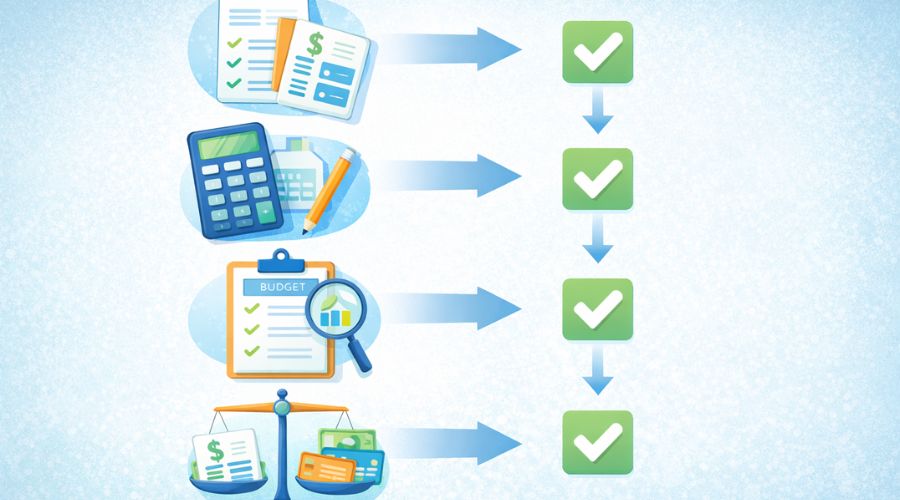
This simple checklist helps clarify whether consolidation is a good fit.
Step 1: List All Debts Clearly
Include:
- Current balances
- Interest rates
- Minimum payments
This shows whether interest costs are truly the main problem.
Step 2: Calculate Total Interest Without Consolidation
Look at:
- How long it would take paying current minimums
- Total interest paid over that time
Credit card statements often show estimated payoff timelines.
Step 3: Compare With Consolidation Terms
For any consolidation option, calculate:
- New interest rate
- Fees
- Total amount repaid over the full loan term
If total cost is not clearly lower — consolidation may not help.
Step 4: Stress-Test Your Budget
Ask honestly:
- Can I make this payment even if my expenses rise slightly?
- What happens if income drops temporarily?
If the payment would already stretch your budget, consolidation adds risk.
Step 5: Lock Down New Spending
Before consolidating, plan how you will:
- Limit credit card use
- Handle emergencies without borrowing
Without this step, consolidation often becomes temporary relief instead of permanent progress.
Debt Consolidation vs Other Debt Relief Options
Many people confuse consolidation with other programs. They are not the same.
| Option | What It Does | Main Risk |
|---|---|---|
| Debt Consolidation Loan | Replaces debts with new loan | Longer repayment, possible higher cost |
| Balance Transfer Card | Temporarily lowers interest | High rates after promo ends |
| Debt Management Plan (DMP) | Negotiates lower rates, structured repayment | Accounts usually closed |
| Debt Settlement | Attempts to reduce balances owed | Credit damage, taxes on forgiven debt |
| Bankruptcy | Legal discharge of certain debts | Severe credit impact, legal process |
Consolidation is about repayment efficiency, not debt reduction or legal protection.
Legal and Regulatory Considerations in the U.S.
Debt consolidation itself is legal and common, but important rules apply depending on the method used.
For official Consumer Financial Protection Bureau debt consolidation guidance on managing debt and repayment options, refer to this government resource.
Lending Laws
- Personal loans are regulated by federal and state consumer lending laws
- Lenders must disclose APR, fees, and total repayment under Truth in Lending Act (TILA) rules
Always review the full loan disclosure, not just advertised rates.
Credit Counseling Agencies
Legitimate nonprofit agencies are regulated and often affiliated with:
One of the largest nonprofit networks is the National Foundation for Credit Counseling, which connects consumers to certified credit counselors across the U.S.
- National Foundation for Credit Counseling (NFCC)
- Financial Counseling Association of America (FCAA)
They should provide:
- Full fee disclosure
- No-pressure consultations
Be cautious of organizations that push settlement instead of repayment.
Tax Considerations
Standard consolidation does not create taxable income because no debt is forgiven.
However, if any portion of debt is forgiven through settlement (not consolidation), the IRS may treat forgiven amounts as taxable income, with exceptions for insolvency.
Consolidation alone does not trigger tax reporting.
Long-Term Financial Impact of Consolidation
Used properly, consolidation can:
- Reduce interest costs
- Improve payment consistency
- Support gradual credit recovery
But used poorly, it can:
- Extend debt for many more years
- Increase total repayment
- Delay financial stability
Consolidation should support a broader plan that includes:
- Emergency savings
- Controlled spending
- Long-term debt avoidance
It is a financial tool, not a financial strategy by itself.
Comparing Major Debt Consolidation Options (Detailed Breakdown)
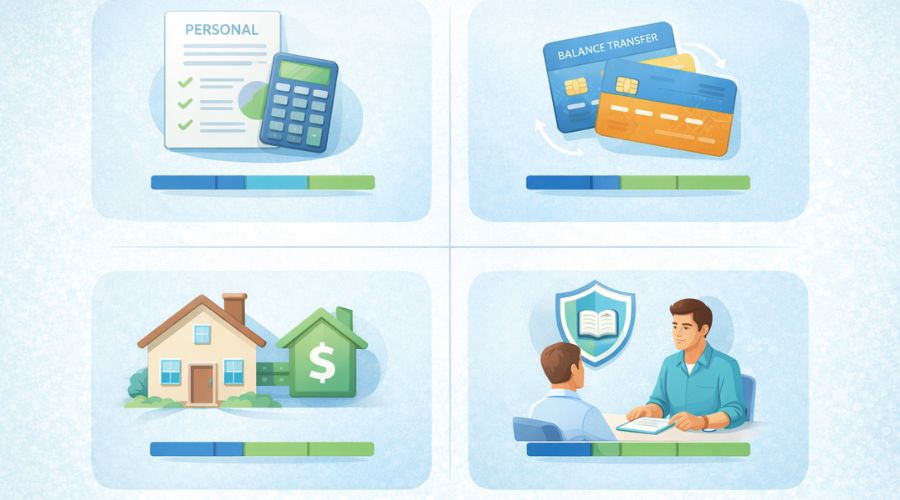
Not all consolidation methods carry the same risks, costs, or long-term effects. Choosing the wrong method can increase financial pressure instead of reducing it. The right option depends on your credit profile, income stability, and how quickly you can realistically repay the debt.
Below is a practical comparison of the most common U.S. consolidation methods.
Personal Debt Consolidation Loans
How It Works
You take out a new fixed-rate installment loan and use it to pay off multiple debts, usually credit cards and personal balances. You then repay the new loan in monthly installments over a set term.
When It Makes Sense
This option is most appropriate when:
- Your credit qualifies you for lower interest than current debts
- You want a clear payoff timeline
- You can handle a fixed payment every month
Advantages
- One predictable payment
- Fixed interest rate (no surprises)
- Clear end date for debt
Downsides and Risks
- Origination fees may apply
- Longer loan terms may increase total interest
- Missed payments hurt credit just like any other loan
- Easy to run up new card balances afterward
Best Fit Profile
Borrowers with:
- Fair to good credit
- Stable income
- Moderate debt balances that can be repaid within a few years
Balance Transfer Credit Cards
How It Works
You move balances from high-interest cards to a new card offering a 0% or reduced APR promotional period. You then pay down the balance during that period.
When It Makes Sense
This option works best when:
- You can repay most or all of the balance before promo ends
- Your credit qualifies for strong offers
- Transfer fees are reasonable relative to interest savings
Advantages
- Potentially zero interest for months
- Fast interest savings
- No new loan required
Downsides and Risks
- Transfer fees often range from 3%–5% of transferred balance
- High interest applies after promo period
- Missed payments can cancel promo rates
- Encourages delaying payoff if not disciplined
Best Fit Profile
Borrowers with:
- Good to excellent credit
- Smaller balances
- Strong ability to pay down debt quickly
Home Equity Loans and HELOCs
How It Works
You borrow against the equity in your home and use that money to pay off other debts. The home becomes collateral for the new loan.
When It Makes Sense
This may be considered when:
- Interest savings are significant
- Payments remain comfortably affordable
- Other options are unavailable
Advantages
- Lower interest than unsecured debt
- Longer repayment periods
- Predictable payments (home equity loan)
Downsides and Risks
- Your home secures the debt
- Missed payments can lead to foreclosure risk
- Closing costs and fees may apply
- Extends unsecured debt into long-term housing debt
Best Fit Profile
Homeowners with:
- Substantial equity
- Very stable income
- Conservative borrowing behavior
Debt Management Plans (Through Credit Counseling)
How It Works
A nonprofit agency negotiates reduced interest rates and structured payments with creditors. You make one monthly payment to the agency, which distributes it to creditors.
When It Makes Sense
This option works well when:
- Interest rates are very high
- You cannot qualify for low-rate loans
- You want professional repayment structure
Advantages
- Lower negotiated interest
- No new loan required
- Clear payoff timeline
Downsides and Risks
- Accounts are usually closed
- Monthly program fees may apply
- Less flexibility during repayment
- Credit may dip temporarily due to account closures
Best Fit Profile
Borrowers who:
- Are committed to structured repayment
- Are struggling with high interest but can repay principal
- Prefer guidance and accountability
Important Warning About Debt Settlement Companies
Debt settlement is often marketed alongside consolidation, but it is not the same thing.
Settlement typically involves:
- Stopping payments
- Letting accounts go delinquent
- Negotiating lump-sum reductions later
This can result in:
- Major credit score damage
- Collection activity and lawsuits
- Tax bills on forgiven amounts
Settlement may be appropriate only in serious financial distress and should not be confused with consolidation strategies.
How Long Does Debt Consolidation Take to Work?
Debt consolidation does not produce instant results.
Typical timelines:
| Stage | What Happens |
|---|---|
| First 1–3 months | Credit inquiry and account changes |
| 3–12 months | Payment history stabilizes |
| 1–3 years | Majority of interest savings realized |
| End of term | Full debt payoff if no new balances |
Improvement depends entirely on:
- Payment consistency
- Avoiding new borrowing
- Budget stability
There is no guaranteed or automatic financial improvement from consolidation alone.
Emotional and Behavioral Side of Consolidation
This part often gets overlooked.
Many people feel:
- Temporary relief
- Reduced anxiety from fewer bills
- False sense of being “done” with debt
That emotional relief can be helpful — but it can also reduce urgency to change spending habits.
Successful consolidation almost always includes:
- Spending awareness
- Clear savings goals
- Realistic budget adjustments
Without those, debt often returns.
Common Myths and Costly Misunderstandings About Debt Consolidation
Many Americans enter debt consolidation with expectations that don’t match how it actually works. These misunderstandings are a major reason people end up deeper in debt after trying to “fix” it.
Let’s clear up the most common ones.
Myth: “My monthly payment will always go down.”
Reality:
Payments may go down — but not always in a healthy way.
Lower payments often happen because:
- The loan term is longer
- Interest is spread over more years
That can reduce monthly pressure while increasing total cost.
A slightly higher payment that shortens payoff time may be financially better than a very low payment that keeps you in debt for years.
Myth: “Once I consolidate, my credit problems are solved.”
Reality:
Consolidation does not repair credit by itself.
Credit improves only when:
- Payments are made on time
- Balances gradually decrease
- New debt is avoided
If missed payments or new balances continue, consolidation provides no long-term credit benefit.
Myth: “One payment means less risk.”
Reality:
One payment is simpler, but risk depends on affordability, not number of bills.
If the new payment is too high and you fall behind, damage can be just as serious as missing multiple card payments.
Myth: “Debt management plans and consolidation loans are basically the same.”
Reality:
They work very differently.
- Loans replace your debts with a new creditor
- Debt management plans restructure existing accounts
Each affects credit, fees, and flexibility in different ways. Confusing them can lead to choosing the wrong solution for your situation.
Myth: “Using home equity is smart because interest is lower.”
Reality:
Lower interest does not mean lower risk.
When you convert unsecured debt into home-secured debt, the consequences of trouble become much more serious.
Interest savings must be weighed against:
- Long repayment periods
- Housing risk exposure
- Loss of future borrowing flexibility
How Lenders and Programs Are Often Misunderstood
Understanding what lenders actually evaluate helps avoid false expectations.
Credit Score Alone Is Not Enough
Approval and interest rates depend on:
- Credit score
- Income
- Debt-to-income ratio
- Employment stability
A good score does not guarantee affordable terms if income is stretched.
Promotional Rates Are Conditional
Introductory credit card rates usually require:
- On-time payments
- No violations of account terms
One late payment may cancel the promo rate and apply penalty APRs.
Fees Change the Math
Even small-sounding fees matter:
- 4% balance transfer fee on $10,000 = $400 upfront cost
- Loan origination fees reduce how much of the loan goes toward debt
Always include fees when comparing options.
Behavioral Risks That Undermine Consolidation
Most failed consolidation attempts do not fail because of interest rates. They fail because of behavior and cash flow.
Credit Card Reuse After Consolidation
This is the single biggest problem.
Psychologically, people see:
- Old balances gone
- Available credit restored
Without strict controls, spending often resumes and debt grows again.
Emergency Expenses With No Savings Buffer
If every surprise expense goes back on credit, consolidation becomes temporary relief instead of permanent progress.
Even small emergency savings reduce the need to reborrow.
Overconfidence After Approval
Loan approval can feel like validation that finances are “fine.”
But approval only means:
- A lender believes repayment is likely
- Not that the plan is financially optimal
The borrower still carries full risk.
What Success With Debt Consolidation Usually Looks Like
When consolidation actually helps long term, certain patterns are usually present.
Successful borrowers tend to:
- Stop using credit cards for daily expenses
- Track spending more closely
- Build even small emergency savings
- Focus on early principal reduction when possible
They treat consolidation as one step in a broader financial reset, not a stand-alone solution.
How Consolidation Fits Into Long-Term Financial Health
Debt consolidation should support, not replace:
- Emergency savings
- Retirement contributions (when affordable)
- Stable monthly cash flow
Remaining in constant repayment mode without building financial resilience often leads to repeating debt cycles.
Long-term progress requires:
- Reduced dependence on credit
- Predictable budget margins
- Gradual asset building
Consolidation can help create breathing room for those goals, but it does not create them by itself.
Real-Life Scenarios: When Debt Consolidation Helps — and When It Hurts

Looking at realistic situations makes it easier to see how the same tool can produce very different outcomes depending on how it’s used.
These examples reflect common U.S. household financial patterns, not extreme cases.
Scenario 1: Consolidation That Works
Situation:
A household has $14,000 in credit card debt across three cards with interest rates between 22% and 28%. Both adults are fully employed, and monthly income has been stable for over two years.
They qualify for a personal loan at 10% APR with a three-year term.
What They Do
- Use the loan to pay off all three cards
- Stop using credit cards except for planned expenses paid in full
- Maintain automatic payments on the new loan
- Build a small emergency fund
Outcome
- Monthly payment is manageable and predictable
- Total interest is significantly lower than continuing card payments
- Debt is fully paid off within three years
- Credit improves gradually through on-time payments
Why It Worked
- Lower interest rate
- Stable income
- Spending behavior changed after consolidation
The loan simply reorganized debt while the household fixed the cash-flow side of the problem.
Scenario 2: Consolidation That Backfires
Situation:
An individual consolidates $9,000 of credit card debt using a five-year personal loan. Income is stable but tight. Cards are paid off and show $0 balances.
What Happens
- Credit cards are used again for unexpected expenses
- New balances grow while loan payments continue
- Total debt becomes higher than before consolidation
Outcome
- Monthly obligations increase
- Stress returns
- Credit utilization worsens
- Borrower considers further consolidation
Why It Failed
- No emergency savings
- No spending adjustment
- Psychological “reset” led to new borrowing
The loan added structure but not financial stability.
Scenario 3: Balance Transfer Success With Strict Discipline
Situation:
A borrower has $5,500 on a high-interest card. They qualify for a 15-month 0% balance transfer with a 3% fee.
What They Do
- Transfer the full balance
- Divide the balance into 15 equal monthly payments
- Pay it off before promo ends
Outcome
- Minimal interest paid
- Debt eliminated quickly
- Credit utilization improves
Why It Worked
- Small enough balance
- Clear payoff plan
- No new card use during promo period
This approach requires focus but can be highly effective for short-term debt.
Scenario 4: Home Equity Used With High Risk
Situation:
A homeowner uses a HELOC to consolidate $30,000 of credit cards.
Interest rate drops significantly.
What Happens
- Payment is lower, but term is much longer
- New credit card balances gradually build again
- Housing debt increases overall
Outcome
- Total debt increases
- Financial risk shifts to home equity
- Long-term financial pressure remains
Why It Was Risky
- Debt behavior did not change
- Secured debt replaced unsecured debt
- Repayment horizon extended
Lower interest alone was not enough to ensure safety.
What These Scenarios Show
Consolidation success depends more on:
- Income reliability
- Spending behavior
- Repayment structure
than on the specific product used.
The same tool can help one person and harm another based on financial habits and cash-flow reality.
Warning Signs That Consolidation Is Becoming a Problem
If any of the following appear after consolidating, reassessment is needed:
- Credit cards are filling up again
- Payments feel increasingly tight
- Emergency expenses require borrowing
- New loans are being considered
These signals usually mean:
- Budget is still unbalanced
- Income is insufficient for expenses
- Consolidation did not address root causes
What to Do If Consolidation Is No Longer Working
If you already consolidated and are struggling:
- Review monthly budget honestly
- Contact the lender early if payments may be missed
- Consider nonprofit credit counseling before accounts fall behind
Early action preserves more options and limits long-term damage.
Frequently Asked Questions (FAQs)
These are real questions Americans commonly search when deciding whether debt consolidation is the right move.
-
Does debt consolidation lower the amount I owe?
No. Debt consolidation does not reduce your principal balance.
It only changes how the debt is structured and repaid.If your balance goes down, it’s because:
– You are making payments
– Not because of consolidation itselfDebt reduction happens only through repayment, settlement, or legal discharge — not through consolidation alone.
-
Will debt consolidation hurt my credit score?
It can cause small short-term changes, but long-term impact depends on behavior.
Short-term effects may include:
– A hard inquiry when applying for a loan or new card
– Changes in credit utilization
– Closed accounts (in debt management plans)Long-term improvement happens only if:
– All payments are made on time
– New debt is avoidedMissed payments on a consolidation loan hurt credit just like missed credit card payments.
-
Is debt consolidation better than paying credit cards directly?
It depends on the interest rate and repayment speed.
Consolidation may be better if:
– The new rate is much lower
– The payment schedule helps you pay fasterPaying cards directly may be better if:
– You already qualify for low-interest options
– You can aggressively pay down balances without new loansThe right choice depends on total cost, not convenience.
-
Can I consolidate medical bills the same way as credit cards?
Sometimes, but not always.
Medical debt may be:
– Directly owed to providers
– Already sent to collectionsOptions may include:
– Payment plans with providers
– Personal loans
– Credit counseling programsMedical providers often offer interest-free payment plans, which may be cheaper than borrowing.
-
What credit score do I need for debt consolidation?
There is no single cutoff.
Approval and rates depend on:
– Credit score
– Income
– Debt-to-income ratio
– Employment stabilityHigher scores usually qualify for better rates, but income matters just as much.
Some people with decent scores still receive high rates if income is tight.
-
Does consolidation affect my ability to get future loans?
It can.
Lenders may consider:
– New loan balances
– Debt-to-income ratio
– Recent credit activityIf consolidation improves your debt profile over time, future borrowing may become easier.
If it increases total obligations, future approvals may become harder. -
Can I consolidate student loans with credit card debt?
Federal student loans usually cannot be included in standard consumer consolidation loans without losing federal protections.
Private student loans may be included, but combining different debt types can:
– Increase risk
– Remove federal repayment protectionsStudent loans should be evaluated separately from consumer debt.
-
Is it safe to use home equity for debt consolidation?
It is legally allowed but financially risky.
Using home equity:
– Lowers interest
– Increases risk to housingIf income becomes unstable, missed payments can threaten your home — which is not the case with credit card debt.
This option should be considered carefully and conservatively. -
How long does debt consolidation stay on my credit report?
The consolidation loan or new account appears like any other credit account.
Payment history remains visible for:
– As long as the account is active
– Plus several years after closureThere is no special “consolidation mark” on your credit report — only normal account records.
-
What if I’m already behind on payments?
Consolidation may not be the best first step.
If accounts are delinquent:
– Lenders may not offer good terms
– Credit counseling or hardship programs may be more appropriateAddressing missed payments early protects more future options.
-
Can I consolidate debt more than once?
You can, but repeated consolidation often signals:
– Ongoing budget problems
– Insufficient income
– Repeated debt cyclesMultiple consolidations without behavior change usually make financial recovery harder, not easier.
-
When should I consider alternatives instead of consolidation?
Alternatives may be better when:
– Income cannot support repayment
– Debt is extremely high relative to income
– Financial hardship is ongoingIn those cases, structured repayment programs or legal financial remedies may be necessary instead of simple reorganization.
Final Perspective: Using Debt Consolidation Responsibly

Debt consolidation is not a shortcut out of debt. It is a financial restructuring tool that can either support recovery or quietly extend financial strain, depending on how and why it is used.
When consolidation is helpful, it usually does three things:
- Lowers interest in a meaningful way
- Creates a realistic and predictable payoff timeline
- Supports better cash-flow management, not avoidance of it
Same for next list:
When it causes problems, it usually masks deeper issues such as:
- Spending that exceeds income
- Lack of emergency savings
- Financial stress that requires income or expense changes, not new loans
Same for goals list:
Long-term financial health means reaching a point where:
- Credit is used intentionally, not out of necessity
- Monthly income consistently covers basic expenses
- Borrowing becomes optional, not required
Debt consolidation can help create space for that transition, but it cannot create it by itself.
The most responsible approach is to view consolidation as one part of a broader financial stabilization plan, not as a stand-alone fix.
Disclaimer
This content is provided for educational and informational purposes only and does not constitute financial, legal, or tax advice.
Financial decisions depend on individual circumstances, including income, debt levels, credit history, and local regulations. Readers should consult a qualified financial advisor, credit counselor, tax professional, or attorney before making decisions about debt consolidation or other financial strategies.
Laws, lending practices, and financial program rules may change over time and may vary by state and institution. Always verify current terms and eligibility directly with appropriate professionals or official sources.
