
Choosing the right bank in the U.S. may seem simple, but it affects how easily you can pay bills, access cash, and manage everyday money without unnecessary stress.
Key Takeaways
- The “right” bank depends more on how you use money than on brand names.
- Fees, access to cash, and transfer speed usually matter more than interest rates.
- Online banks and branch-based banks serve different daily needs.
- Choosing poorly can lead to long-term costs through fees and limited access, even if the account is free to open.
- Many people benefit from using more than one bank for different purposes.
Why Choosing a Bank Is Harder Than It Looks
Most Americans don’t actively choose a bank after their first account.
They often stick with:
- the bank their parents used
- the bank near their first job or college
- the bank that approved their first account quickly
Years later, they may still be paying:
- monthly maintenance fees
- ATM charges
- slow transfer delays
without realizing that these costs are not universal.
Another common problem is choosing a bank based on:
- brand reputation
- advertising
- short-term promotions
rather than daily usability.
The result is not usually financial disaster — but it often leads to unnecessary friction and small recurring losses that add up over time.
What a Bank Actually Does for You (Beyond Holding Money)
Before comparing banks, it helps to understand what role the bank plays in your financial life.
For most households, banks are used for:
- receiving income
- paying bills
- storing emergency funds
- moving money between accounts
- accessing cash when needed
Banks are not primarily designed to:
- grow your wealth
- replace investing platforms
- eliminate financial risk
Their main job is transaction reliability and safekeeping, not maximizing returns.
This is why convenience and cost control often matter more than chasing slightly higher interest.
The Two Main Types of Banks Most People Choose Between
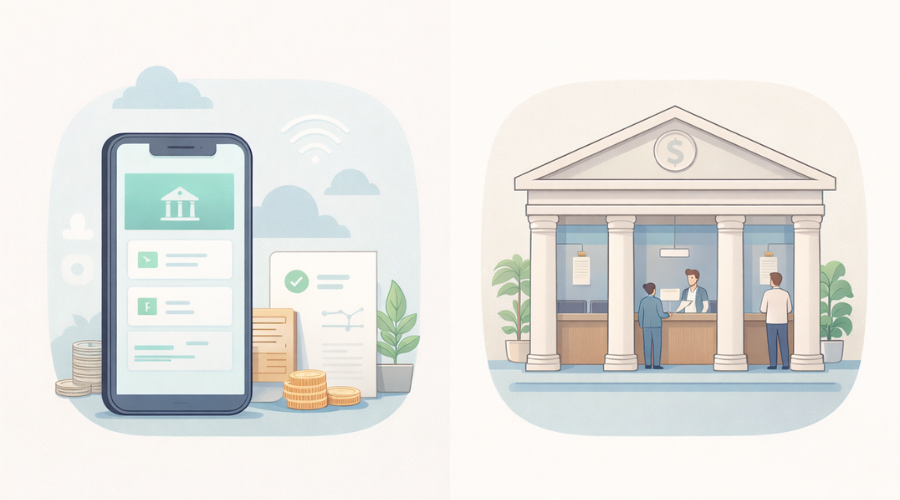
While there are many variations, most consumer banking options fall into two broad categories. Most people end up choosing between these two models when opening everyday checking and savings accounts.
Traditional banks with physical branches
These include large national banks and smaller local banks that operate branches.
Common features:
- in-person customer service
- cash deposits and withdrawals
- teller assistance for complex issues
- wider ATM networks
Trade-offs:
- often higher fees
- lower savings interest rates
- stricter minimum balance rules
These banks work well for people who:
- regularly use cash
- prefer face-to-face help
- handle official documents in person
Online-only banks
These operate without physical branches and rely entirely on digital services.
Common features:
- no branch visits
- strong mobile apps
- fewer account fees
- often higher savings interest rates
Trade-offs:
- no cash deposits without third-party services
- slower access to physical money
- all support handled remotely
Online banks work well for people who:
- rarely use cash
- manage money digitally
- value lower fees over in-person service
Why “Best Bank” Lists Usually Miss What Matters
When learning how to choose the right bank in the U.S., daily usability often matters more than promotional offers or short-term bonuses.
Many rankings focus on:
- interest rates
- promotional offers
- brand popularity
But most people’s daily experience depends more on:
- fee structures
- ATM availability
- transfer speed
- account usability
For example:
- A high-interest savings account is less helpful if transfers take several days during emergencies.
- A no-fee checking account loses value if every ATM withdrawal costs extra.
- A large national bank may still feel inconvenient if branches are far from your home or job.
The best bank for one person can be a poor choice for another with different routines.
How to Choose the Right Bank in the U.S.: Core Factors That Matter
Instead of starting with brand names, it’s usually better to start with how you use your money. Your income pattern, spending habits, and need for quick access all influence which banking setup will feel easiest to manage.
The next sections will break down the most important decision factors:
- fees and minimum balances
- access to cash and ATMs
- transfer and payment speed
- customer service models
- account integration (checking, savings, future needs)
Each of these affects long-term satisfaction far more than marketing claims.
Fees and Minimum Balance Rules: Where Most People Lose Money
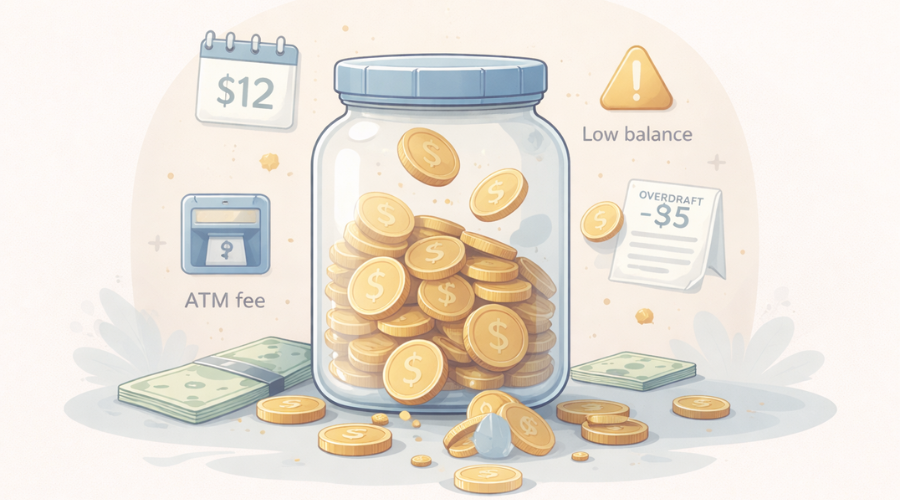
For many households, banking costs do not come from big one-time charges.
They come from small monthly fees that quietly repeat.
Understanding fee structures is one of the most important parts of choosing the right bank.
Monthly maintenance fees
Some banks charge a fixed monthly fee simply for keeping the account open.
This fee may be waived if you meet conditions such as:
- maintaining a minimum daily balance
- receiving qualifying direct deposits
- linking multiple accounts at the same bank
Problems arise when:
- income becomes irregular
- balances temporarily drop
- job changes interrupt direct deposits
What was once a “free” account can quietly become a paid account.
For example, a $12 monthly fee may not feel large, but over one year it adds up to $144—money that provides no extra benefit or service.
Minimum balance requirements
Banks may require:
- a minimum daily balance
- or a minimum average monthly balance
Failing to meet these can trigger:
- monthly fees
- account downgrades
- loss of perks
This matters especially for people who:
- live paycheck to paycheck
- keep small emergency reserves
In those cases, lower or no minimums usually provide more stability.
ATM and cash access fees
Even if your own bank does not charge ATM fees, you may still pay:
- out-of-network ATM fees
- operator fees from the ATM owner
Costs can occur when:
- traveling
- withdrawing cash frequently
- living in areas with few partner ATMs
Some banks reimburse ATM fees; others do not.
Access patterns matter more than marketing promises.
Someone who withdraws cash twice a week from out-of-network ATMs could easily pay $8–$12 per month in ATM charges alone.
Overdraft-related fees (even for checking-linked savings)
While savings accounts themselves usually cannot overdraft, problems can happen when:
- savings is linked as overdraft protection
- transfers fail or are delayed
- fees apply per transfer
Choosing a bank with transparent overdraft policies reduces surprise charges across all accounts, not just savings.
Some banks charge a fee for each overdraft transfer, while others limit or waive these charges, which can make a big difference over time.
Access to Your Money: Speed and Reliability Matter
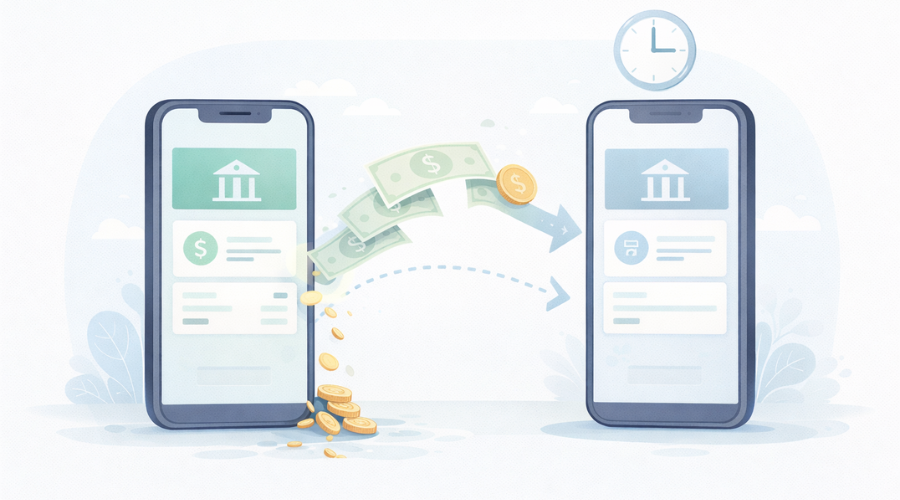
Interest rate differences are often small.
Access differences are not.
Internal transfers within the same bank
When checking and savings are at the same bank:
- transfers are usually instant or same-day
- overdraft protection is easier to manage
- money movement feels simpler
This setup works well for:
- emergency funds
- short-term budgeting adjustments
Transfers between different banks
When accounts are at different institutions:
- ACH transfers typically take 1–3 business days
- weekends and holidays can delay access
- transfer limits may apply
This matters during:
- medical emergencies
- sudden job income gaps
- urgent bill payments
Higher interest does not help if money is not available when needed.
Cash access considerations
If you regularly handle cash:
- branch access becomes more important
- deposit methods matter
- ATM networks affect convenience
Online banks may rely on:
- partner ATM networks
- retail deposit partnerships
But these options may not exist in all locations. Availability can vary by city and even by neighborhood, which makes location an important factor when choosing an online bank.
Customer Service Models: Not All Support Is Equal
Customer service is not about politeness — it is about problem resolution.
Branch-based service
With physical branches, you can:
- speak directly with staff
- resolve identity issues faster
- handle official paperwork in person
This can matter for:
- name changes
- document verification
- account disputes
However, branch hours may be limited, and wait times can be long.
Digital-only service
Online banks rely on:
- chat
- phone
This can be efficient for routine issues but frustrating when:
- accounts are frozen
- identity verification fails
- urgent access is needed
Some people prefer digital speed.
Others prefer human escalation when things go wrong.
Account Integration: Thinking Beyond Just One Account
Most people start with one account but later need:
- checking
- savings
- certificates or money market accounts
- future loan products
Banks differ in how smoothly these work together. This is especially important when moving money between checking and savings during emergencies or unexpected expenses.
Single-bank convenience
Keeping multiple accounts at the same bank can offer:
- instant internal transfers
- consolidated statements
- easier customer service
But it may also mean:
- accepting lower savings rates
- fewer competitive options
Multi-bank strategies
Some people use:
- one bank for checking and bill pay
- another for savings or emergency funds
This can improve:
- interest earnings
- risk separation
But it also increases:
- account management complexity
- transfer timing issues
There is no universal right answer—only what fits your habits.
Who Benefits Most From Each Banking Model
While personal situations vary, patterns are common.
Branch-based banks often suit people who:
- use cash frequently
- prefer face-to-face help
- handle paperwork in person
- want simple local access
Online banks often suit people who:
- rarely use cash
- manage money digitally
- prioritize low fees
- are comfortable with remote support
Mixed setups often suit people who:
- keep emergency savings separate
- want fast checking access
- optimize for different purposes
Using more than one bank is not unusual and not unsafe when managed carefully.
Safety, Insurance, and What Really Protects Your Money
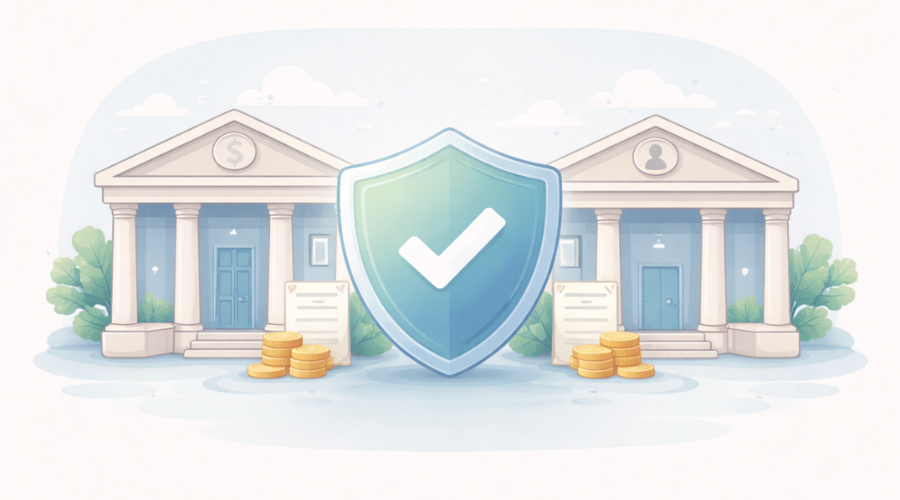
When choosing a bank, safety is not just about whether the institution looks trustworthy.
It is about whether your deposits are legally protected under federal insurance programs.
Understanding this difference matters more than most people realize. Many people assume their money is always safe, but protection depends on how and where the account is actually held.
Federal deposit insurance: what it actually means
In the U.S., deposit insurance is provided by:
This insurance protects your money if the institution fails.
Key points:
- Coverage is up to $250,000 per depositor, per institution, per ownership category
- Protection applies to checking and savings accounts
- Insurance does not depend on account balance history or how long you’ve been a customer
If a bank fails, insured deposits are typically:
- transferred to another institution
- or paid directly to depositors
You do not need to apply for this protection — it is automatic when the institution is insured.
What deposit insurance does NOT protect against
Federal insurance does not cover:
- fraud caused by your own negligence
- scams where you authorize transfers
- losses from investment products
It also does not protect against:
- poor interest rates
- account fees
- inflation reducing buying power
Insurance protects your deposit if the bank collapses, not your overall financial outcomes. This means choosing a bank with low fees and reliable access still matters, even when deposits are insured.
Verifying whether a bank is insured
Before opening any account, you should confirm:
- the institution is FDIC-insured (bank)
- or NCUA-insured (credit union)
Most legitimate institutions display this clearly, but verification matters when dealing with:
- new financial apps
- fintech platforms
- cash management services
Some apps partner with banks, meaning:
- your money is insured only after it reaches the partner bank
- delays or errors could affect protection timing
Knowing where your money is actually held is critical.
Account Stability: How Likely Is Disruption?
Even insured banks can still cause inconvenience through:
- account freezes
- fraud investigations
- technical outages
Choosing a stable institution reduces daily stress.
Common reasons banks freeze accounts
Banks may temporarily restrict access if they detect:
- unusual transaction patterns
- suspected fraud
- identity verification problems
- legal orders
While most freezes are resolved, they can:
- block access for days or weeks
- delay bill payments
- cause cascading financial issues
While this is not common, it is disruptive when it happens, which is why support access and backup options matter.
Banks with strong customer service channels often resolve these faster.
Technical reliability and system outages
Digital banking relies on:
- mobile apps
- backend payment systems
- external payment networks
Outages can affect:
- mobile deposits
- transfers
- debit card transactions
Having at least one backup payment method or secondary account reduces vulnerability during disruptions.
Regulation and Oversight: Why It Matters for Consumers
U.S. banks operate under:
- federal banking regulators
- state regulators
- consumer protection agencies
This framework enforces rules on:
- identity verification
- dispute handling
- disclosure of fees
- fraud investigation processes
Not all financial platforms operate under the same level of oversight.
Traditional banks and credit unions face stricter regulatory obligations than many financial apps.
This does not mean apps are unsafe, but it does mean consumer protections can differ.
Choosing Between Big National Banks and Local Institutions
Both large and small institutions play important roles in the U.S. banking system.
Large national banks
Strengths often include:
- wide ATM networks
- extensive digital tools
- multiple product offerings
Potential downsides:
- more standardized service
- less flexibility for special cases
- longer wait times for complex issues
Community banks and credit unions
Strengths often include:
- personalized service
- flexible policies
- local decision-making
Potential downsides:
- fewer branches overall
- smaller ATM networks
- sometimes fewer digital features
For many people, service quality matters more than institution size.
The better choice depends on whether you value broad access and digital tools or personal service and local flexibility.
Red Flags When Evaluating Banking Options
Certain warning signs should trigger caution before opening accounts.
Unclear fee disclosures
If you cannot easily find:
- monthly fees
- withdrawal rules
- overdraft policies
that lack of transparency is a concern.
Banks are required to disclose fees clearly.
Vague insurance claims
Statements like:
- “funds are protected”
- “secured by our partners”
are not the same as confirmed FDIC or NCUA insurance.
You should always verify actual insurance coverage.
Pressure-based marketing
Urgent promotions encouraging you to:
- move large balances quickly
- bypass verification steps
can increase risk.
Responsible banks prioritize compliance over speed.
Practical Decision Framework: How to Narrow Down Your Choice

Instead of trying to find a perfect bank, it is often better to narrow options using practical questions:
- Do I need regular access to cash?
- Will I meet minimum balance requirements consistently?
- How fast do I need transfers between checking and savings?
- Do I prefer in-person help when problems occur?
- Am I comfortable managing everything digitally?
Answering these honestly usually points clearly toward:
- branch-based banks
- online banks
- or a mixed setup
No ranking list can answer these questions for you.
When Switching Banks Makes Sense (and When It Usually Doesn’t)
Many people stay with the same bank for years, even when it no longer fits their needs.
Switching is not something to do casually, but there are clear situations where it is reasonable and practical.
The goal is not constant switching, but choosing a setup that matches your current financial habits and access needs.
Situations where switching banks may be a smart move
You may benefit from changing banks if:
- monthly fees are consistently reducing your balance
- minimum balance rules no longer match your income pattern
- ATM access is inconvenient or costly
- customer service issues are frequent or unresolved
- digital tools no longer meet your needs or you have moved to a new area where branch or ATM access has become less convenient
Over time, small inconveniences can turn into real financial and time costs.
Situations where switching may not be necessary
Switching banks may not help much if:
- your account is already free and convenient
- service problems are rare
- your financial needs have not changed and your bank continues to meet your basic access and service expectations
In those cases, effort and risk from switching may outweigh potential benefits.
How to Switch Banks Without Causing Payment Problems
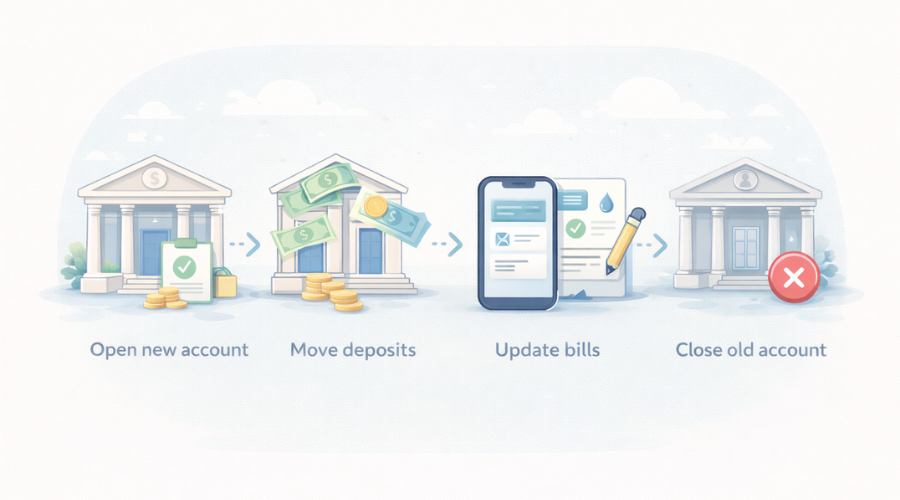
Changing banks incorrectly can lead to:
- missed bill payments
- overdraft fees
- delayed income deposits
A structured approach reduces those risks.
Step 1: Open the new account first
Before closing anything, make sure:
- the new account is fully active
- online access is working
- transfers can be sent and received
Never close your old account before confirming this.
Step 2: Move income sources
Update direct deposits such as:
- employer payroll
- government benefits
- retirement payments
Wait until at least one full payment cycle confirms the deposit is working.
Step 3: Transfer automatic payments
Update all recurring payments, including:
- utilities
- subscriptions
- insurance
- loan payments
Many people forget at least one bill, which can cause late fees or service interruptions. Reviewing the last two or three bank statements can help identify recurring charges you may have forgotten.
Step 4: Leave the old account open temporarily
Keep a small balance and monitor for:
- unexpected charges
- delayed transactions
- refunds posting late
This buffer period reduces the risk of missed activity.
Step 5: Close the old account properly
Once all activity has stopped:
- transfer remaining balance
- download past statements
- request formal closure
Some banks require closure in person or by written request.
Confirm that the account is officially closed to avoid future fees.
Using More Than One Bank: When It Actually Helps
Some people assume having multiple banks is risky or complicated.
In reality, it can be helpful when managed deliberately.
Common multi-bank setups
People may use:
- one bank for checking and bills
- another for savings and emergency funds
This can:
- reduce temptation to spend savings
- provide backup access if one bank has issues
Risks of multi-bank setups
Multiple banks also increase:
- tracking responsibilities
- forgotten accounts
- potential inactivity fees
This strategy works best for people who:
- monitor accounts regularly
- understand transfer timing
More accounts are not automatically better.
FAQs: Choosing the Right Bank in the U.S.
-
Does changing banks affect my credit score?
No. Bank deposit accounts are not reported to credit bureaus and do not affect credit scores.
Only credit products influence credit history.
-
Is it safe to keep all my money in one bank?
From an insurance standpoint, balances up to federal limits are protected.
However, relying on a single institution may create:
– access issues during outages
– delays if accounts are frozenSome people prefer having at least one backup account.
-
Do credit unions work the same way as banks?
Credit unions offer similar deposit accounts and insurance protection but operate as member-owned institutions.
They often provide:
– lower fees
– more personalized serviceMembership eligibility rules apply, but many credit unions have broad qualification options.
-
Can I change banks if I have loans or credit cards at my current bank?
Yes. Deposit accounts are separate from loans and credit cards.
However, closing accounts may affect:
– automatic payments
– bundled fee waiversAlways review how products are linked before switching.
-
Should I choose a bank just because it has the highest savings rate?
Not necessarily. Transfer speed, fees, and access may matter more for daily financial stability.
Higher interest is helpful, but it should not override usability.
Final Perspective on Choosing a Bank
Choosing a bank is not about finding a perfect institution.
It is about reducing friction in everyday money management.
The right bank:
- supports your financial habits
- does not punish you with unnecessary fees
- allows you to access money when you need it
- resolves problems efficiently when they occur
Your needs will change over time, and your banking setup may change with them.
That is normal and does not mean earlier choices were wrong.
Disclaimer
This content is provided for educational and informational purposes only and is not intended as legal, tax, or financial advice.
Banking rules, fees, insurance coverage, and account features vary by:
- financial institution
- state regulations
- individual financial circumstances
Readers should consult a qualified financial professional or banking representative before making personal financial decisions.
